Reloj De Bolas De Acero "Noria" / Rolling Ball Clock "Noria"
by PedroC77 in Circuits > Clocks
7633 Views, 47 Favorites, 0 Comments
Reloj De Bolas De Acero "Noria" / Rolling Ball Clock "Noria"

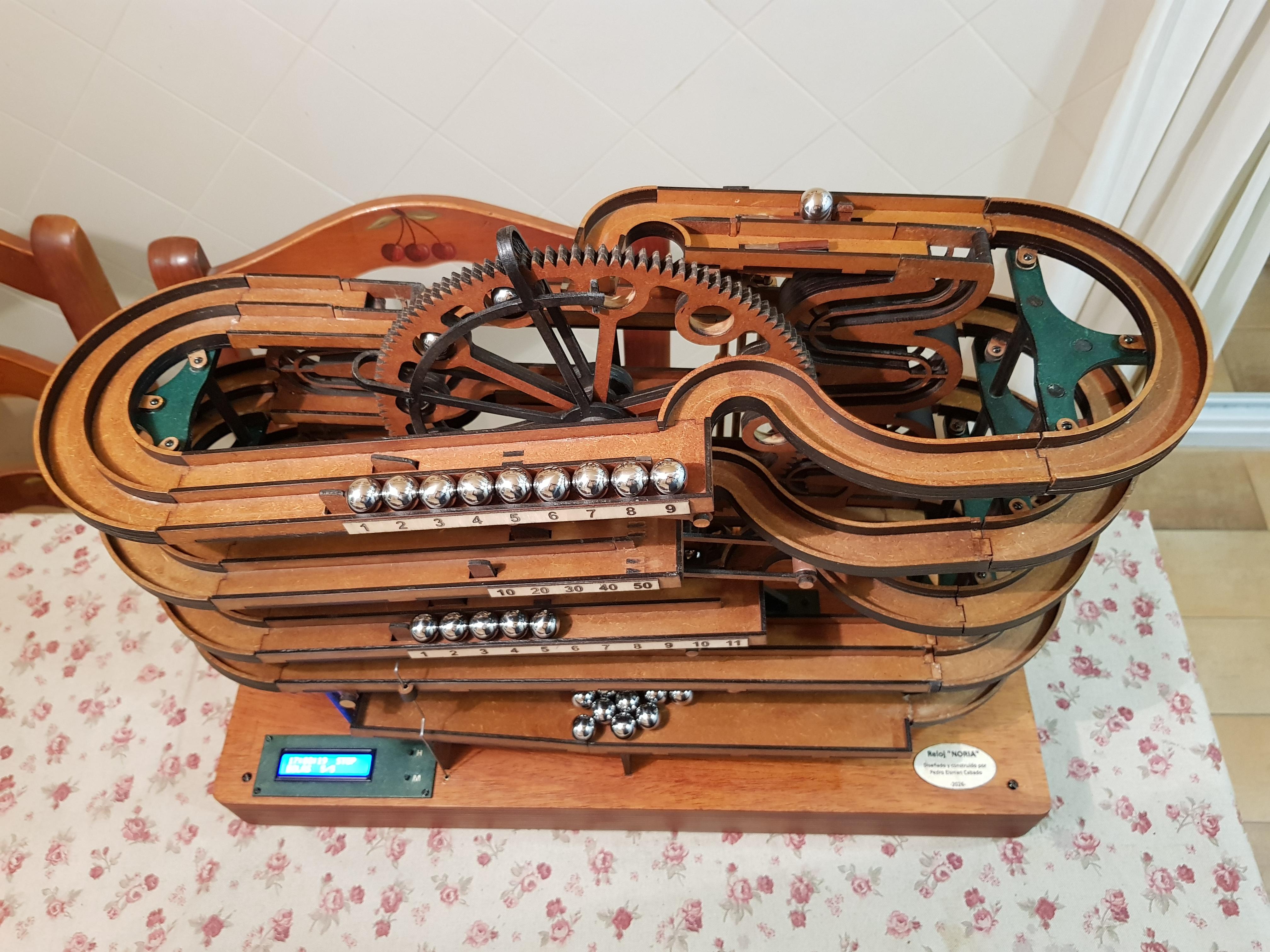
Se trata de una versión del clásico reloj de bolas de acero operado por Arduino Uno que incorpora un sistema de sonería.
El reloj que presento es a la vez un prototipo y el modelo terminado. No tengo fotografías de todo el proceso constructivo ya que he tenido que ir ajustanto muchas partes durante su construcción. En cualquier caso, facilito todos los detalles y explicaciones necesarias para la construcción de un modelo similar.
This is a version of the classic rolling ball clock operated by an Arduino Uno, incorporating a chiming system.
The clock I'm presenting is both a prototype and the finished model. I don't have photos of the entire building process since I had to adjust many parts during its construction. In any case, I provide all the necessary details and explanations for building a similar model.
Supplies
Para la construcción de este reloj se han utilizado los siguientes materiales:
ESTRUCTURA DEL RELOJ
- Planchas de MDF de 3 y 2 mm de espesor para rampas, engranajes, etc.
- Plancha de abedul de 0.6 mm de espesor (números grabados)
- Tablero de contrachapado de 15 mm de espesor para la base
- Redondos de haya o ramín de varios diámetros para las columnas de sujección de las rampas
- Tubos de latón de diferentes diámetros (4, 5 y 6 mm)
- Tubo de cobre de 12 mm de diámetro
- 4 rodamientos 21/12/5
- Tornillos de fijación de cabeza hexagonal
- Alambre de acero de 1.5 mm de diámetro para conexiones con servos
- 30 bolas de acero de 18 mm de espesor
- 1 campana
- Cuadradillo de samba para la base
- Tornillos de varios tamaños
- Tintes para madera, tapa poros y barniz en spray
CIRCUITO ELÉCTRICO
- 1 Arduino Uno
- 1 motor DC 30 rpm
- 1 controlador TB6612FNG
- 2 interruptores de fin de carrera SS-5GL 5A
- 3 micro servomotores 9G
- 1 step down LM2596S DC-DC
- 1 LCD 1602
- 1 RTC DS3231
- 3 micro pulsadores para ajuste de hora y reset
- 1 fuente de alimentación de 9v
- Clavija jack hembra, jumpers, tubo termo retráctil, etc.
- Condensadores electrolíticos de 4700, 1000 y 22 microfaradios y cerámicos de 20 y 100 nanofaradios
- 3 resistencias de 100 ohmnios
The following materials were used to construct this clock:
CLOCK STRUCTURE
- 3 and 2 mm thick MDF sheets for ramps, gears, etc.
- 0.6 mm thick birch plywood (numbers engraved)
- 15 mm thick plywood board for the base
- Beech or ramin rounds of various diameters for the ramp support columns
- Brass tubes of different diameters (4, 5, and 6 mm)
- 12 mm diameter copper tube
- 4 21/12/5 bearings
- Hex head fixing screws
- 1.5 mm diameter steel wire for servo connections
- 30 18 mm thick steel balls
- 1 bell
- Samba wood square for the base
- Screws of various sizes
- Wood stain, wood filler, and spray varnish
ELECTRICAL CIRCUIT
- 1 Arduino Uno
- 1 30 rpm DC motor
- 1 TB6612FNG controller
- 2 SS-5GL 5A limit switches
- 3 9G micro servomotors
- 1 step-down converter LM2596S DC-DC
- 1 LCD 1602
- 1 RTC DS3231
- 3 micro pushbuttons for time setting and reset
- 1 9V power supply
- Female jack plug, jumpers, heat shrink tubing, etc.
- Electrolytic capacitors of 4700, 1000, and 22 microfarads and ceramic capacitors of 20 and 100 nanofarads
- 3 100-ohm resistors
EL CIRCUITO / THE CIRCUIT
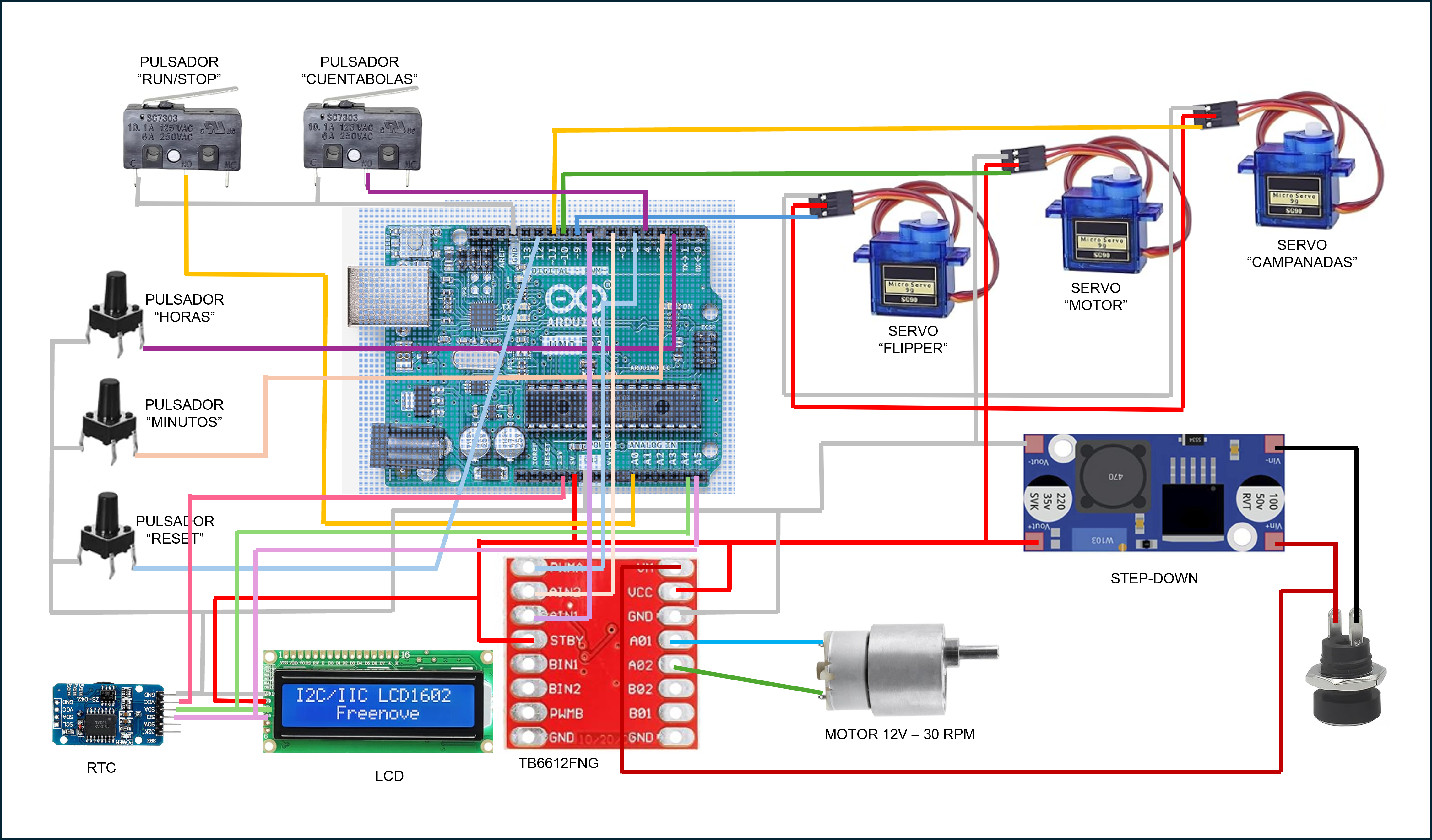
Comienzo por lo más complicado, por el circuito. En el diagrama adjunto se muestran los distintos componentes que conforman el sistema de control del reloj, así como sus conexiones. En este esquema no se muestran los condensadores. De estos últimos hablo más adelante.
En primer lugar, describo cómo está pensado el funcionamiento del reloj para que se entienda mejor la misión de cada uno de los elementos del sistema.
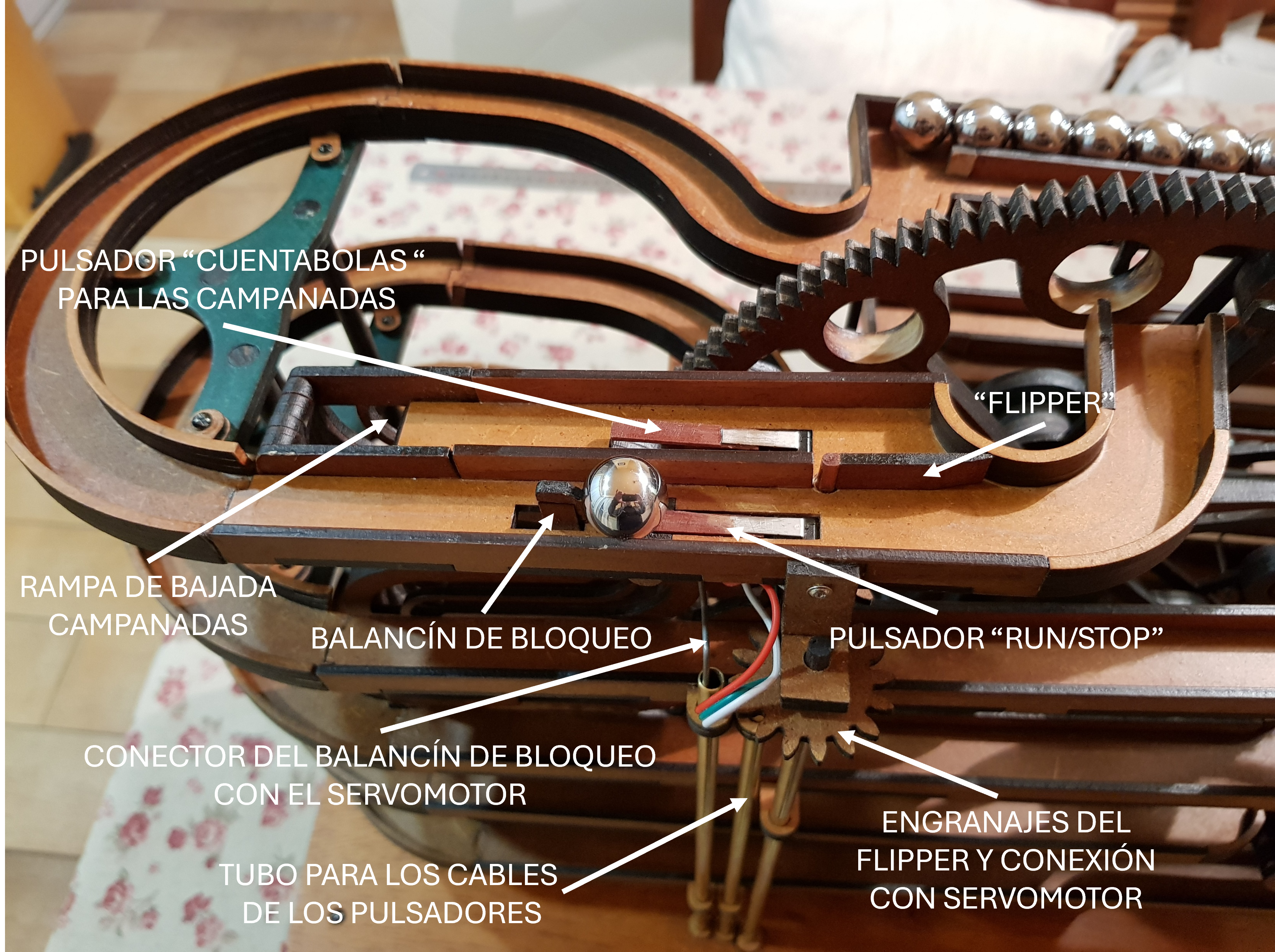
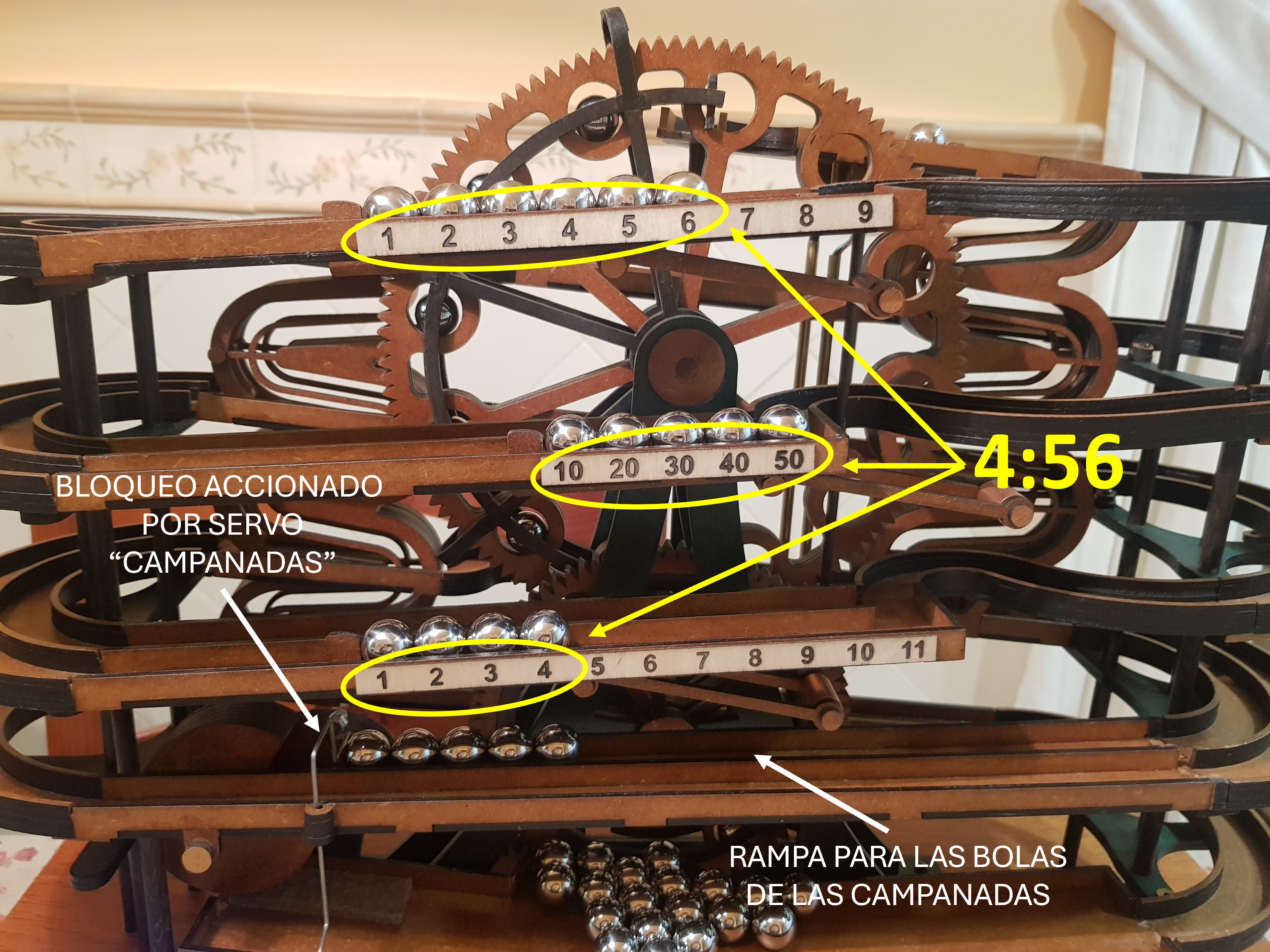
El motor está conectado directamente a una fuente de alimentación exterior de 12 o 9 voltios a través de su controlador. En principio el motor gira siempre de forma continua salvo que se active el pulsador "RUN/STOP". Cuando se pulsa este pulsador el motor se para y cuando el pulsador se libera el motor vuelve a girar. Este pulsador se ubica frente a un balancín que bloquea la bola que se libera en la parte superior de la noria. Cuando la bola llega a ese balancin la bloquea a la par que dicha bola pisa el pulsador y para el motor. El servo "MOTOR" mueve el balancín cada minuto. Esto libera la bola de forma que deja de pisar el pulsador, el motor vuelve a girar y se libera una nueva bola de la noria. Es decir, con este sistema se libera una bola cada minuto. Las rampas hacen el resto para marcar las horas. En una de las fotos muestro como se lee la hora.
Como he mencionado el servo "MOTOR" se acciona cada miinuto. En el programa del Arduino se definen los grados de giro según el diseño del balancín. El servo vuelve a su posición inicial tras 2 segundos. Este tiempo tambien se puede modificar en el programa en caso necesario.
El otro pulsador tipo interruptor fin de carrera y los otros dos servos forman parte del sistema que controla la sonería. Cada 30 minutos, es decir a las XX:30, se activa el servo "FLIPPER". Esto hace que las bolas que suben desde la noria se devien por el segundo carril de la rampa superior y pasen por encima del otro pulsador denominado "CUENTABOLAS". El programa calcula cuantas bolas deben cargarse en ese momento. Si por ejemplo son las 10:30 la siguiente hora en punto será a las 11:00 h por lo que deben cargarse 11 bolas para dar las campanadas. Cuando se hayan contado las bolas que correspondan el flipper se cierra y vuelve a su posición inicial. En cada hora en punto, es decior cada XX:00 h, se activa el servo "CAMPANADAS" que deja pasar las bolas que están bloqueadas en la rampa correspondiente. Este servo vuelve a su posición original despues de 12 segundos (este tiempo se puede parametrizar en el programa del Arduino).
El circuito está dotado de un RTC para almacenar la hora. Los botones "HORA" y "MINUTOS" sirven para cambiar la hora en dicho RTC. Al pulsarlo se reinician los segundos y tambien los minutos en el caso del botón "HORAS". Se avanza una unidad con cada pulsación.
Como he mencionado el motor gira siempre que el pulsador "RUN/STOP" no esté pulsado. Si se produce una avería mecánica que impida que las bolas pisen ese pulsador entonces el motor no para de girar. Para evitar que el motor gire continuamente se ha incluido un comando en el programa por el cual se obliga a parar el motor si este gira continuamente durante 2 minutos. El botón "RESET" reinicia el sistema tras una pulsación larga de 3 segundos.
El step-down se ha incluido para liberar a la placa de Arduino UNO. Está calibrado con un multímetro para dar 5 voltios a su salida. Desde este step-down se alimentan los servos y tambien el Arduino UNO directamente por el pin de 5V.
El tema de los condensadores es opcional, pero a mi me han resultado imprescindibles para evitar que picos de tensión o interferencias en las señales generen bloqueos en el programa. La pantalla LCD comparte pines I2C con el RTC y es muy sensible. Se queda en cuadros "negros" a la mínima de cambio. Para filtrar señales y atenuar picos he dispuesto condensadores de la siguiente forma:
- Electrolítico de 4700 μF a la salida del step-down LM2596S (entre + y -)
- Electrolítico de 1000 μF entre 5v y GND en Arduino UNO
- Electrolítico de 22 μF y cerámico de 100 nF entre VCC Y GND del LCD
- Cerámico de 20nF entre GND y señal de los botones "HORA" y "MINUTOS"
- Cerámico de 20nF entre los dos bornes de alimentación del motor
- Cerámico de 20nF entre GND y salidas PWMA, AIN1 y AIN2 del controlador
- 1 resistencia de 100 ohmnios entre el condensador anterior y el Arduino Uno para cada señal (PWMA, AIN1 y AIN2)
Los valores de los condensadores pueden variar dependiendo un poco de la disponibilidad (como ha sido mi caso). Con estos condensadores y resistencias se aumenta notablemente la estabilidad del sistema.
I'll start with the most complicated part: the circuit. The attached diagram shows the various components that make up the clock's control system, as well as their connections. The capacitors are not shown in this diagram. I'll discuss them later.
First, I'll describe how the clock works so you can better understand the function of each element in the system.
The motor is connected directly to an external 12 or 9 volt power supply through its controller. In principle, the motor runs continuously unless the "RUN/STOP" button is pressed. When this button is pressed, the motor stops, and when it is released, the motor starts running again. This button is located opposite a rocker arm that locks the ball released at the top of the Ferris wheel. When the ball reaches the rocker arm, it locks onto it, and the ball presses the button, stopping the motor. The "MOTOR" servo moves the rocker arm every minute. This releases the ball, causing it to stop pressing the button. The motor then rotates again, releasing a new ball from the Ferris wheel. In other words, with this system, one ball is released every minute. The ramps do the rest to mark the hours. One of the photos shows how to read the time.
As I mentioned, the "MOTOR" servo is activated every minute. The Arduino program defines the degrees of rotation according to the design of the rocker arm. The servo returns to its initial position after 2 seconds. This time can also be modified in the program if necessary.
The other push button, a limit switch, and the other two servos are part of the system that controls the chime. Every 30 minutes, at XX:30, the "FLIPPER" servo is activated. This causes the balls rising from the Ferris wheel to be diverted along the second track of the upper ramp and pass over the other push button called "BALL COUNTER." The program calculates how many balls should be loaded at that moment. For example, if it's 10:30, the next hour on the hour will be 11:00, so 11 balls must be loaded to chime the bells. Once the required number of balls have been counted, the flipper closes and returns to its initial position. On the hour, that is, every XX:00h, the "CHIMES" servo is activated, allowing the balls that are stuck on the corresponding ramp to pass through. This servo returns to its original position after 12 seconds (this time can be parameterized in the Arduino program).
The circuit is equipped with an RTC (Real-Time Clock) to store the time. The "HOUR" and "MINUTES" buttons are used to change the time on the RTC. Pressing them resets the seconds, and the minutes in the case of the "HOUR" button. Each press advances the clock by one unit.
As mentioned, the motor runs as long as the "RUN/STOP" button is not pressed. If a mechanical failure prevents the balls from pressing the button, the motor will continue to rotate. To prevent the motor from running continuously, a command has been included in the program that forces the motor to stop if it runs continuously for 2 minutes. The "RESET" button resets the system after a long press of 3 seconds.
The step-down converter has been included to free up the Arduino UNO board. It is calibrated with a multimeter to provide 5 volts at its output. The servos and the Arduino UNO are powered from this step-down converter via the 5V pin.
The capacitors are optional, but I have found them essential to prevent voltage spikes or signal interference from causing program crashes. The LCD screen shares I2C pins with the RTC and is very sensitive. It displays black squares at the slightest change. To filter signals and attenuate peaks, I've arranged capacitors as follows:
- 4700 µF electrolytic capacitor at the output of the LM2596S step-down converter (between + and -)
- 1000 µF electrolytic capacitor between 5V and GND on the Arduino UNO
- 22 µF electrolytic capacitor and 100 nF ceramic capacitor between VCC and GND of the LCD
- 20 nF ceramic capacitor between GND and the "HOUR" and "MINUTES" button signals
- 20 nF ceramic capacitor between the two motor power terminals
- 20 nF ceramic capacitor between GND and the PWMA, AIN1, and AIN2 outputs of the controller
- 100 ohm resistor between the previous capacitor and the Arduino Uno for each signal (PWMA, AIN1, and AIN2)
The capacitor values may vary slightly depending on availability (as was the case for me). These capacitors and resistors significantly increase the stability of the system.
EL CÓDIGO / THE ARDUINO PROGRAM
Mis conocimientos de programación en "C" los puedo clasificar entre escasos y nulos. Esto pudo ser un problema hace unos meses, pero desde que dispongo de la IA esta se encarga de escribirme los códigos de todos mis nuevos relojes. Basta con dar las instrucciones precisas y hacer simulaciones en Wowki o similar. Eso sí, lleva su tiempo afinarlo todo.
El código que adjunto está ejecutado por ChatGPT (bajo mis instrucciones, se entiende). Ha llevado muchas horas completarlo, no solo para verificar que funciona sino para afinar pequeños errores que se han ido produciendo con el reloj ya en funcionamiento. Este código lleva operando varios días en mi reloj sin dar ni un solo problema. A veces el LCD se cuelga...Una opción es usar uno tipo OLED que son mucho más estables.
Si surge cualquier cuestión o necesidad de cambio, basta con "discutirlo" con ChatGPT y este se encargará de ajustar/cambiar el programa.
My C programming skills are practically nonexistent. This might have been a problem a few months ago, but since I've had AI, it's been writing the code for all my new clocks. All I need to do is give the precise instructions and run simulations on Wowki or a similar platform. Of course, fine-tuning everything takes time.
The attached code is executed by ChatGPT (under my instructions, of course). It took many hours to complete, not only to verify that it works but also to fine-tune small errors that arose while the watch was running. This code has been running on my watch for several days without a single problem. Sometimes the LCD freezes... One option is to use an OLED display, which is much more stable.
If any questions or changes are needed, simply discuss them with ChatGPT, and it will adjust or modify the program.
Downloads
LA "NORIA" DE ELEVACION / THE LIFTING SYSTEM
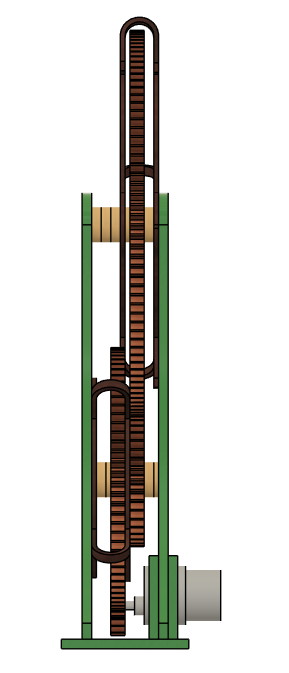
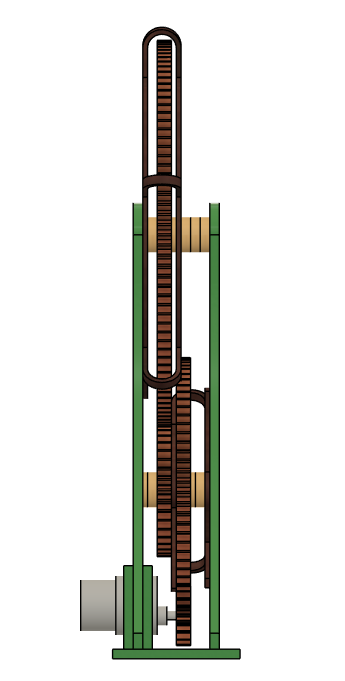
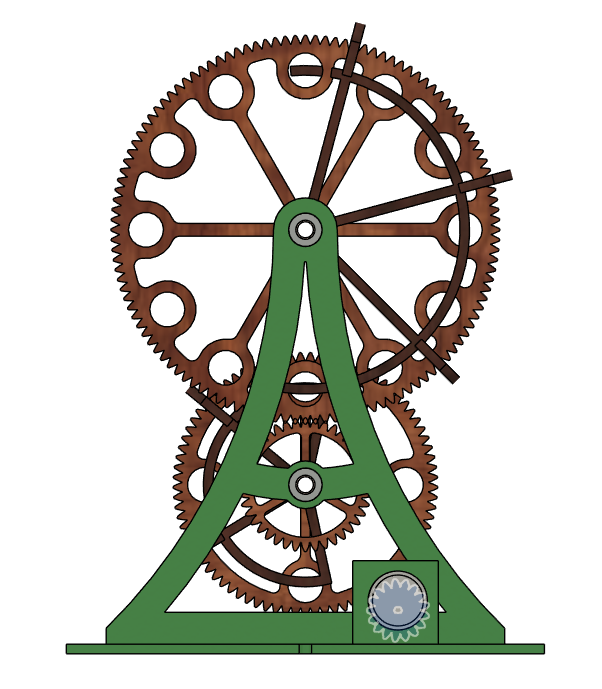
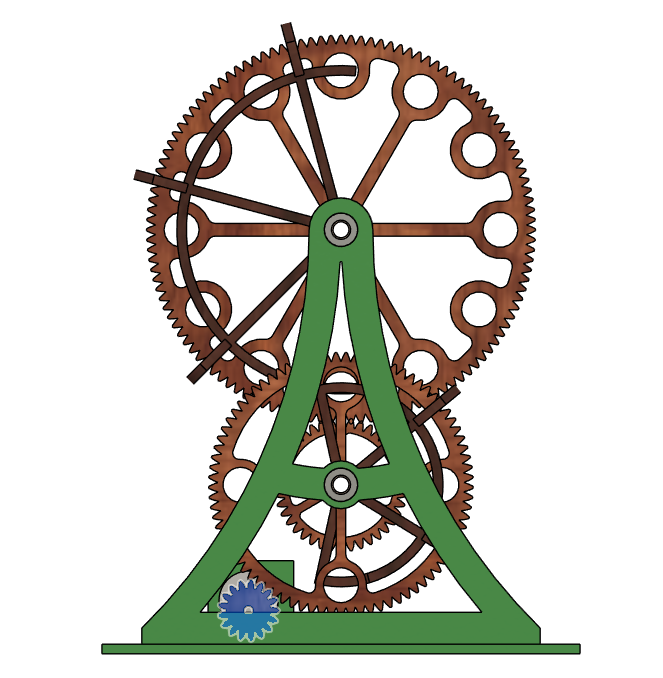
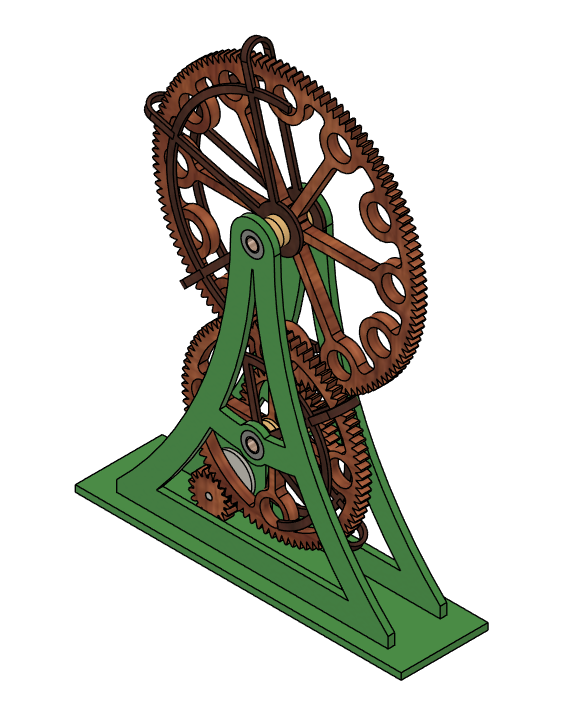
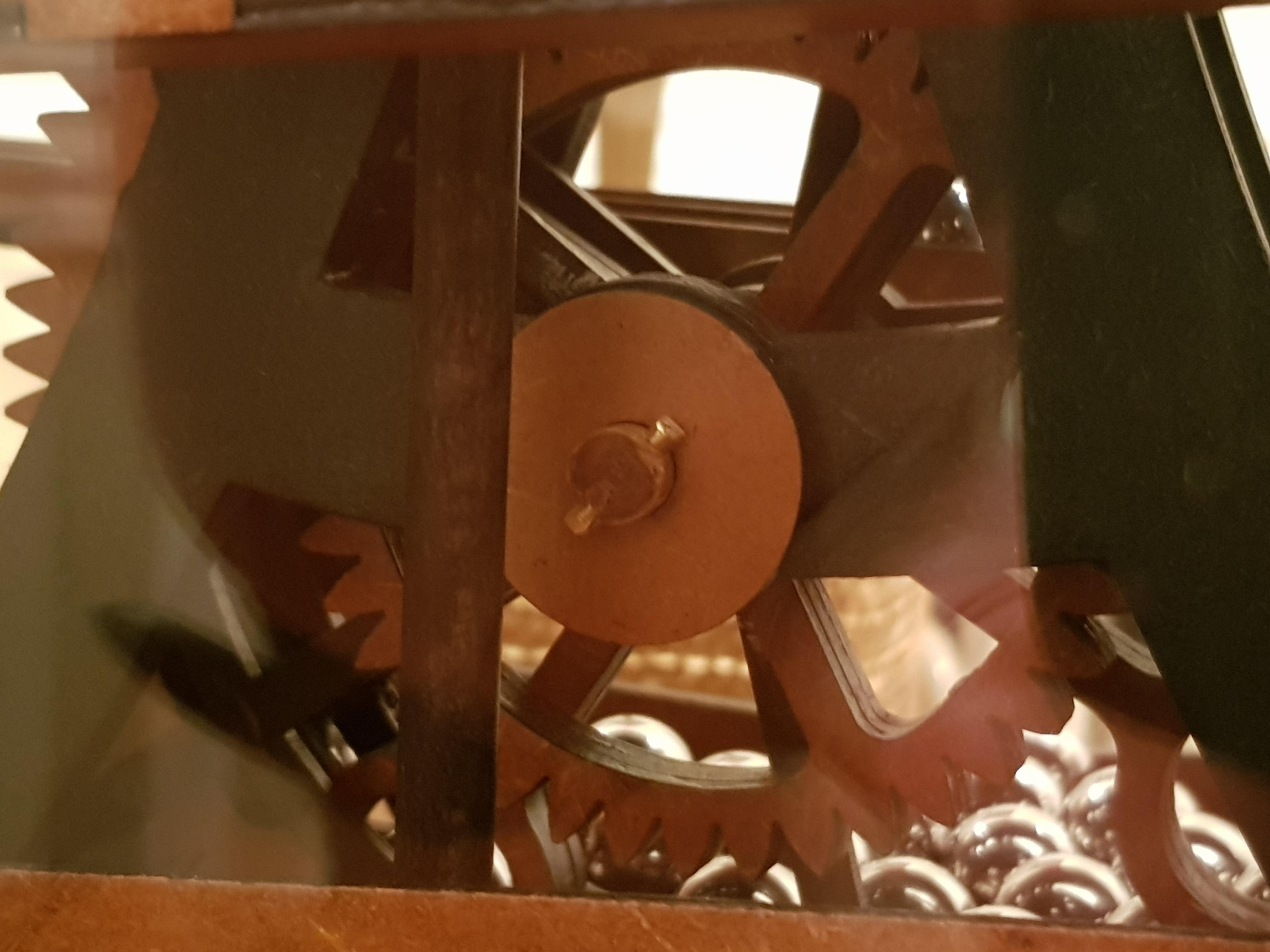
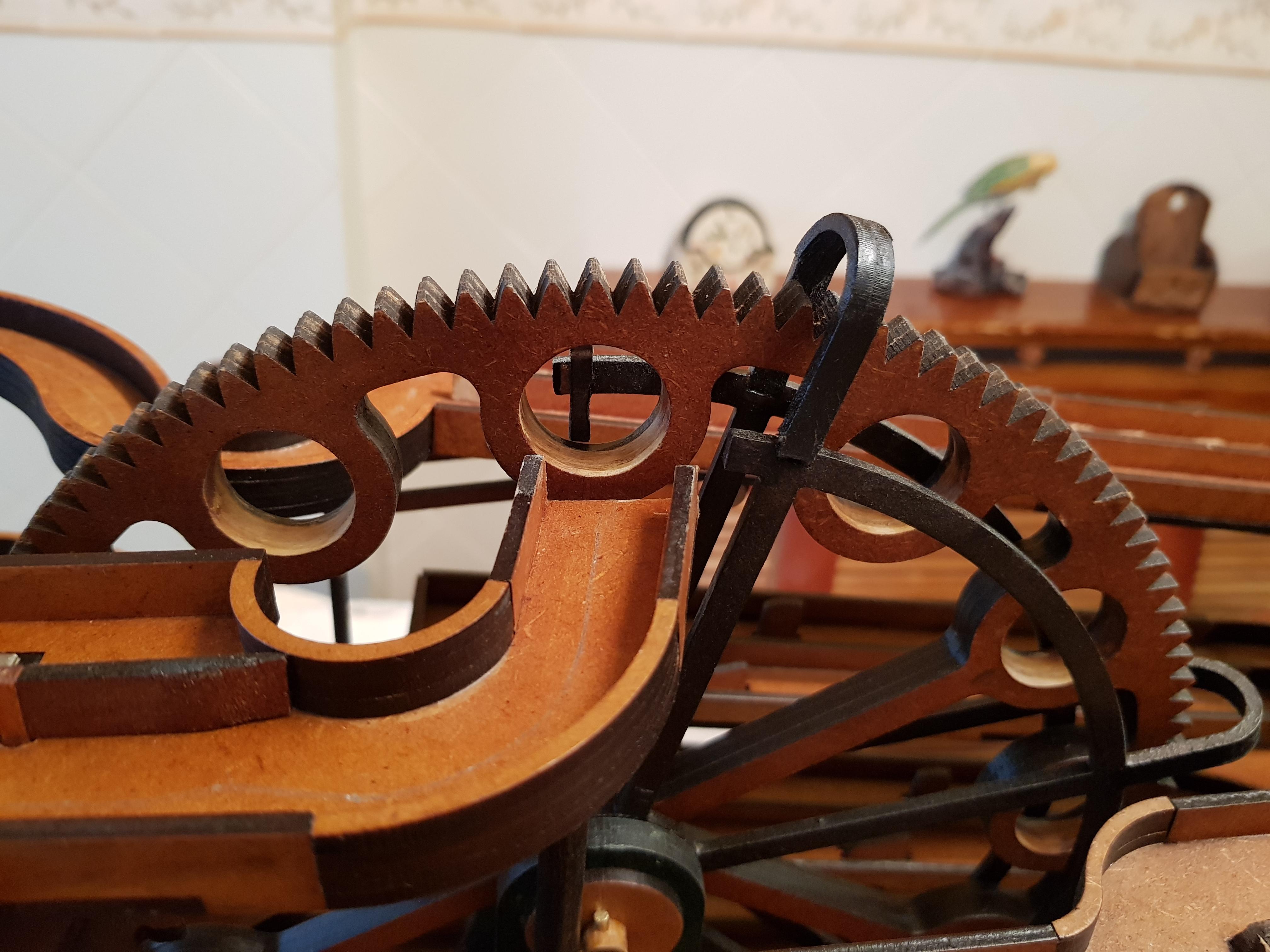
Todas las estructuras del reloj están realizadas básicamente en MDF de 3 mm de espesor que he cortado con mi cortadora laser. Para dar grosor a las piezas lo que hago es simplemente pegar la misma forma las veces necesarias, una sobre otra, con cola blanca. Así por ejemplo en este reloj las ruedas grandes son todas de 9 mm de espesor por lo que he cortado tres piezas iguales de 3 mm de espesor y las he pegado para obtener los 9 mm mencionados.
Como ya he dicho no tengo fotografias del proceso constructivo. No obstante, adjunto la forma de cada una de las piezas en formato DXF tal como las he diseñado en Fusion 360.
En los dibujos adjuntos se ven como van montadas las piezas. Como he mencionado los engranajes son de 9 mm, la base y los soportes verticales son de 6 mm y los sujeta-bolas son de 3 mm.
Las ruedas más grandes van apoyadas en los soportes verticales sobre unos rodamientos y van montadas sobre tubo de cobre del que se usa en fontaneria, de 12 mm de diámetro. En los dibujos de las piezas en formato DXF se ven los orificios trasversales en las planchas centrales donde se ubica el tornillo de apriete (hay que perforar el tubo de cobre para dar robustez al apriete).
Las piezas que se ven en color claro son arandelas de MDF para obtener la separación deseada.
Para evitar que los tubos se salgan del rodamiento he dispuesto de unos círculos de MDF tanto en la parte delantera como trasera, que son atravesados por un redondo de haya o samba y rematados con un pequeño trozo de alambre para que no se puedan desplazar (ver foto).
A los agujeros de las ruedas que suben las bolas les dí conicidad con la dremel para que las bolas entren o salgan de las mismas con facilidad.
El MDF se lija un poco y se tiñe del color que se desee. Luego yo le doy un par de capas de tapaporos (nitro) y lijo ligeramente para rematar con barniz en spray mate.
Despues de algunos dias de operación tuve problemas con la rampa de alimentación de las bolas a la "noria". Las bolas se "apelotonaban" y no entraban en la rueda. Tuve que cambiar varias veces la forma de la rampa y ampliar la zona de recogida. Entonces las bolas se empezaron a "colar" através de la rueda...Así que tuve que poner unos "postizos" a la rueda de admisión para evitar esto. Adjunto un DXF con este postizo (son cuatro en total a ubicar en la rueda grande inferior).
All the clock's parts are made primarily from 3mm thick MDF, which I cut with my laser cutter. To achieve the desired thickness, I simply glue the same shape on top of each other as many times as needed, using white glue. For example, in this clock, the large wheels are all 9mm thick, so I cut three identical 3mm thick pieces and glued them together to obtain the required 9mm thickness.
As I mentioned, I don't have any photographs of the construction process. However, I've attached the shape of each piece in DXF format, exactly as I designed them in Fusion 360. The attached drawings show how the pieces are assembled. As I mentioned, the gears are 9mm thick, the base and vertical supports are 6mm thick, and the ball bearings are 3mm thick.
The larger wheels rest on the vertical supports with bearings and are mounted on 12mm diameter copper plumbing tubing. The DXF drawings of the parts show the transverse holes in the central plates where the tightening screw is located (the copper tube must be drilled to ensure a secure fit).
The light-colored pieces are MDF washers used to achieve the desired spacing.
To prevent the tubes from coming out of the bearing, I've added MDF circles to both the front and back, which are pierced by a round beech or samba wood rod and secured with a small piece of wire to prevent movement (see photo).
I tapered the holes in the wheels that raise the balls using a Dremel tool to allow the balls to slide in and out easily.
The MDF is lightly sanded and stained the desired color. Then I apply a couple of coats of wood sealer (nitro) and lightly sand it before finishing with a matte spray varnish. After a few days of operation, I had problems with the ball feed ramp to the feeder wheel. The balls were clumping together and wouldn't enter the wheel. I had to change the shape of the ramp several times and widen the collection area. Then the balls started slipping through the wheel... So I had to add some spacers to the feed wheel to prevent this. I've attached a DXF file showing these spacers (there are four in total to be placed on the large lower wheel).
BASE Y ESTRUCTURA DE SUJECCION DE LAS RAMPAS / BASE AND RAMPS SUPPORT STRUCTURE
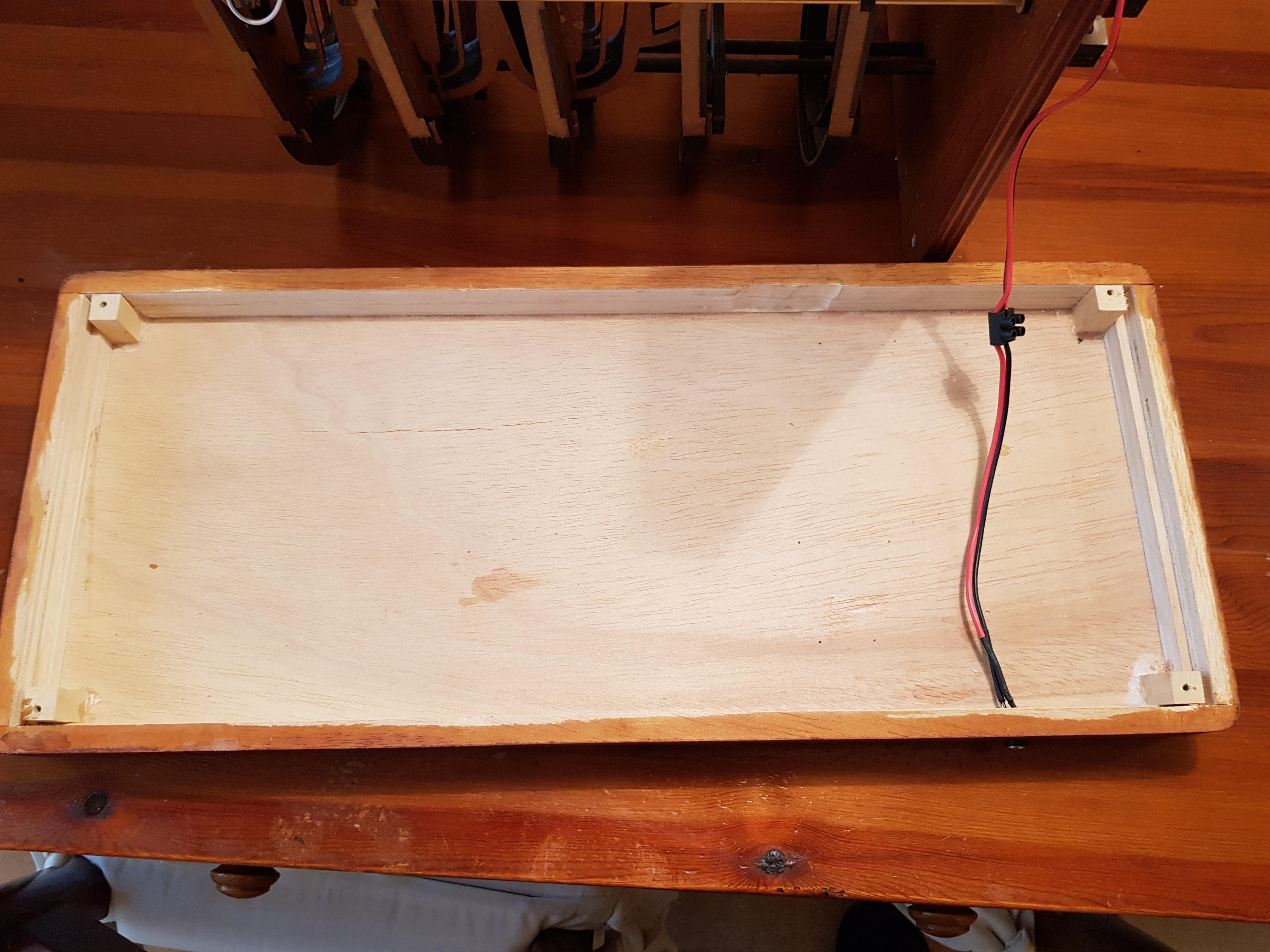
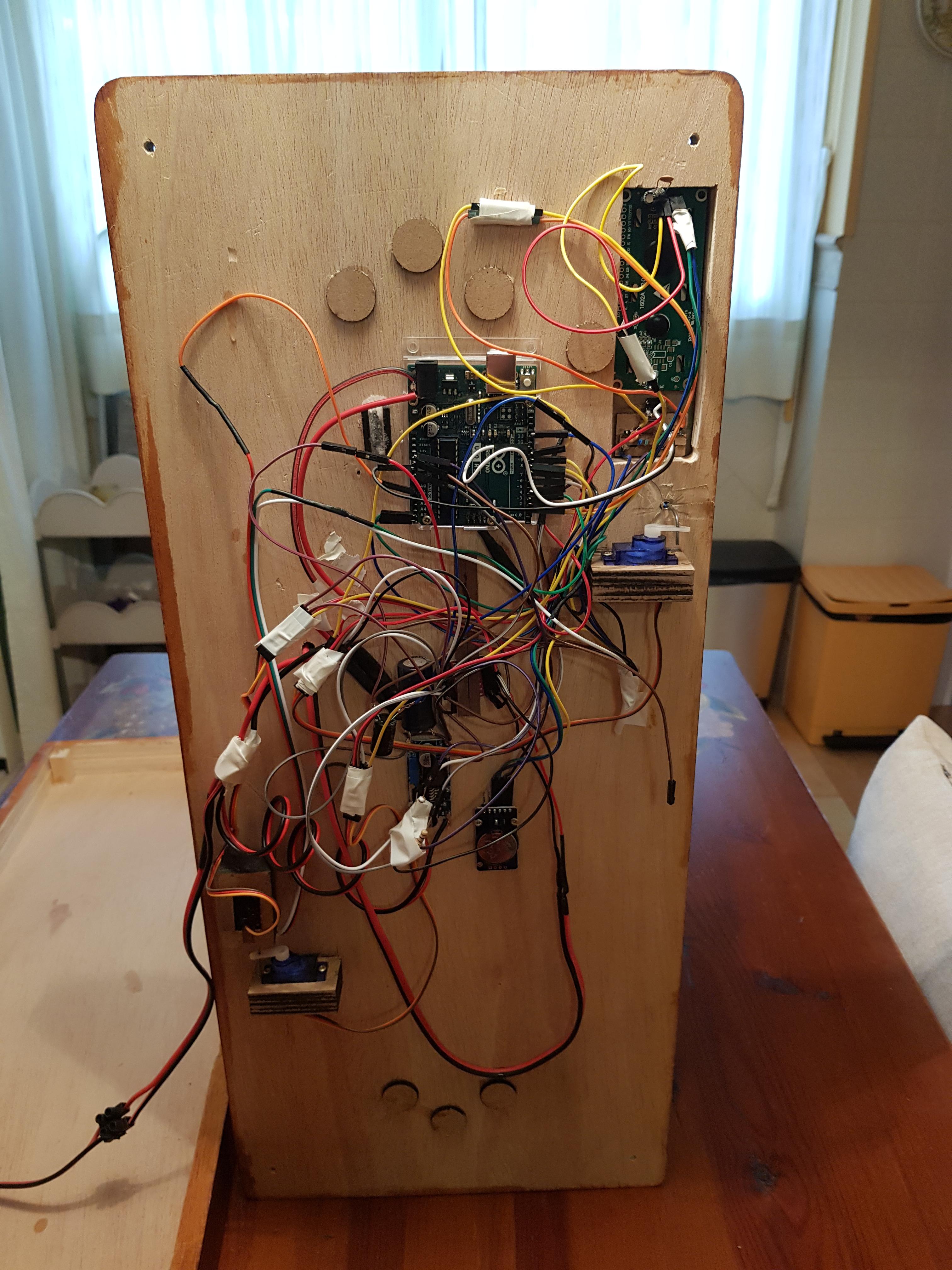
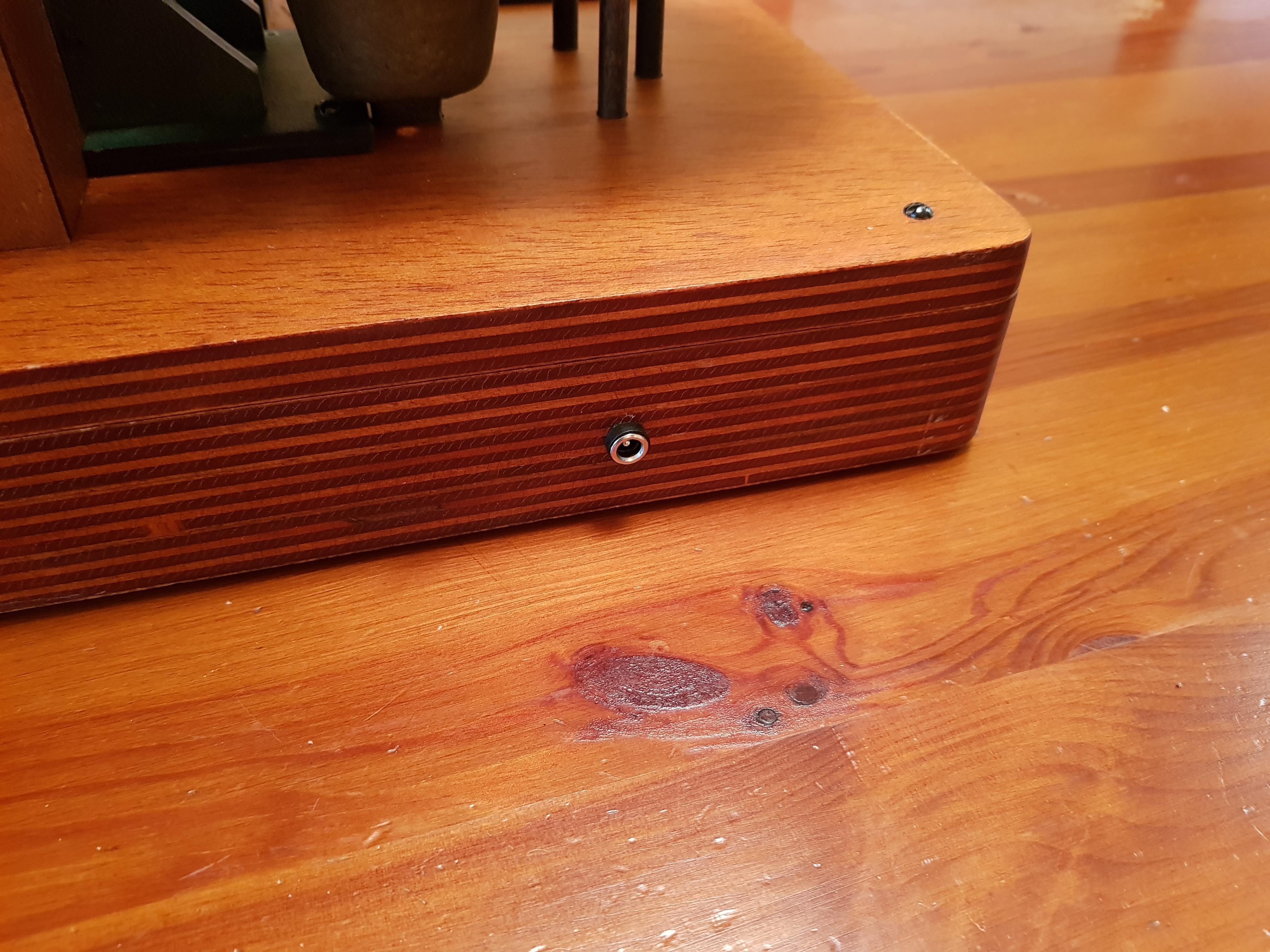
La base está hecha con contrachapado de 15 mm de espesor y los agujeros y cortes están hechos a mano. Esta parte no la gestioné con Fusion 360. La base tiene que albergar los distintos elementos así que he dejado un espacio interior de 3 cm. Adjunto varias fotografías que considero que son suficientes para entender el proceso constructivo. No tiene mayor complejidad.
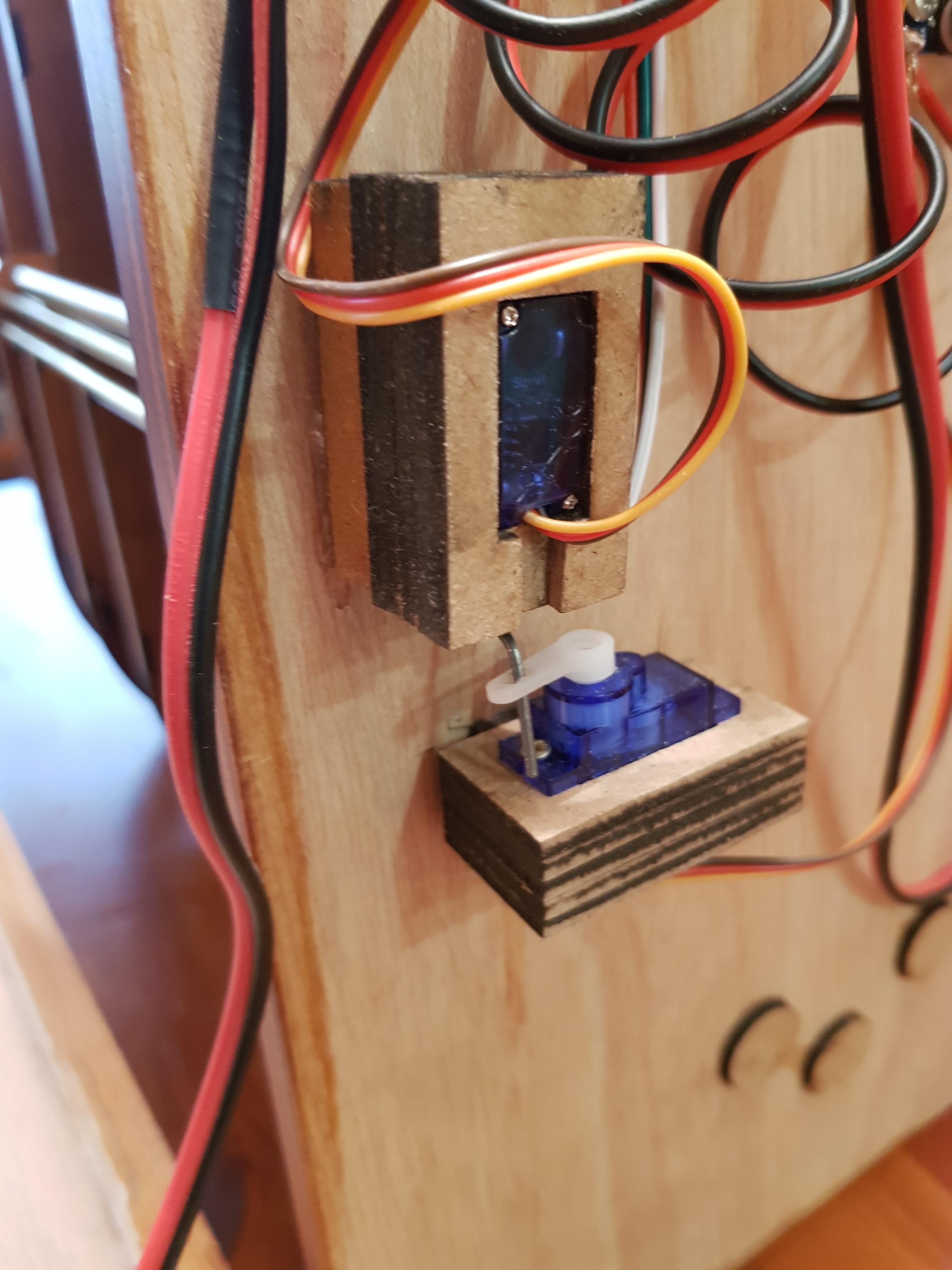
Para sujetar los servos al reverso de la tapa de la base hice unas piezas que adjunto en este apartado.
La tapa se atornilla a unos cuadradillos de samba pegados en el interior de la base.
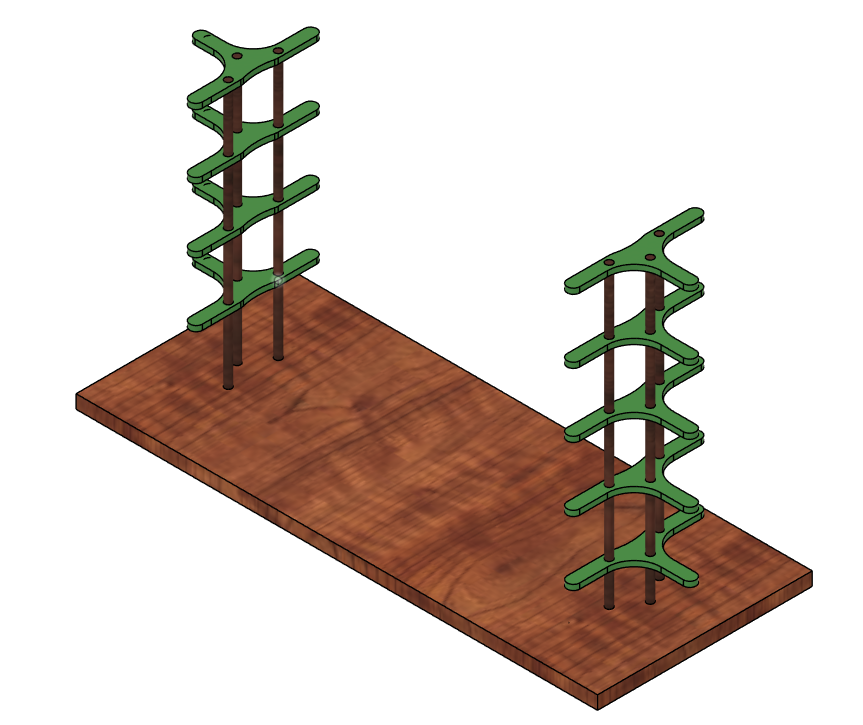
Por lo que se refiere a la estructura de soporte de las rampas, la misma está constituida por redondos de haya de 8 mm de diámetro y 333 cms de alto desde la base aprox. Lo importante a mencionar aquí es que las rampas frontales y posteriores tienen una inclinación de 4 grados. Las de los laterales no tienen casi inclinación, la misma se puede ajustar con unas cuñas. La única rampa que tiene menos inclinación es la de las campanadas para evitar que el tambor se "bloquee" por el peso de las bolas.
Todo esto es un poco ir probando, al menos así ha sido en mi caso.
En las fotografias se ven otros redondos verticales que se han dispuesto para sujetar y dar más pendiente a diversas partes de las rampas.
Incluyo tambien en el DXF la forma de las piezas de tres brazos que sujetan las rampas a izquierda y a derecha. A los redondos de haya les puse unos pasantes con alambre de latón (igual que lo descrito antes en la noria) para evitar que estas piezas se desplacen hacia abajo. Estas piezas no las diseñé para ser atornilladas. Posteriormente les añadi unos "postizos" para poder atornillarlas, pero solo pude hacerlo en las superiores. Esta parte admite mejoras, pero en fin, así se ha quedado. Donde no hay tornillos hay pegamento...
Por último, decir que en el DXF se ven otras piezas de mi modelo. Estas corresponden al soporte del LCD y de los interruptores de ajuste de las horas...Todas estas piezas deberán tener las formas según el tipo de accesorio que se ponga.
The base is made of 15mm thick plywood, and the holes and cuts are all done by hand. I didn't use Fusion 360 for this part. The base has to accommodate the various components, so I've left a 3cm interior space. I've included several photos that I think are sufficient to understand the construction process. It's not very complex.
To attach the servos to the back of the base lid, I made some parts that I've included in this section.
The lid is screwed onto square pieces of samba wood glued to the inside of the base.
As for the ramp support structure, it consists of 8mm diameter beechwood rods, approximately 333cm high from the base. It's important to note that the front and rear ramps have a 4-degree incline. The side ramps have almost no incline, which can be adjusted with wedges. The only ramp with a gentler incline is the one for the bells, to prevent the drum from "blocking" under the weight of the balls.
It's all been a bit of a trial-and-error process, at least that's how it's been for me.
In the photographs, you can see other vertical round bars that have been added to support and increase the slope of various parts of the ramps.
I've also included in the DXF file the shape of the three-armed pieces that support the ramps on the left and right. I added brass wire through-bolts to the beech round bars (just like I described earlier for the Ferris wheel) to prevent them from sliding down. I didn't design these pieces to be screwed in. Later, I added some "add-ons" so I could screw them in, but I was only able to do so on the upper ones. This part could be improved, but oh well, that's how it is now. Where there are no screws, there's glue...
Finally, I should mention that other parts of my model can be seen in the DXF file. These correspond to the LCD support and the time adjustment switches...All these parts must be shaped according to the type of accessory that is installed.
Downloads
LOS "RIZOS" / THE "LOOPS"
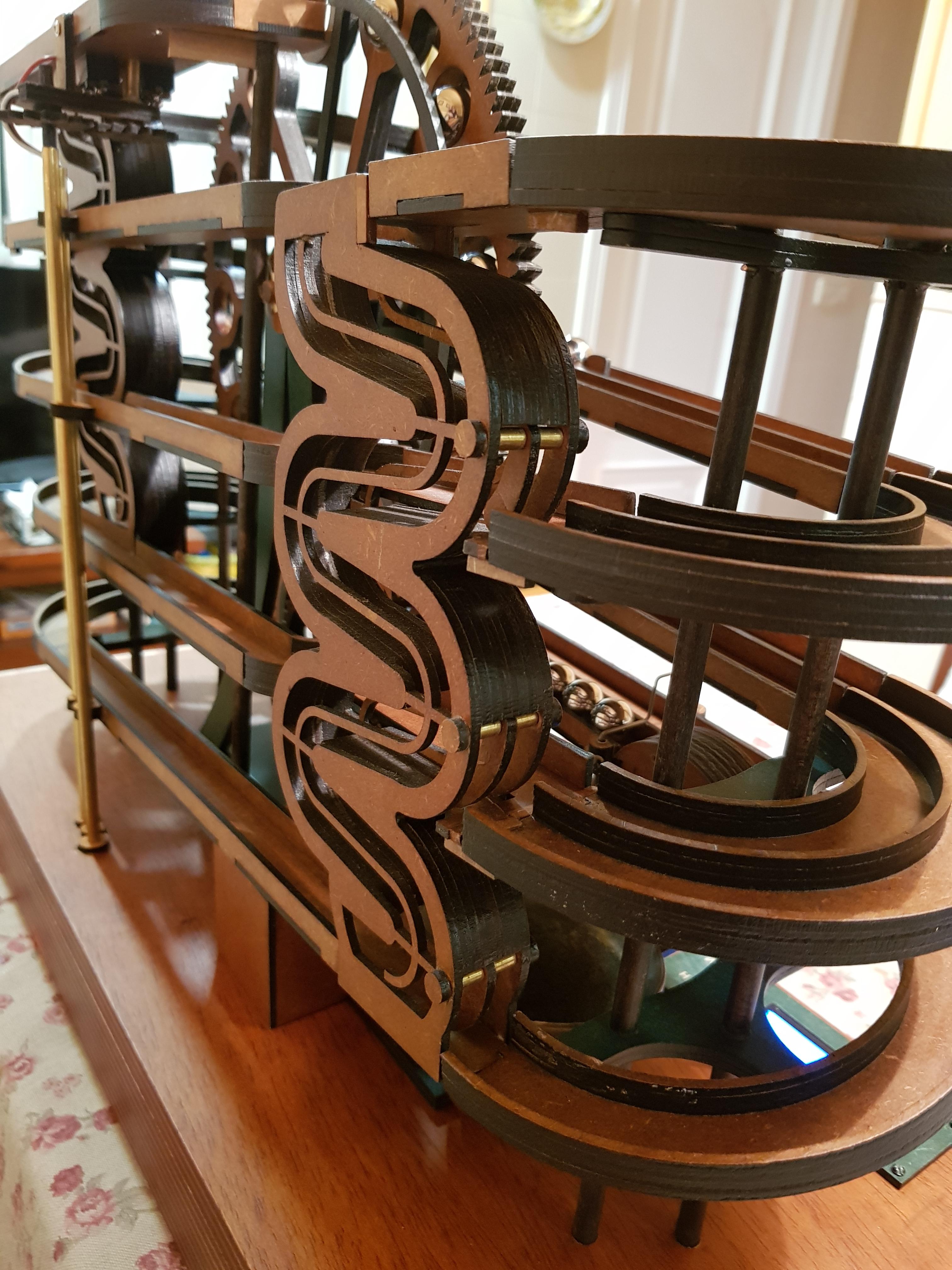
Denomino "rizos" a los dos "loops" verticales que sirven para cargar las campanadas y para descargar las bolas de la parte frontal de las rampas y llevarlas a la plataforma de salida.
Hay dos estructuras de estos "rizos" que no son excatamente iguales. Mientras que en el de las campanadas las bolas entran por arriba y salen por abajo, en el de descarga las bolas pueden entrar de lado a distintas alturas. Por ello esta última estructura dispone de unos balancines que dejan entrar las bolas en el "rizo" pero que impiden que las bolas que bajan se salgan por esos orificios laterales. Estos balancines van montados sobre trozos de tubos de latón concéntricos rematados con unos tapones en los extremos.
El interior de los rizos lo diseñé a 19 mm de ancho para que las bolas de 18 mm circulen sin problemas. Por eso las piezas con una misma forma van pegadas de la siguiente forma: 5 piezas de 3 mm (15 mm en total) más 2 piezas de 2 mm (4 mm en total).
La correcta posición y alineamiento del rizo de descarga con las rampas es una de las partes más crríticas de la construcción del reloj.
I call the two vertical loops used to load the bells and unload the balls from the front of the ramps onto the starting platform "curls."
There are two different types of these loops. While the balls enter the bell loop from the top and exit from the bottom, the unloading loop allows balls to enter from the side at varying heights. Therefore, this latter loop has rockers that allow the balls to enter the loop but prevent them from falling through the side openings. These rockers are mounted on concentric sections of brass tubing, each capped at one end.
I designed the inside of the loops to be 19 mm wide to allow the 18 mm balls to circulate freely. Therefore, pieces of the same shape are glued together as follows: 5 pieces of 3 mm (15 mm total) plus 2 pieces of 2 mm (4 mm total).
The correct positioning and alignment of the discharge loop with the ramps is one of the most critical aspects of the clock's construction.
Downloads
LA RAMPA SUPERIOR / THE UPPER RAMP
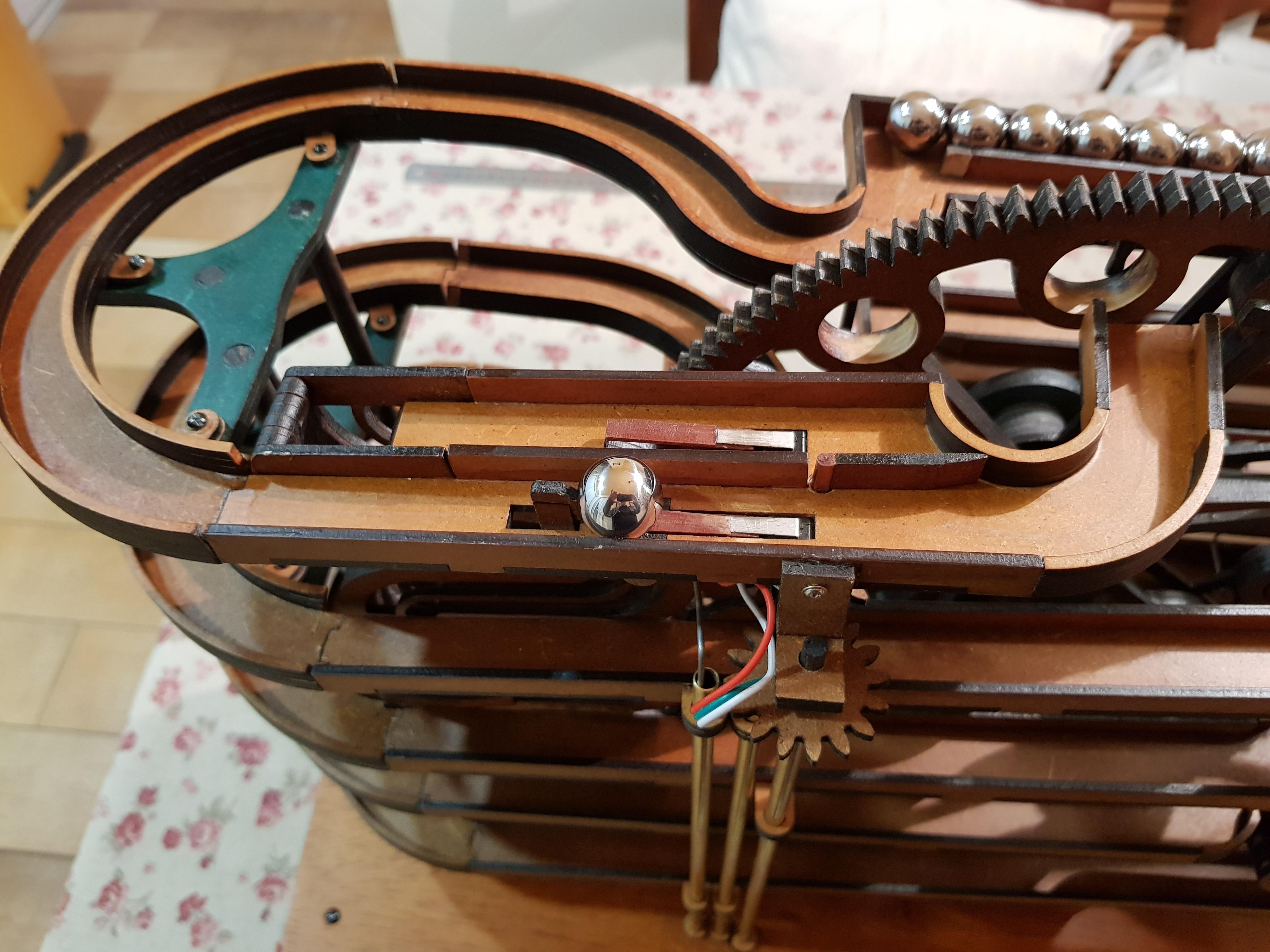
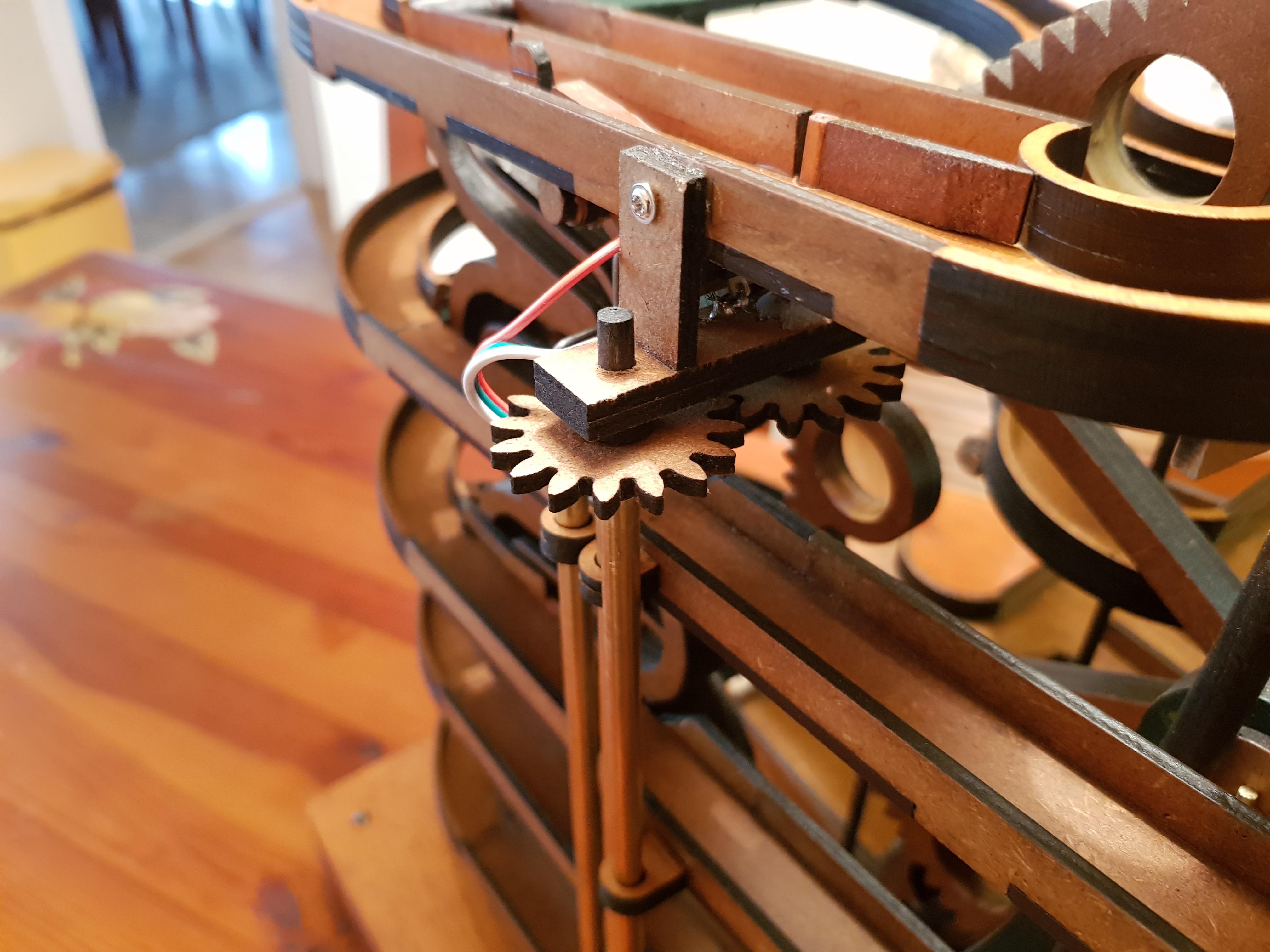
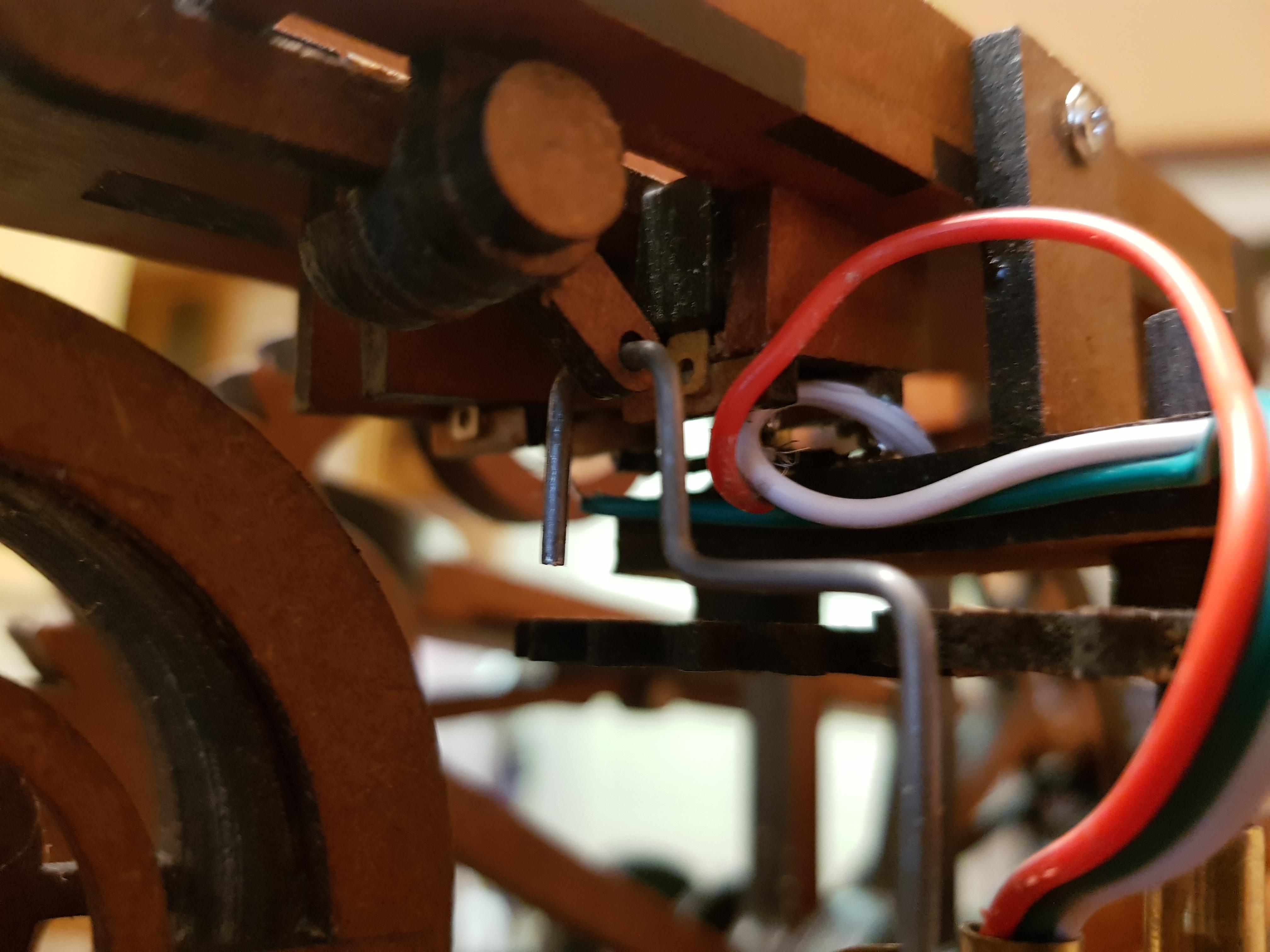
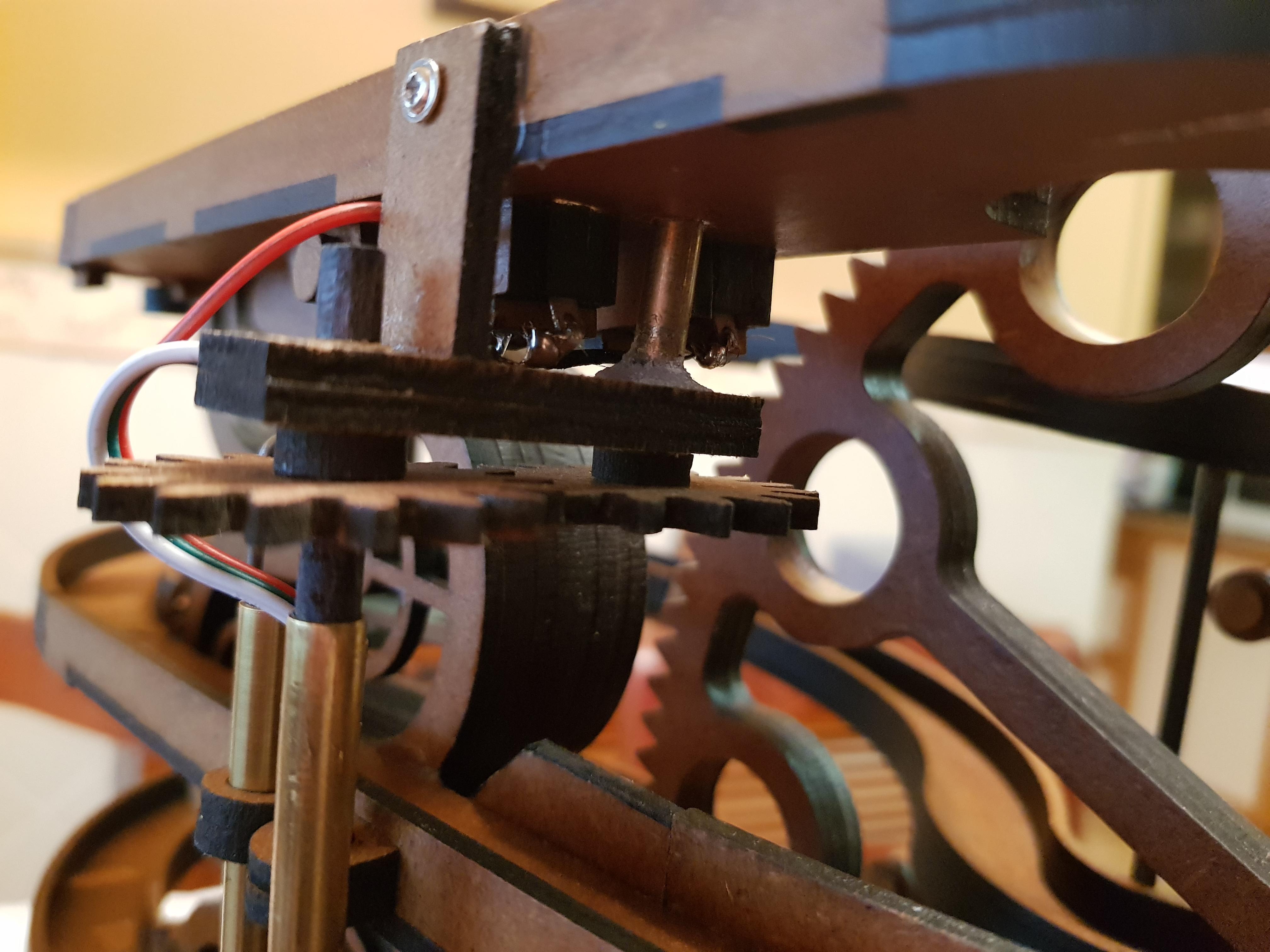
Las rampas son la parte más "caótica" del reloj. Aunque todas las piezas han sido diseñadas en Fusion 360, algunas de ellas han habido que modificarlas durante el montaje, añadiendo o eliminando trozos de estas. Esto se debe a que es muy dificil alinear bien toda la estructura a la para que hay que observar el comportamiento de las bolas e ir ajustando conforme es necesario.
En la rampa superior hay que ubicar el "flipper", el balancín de retención y los dos interruptores de final de carrera. Los interruptores que yo he usado no se activan con el peso de la bola. Es por ello por lo que les he añadido unos "alargadores" en madera de manzonia para aumentar el efecto palanca. Estos interruptores deben fijarse muy bien por debajo de la rampa. Por otro lado, para mover el "flipper" yo he dispuesto de un par de engranajes. En uno de ellos he añadido un redondo muy largo que llega hasta el servo que está en la base y que se mueve dentro de un tubo de latón.
Por lo que se refiere al balancín de bloqueo, este va conectado con el servo de la base por medio de un alamabre de acero de 1.5 mm de diámetro que tambien se mueve dentro de un tubo de latón.
Incluyo los dibujos que tengo disponibles de las piezas que conforman estas rampas, así como diferentes fotografías para ilustrar los detalles referidos.
The ramps are the most "chaotic" part of the clock. Although all the pieces were designed in Fusion 360, some had to be modified during assembly, with pieces added or removed. This is because it's very difficult to perfectly align the entire structure, so you have to observe the behavior of the balls and adjust as needed.
The flipper, the retaining rocker, and the two limit switches must be placed on the upper ramp. The switches I used aren't activated by the weight of the ball. That's why I added some manzonia wood extensions to increase the leverage effect. These switches must be securely fixed underneath the ramp. To move the flipper, I used a couple of gears. On one of them, I added a very long rod that reaches the servo at the base, which moves inside a brass tube.
Regarding the locking rocker arm, it is connected to the base servo by means of a 1.5 mm diameter steel wire that also moves inside a brass tube.
I have included the drawings I have available of the parts that make up these ramps, as well as several photographs to illustrate the details mentioned.
Downloads
LAS CURVAS LATERALES / THE CURVES
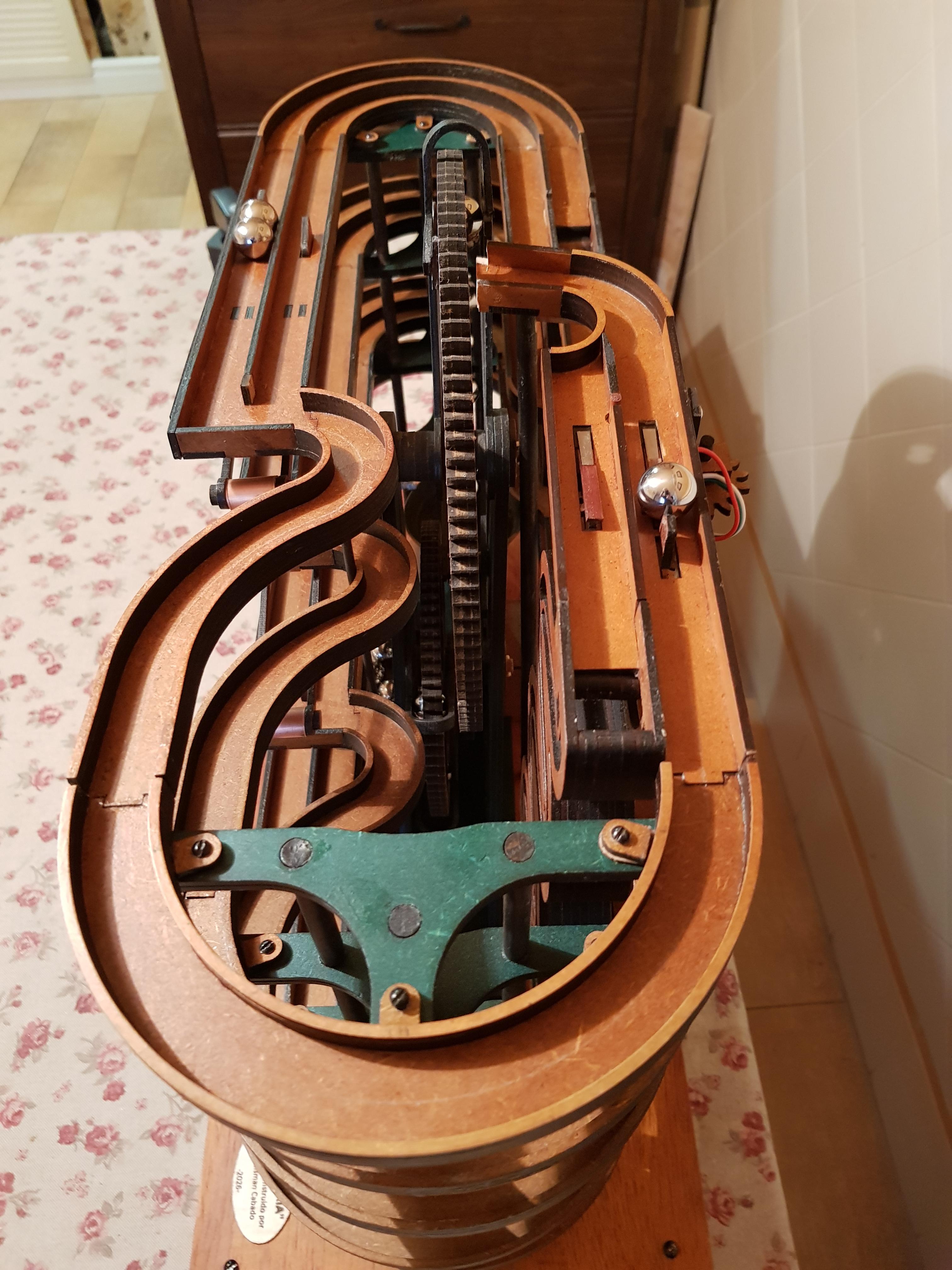
Hay curvas a la derecha e izquierda del reloj, algunas son simples y otras dobles. Como los bordes laterales se elevan 9 mm (la mitad de una bola) hay que superponer tres piezas de 3 mm para construir esos bordes.
Como he mencionado antes, diseñé unos postizos para pegarlos en el interior de las curvas y poder atornillar estas piezas a los soportes de tres brazos. No obstante, las curvas dobles no admiten estos postizos ya que tropiezan con los redondos verticales (allo de diseño mio).
En la parte inferior de las curvas se pueden pegar unas piezas que tienen el ángulo de 4º mencionado anteriormente para unirlas mejor a las rampas frontales y traseras.
There are curves to the right and left of the clock, some single and some double. Since the side edges are raised 9 mm (half the diameter of a ball), three 3 mm pieces must be overlapped to construct these edges.
As I mentioned before, I designed inserts to glue inside the curves so these pieces can be screwed to the three-arm supports. However, the double curves cannot accommodate these inserts because they interfere with the vertical rods (a failure of my design).
At the bottom of the curves, pieces with the previously mentioned 4° angle can be glued to better connect them to the front and rear ramps.
Downloads
RAMPAS FRONTALES Y TRASERAS / FRONT AND REAR RAMPS
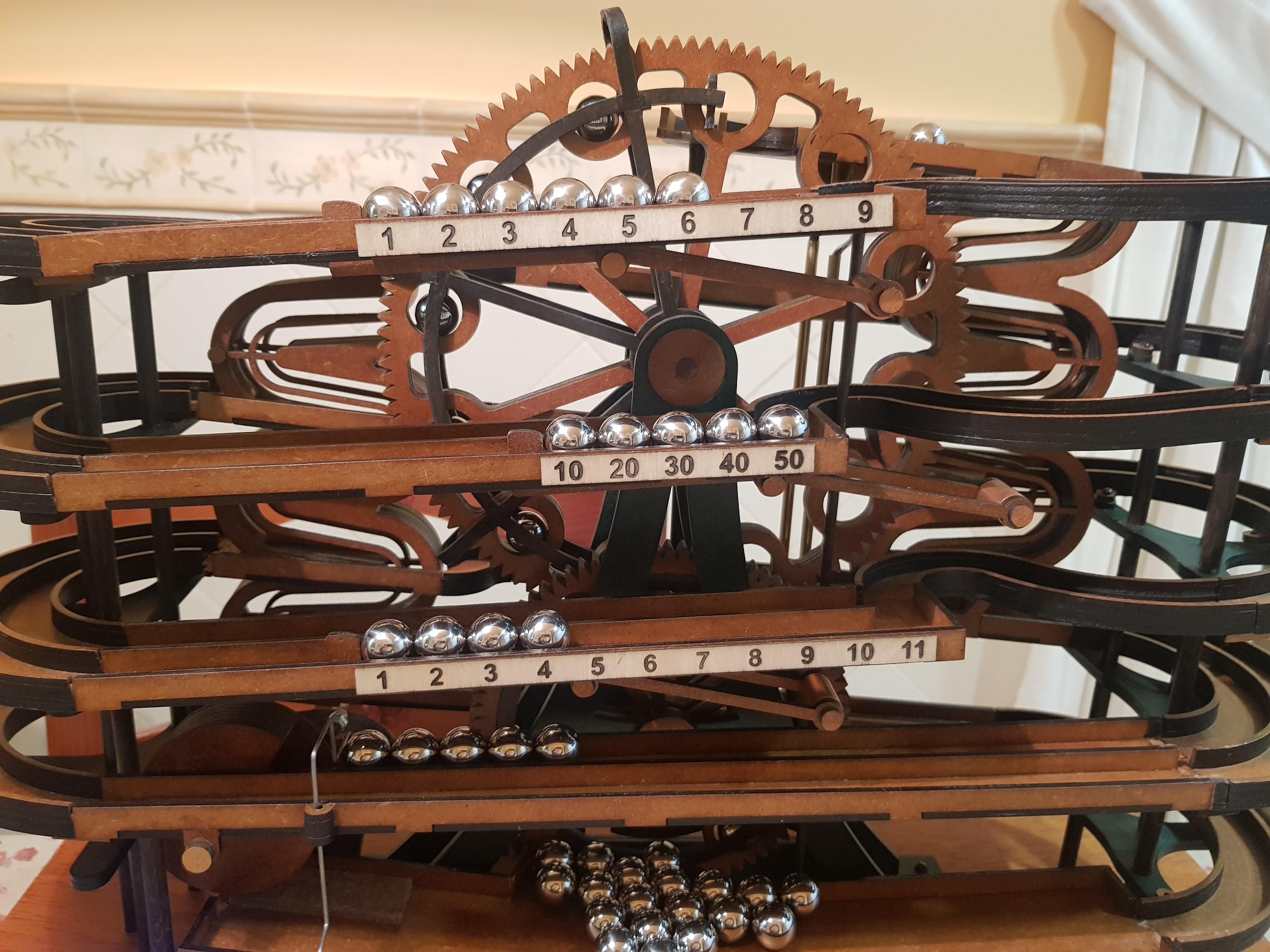
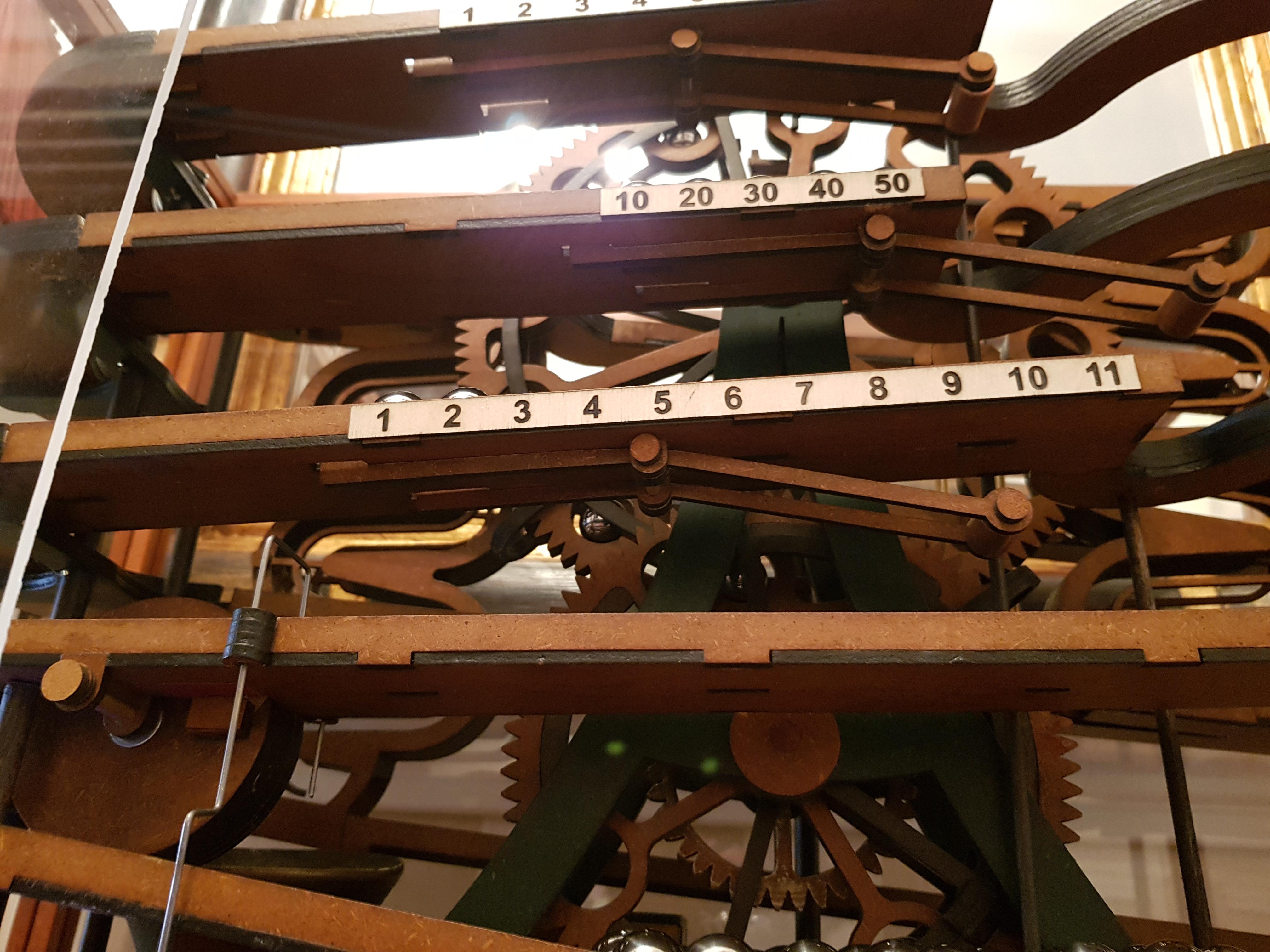
Las tres rampas frontales superiores son las que se utilizan para marcar las horas y los minutos. En el borde de estas rampas se han colocado los números grabados en chapa de abedúl. Por su parte, la cuarta rampa frontal, contada de arriba abajo, es la que alberga las bolas para las campanadas.
Las rampas frontales tienen dos carriles y en las tres primeras van ubicados los balancines que detallo más adelante. El acceso a estas rampas con balancín se hace através de unas curvas con una forma en "S" que fuerzan a las bolas a una entrada casi perpendicular a las rampas de forma que la bola es obligada a circular por el carril externo. Cuando ese carril se llena la siguiente bola tiene que circular por el segundo carril y al hacerlo pisa el balancín que hace descargar todas las bolas del carril externo.
En mi diseño cada rampa frontal tiene una forma diferente, pero se pueden hacer todas iguales si se desea. Lo único que cambia es la posición del balancín.
Por lo que se refiere a las rampas traseras estas tienen la forma necesaria para interactuar con los rizos en la forma que corresponda.
Adjunto las diferentes formas de las rampas en formato DXF, aunque la verdad es que tuve que ajustar (cortar o añadir trozos) algunas de estas piezas, sobre todo la pieza que separa los dos carriles en la parte frontal.
Por lo que se refiere a los balancines estos consisten en dos piezas que van unidas por dos partes: en la parte central mediante un eje que pasa por unas piezas pegadas en la parte inferior de la rampa y en la parte trasera donde se ha de colocar un trozo de tubo de cobre de 12 mm de diámetro que es el que hace de contrapeso.
The three upper front ramps are used to mark the hours and minutes. Numbers engraved are placed along the edge of these ramps. The fourth front ramp, counting from top to bottom, houses the balls for the chimes.
The front ramps have two tracks, and the first three contain the rockers, which I will detail later. Access to these rocker ramps is via S-shaped curves that force the balls to enter almost perpendicular to the ramps, compelling them to travel along the outer track. When that track is full, the next ball must travel along the second track, and as it does so, it strikes the rocker, which then discharges all the balls from the outer track.
In my design, each front ramp has a different shape, but they can all be made the same if desired. The only difference is the position of the rocker.
Regarding the rear ramps, they are shaped to interact with the loops as required.
I've attached the different ramp shapes in DXF format, although I did have to adjust (cut or add pieces to) some of these pieces, especially the piece that separates the two lanes at the front.
As for the seesaws, these consist of two pieces joined in two places: in the center by an axle that passes through pieces glued to the bottom of the ramp, and at the back where a 12mm diameter copper tube is attached to act as a counterweight.
RAMPA CAMPANADA, SONERIA Y BANDEJA DE SALIDA / OTHER RAMPS

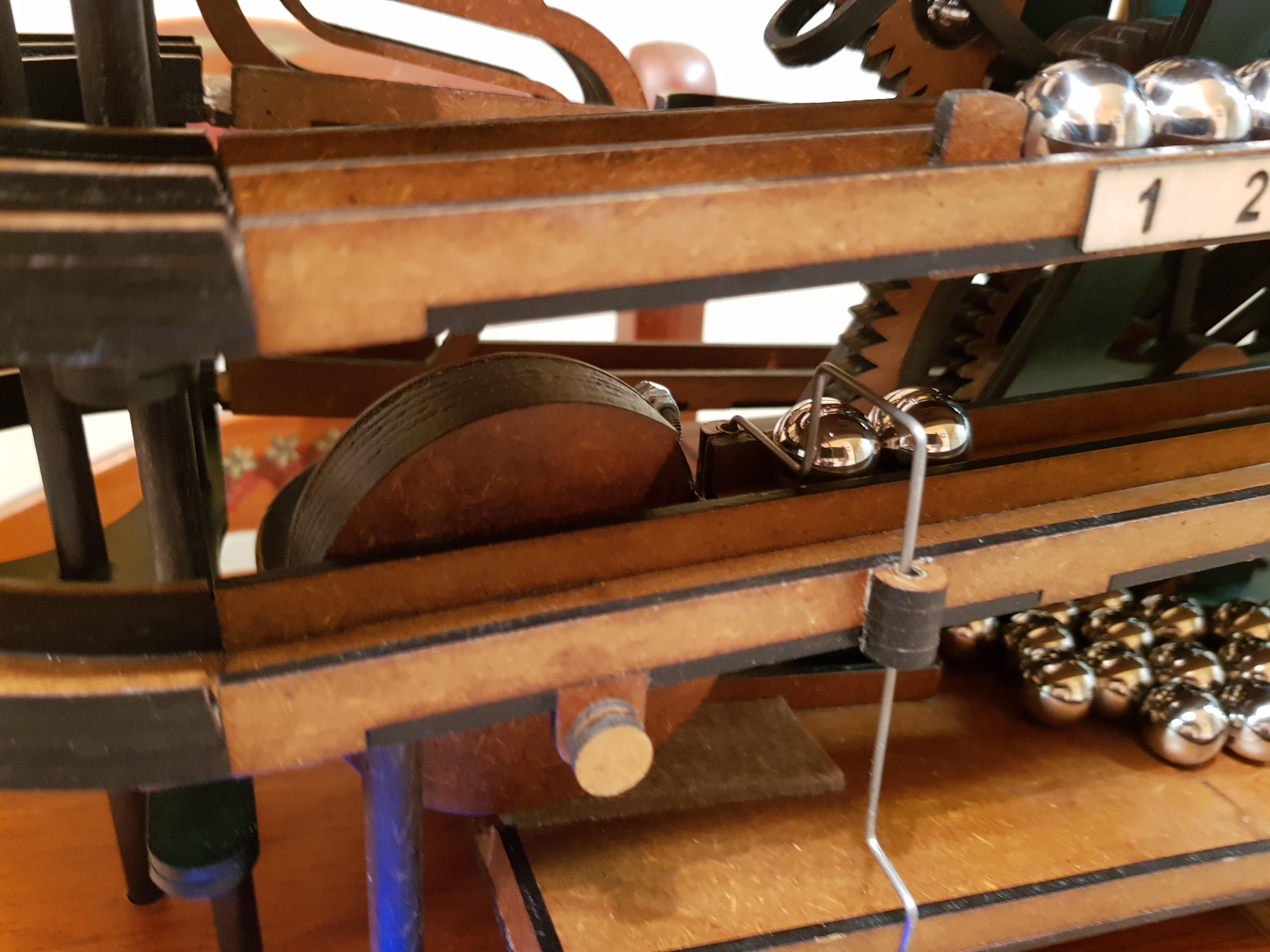
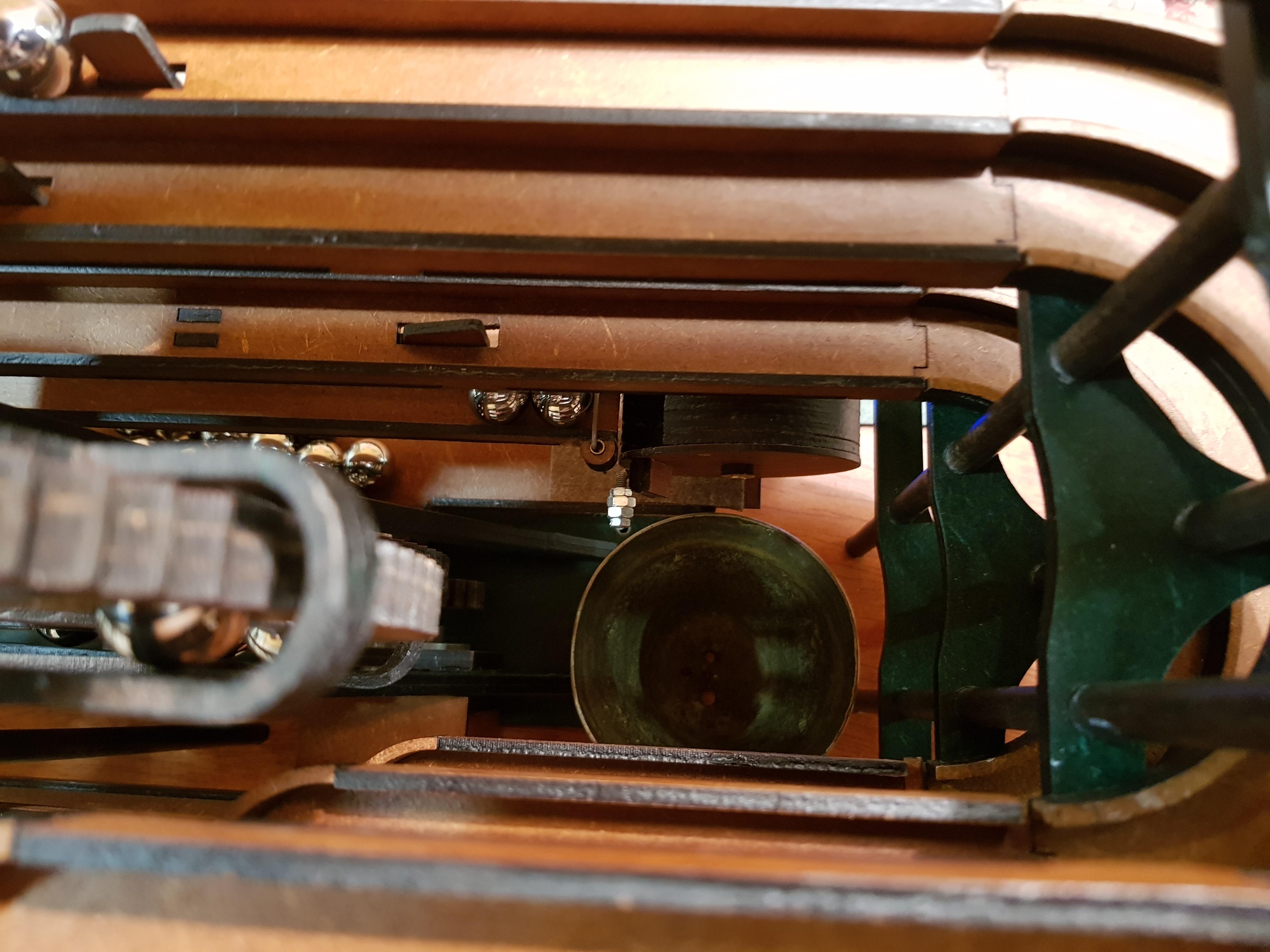
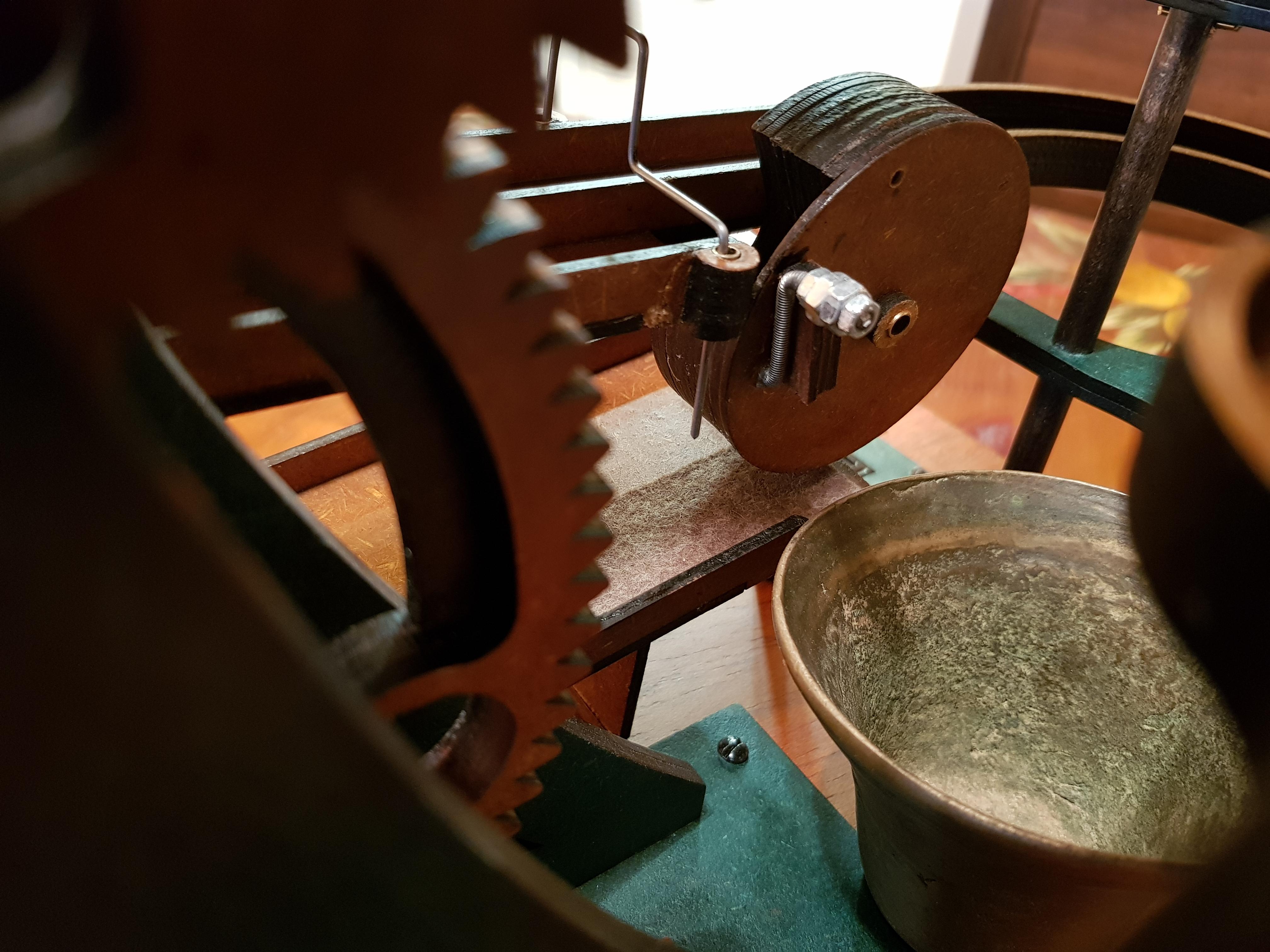
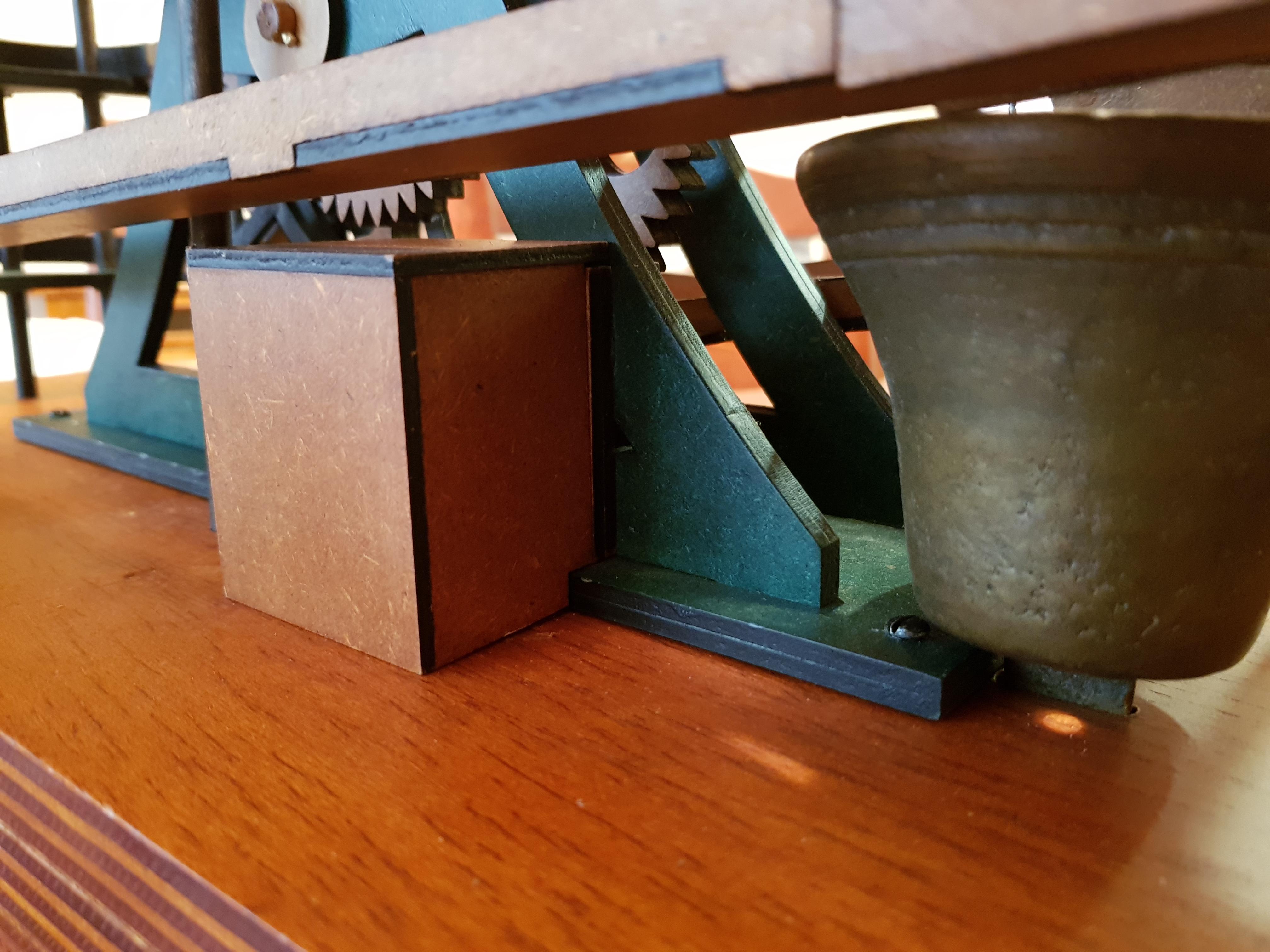
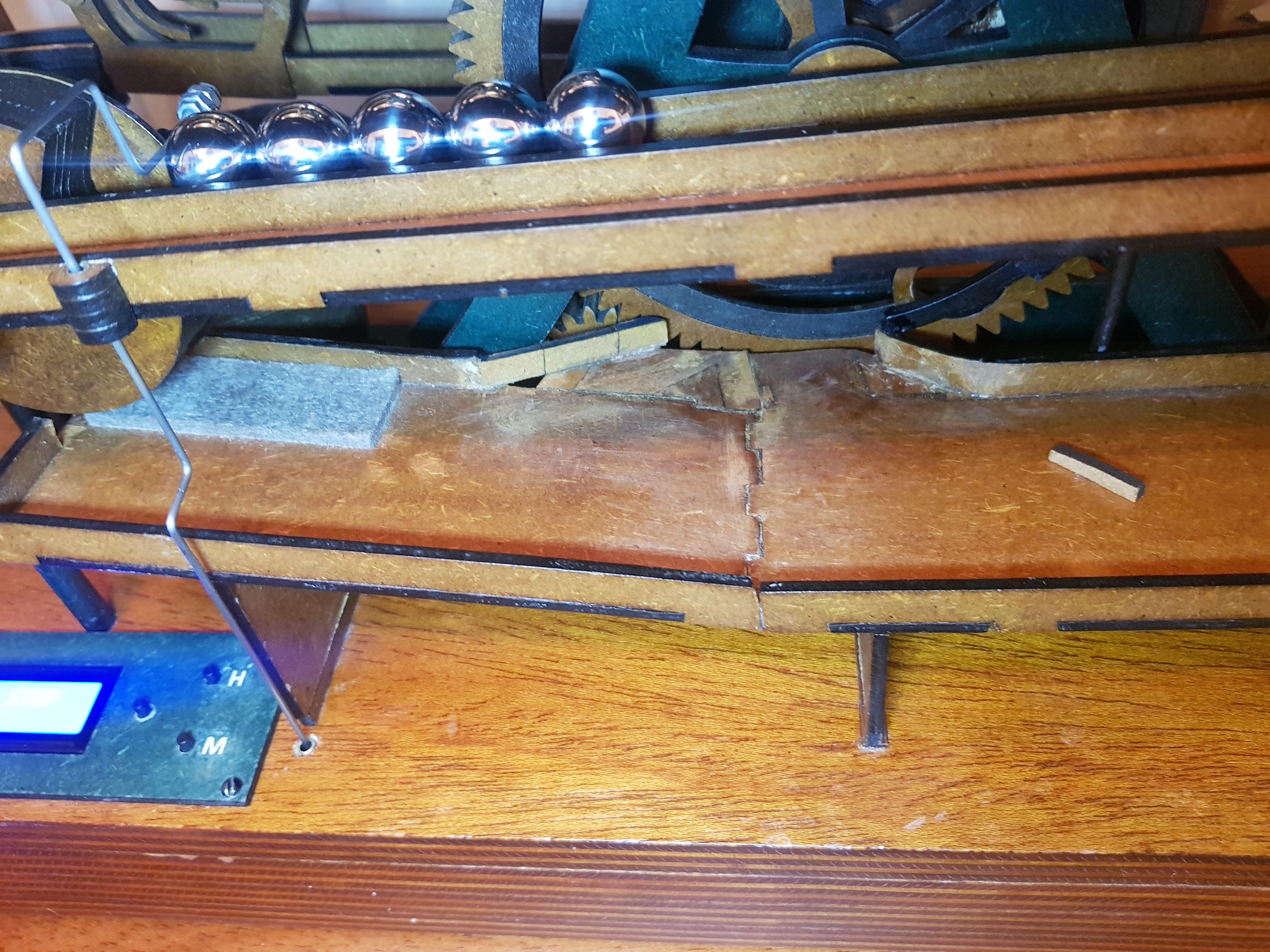
La rampa que alberga las bolas para dar las campanadas y la rampa posterior no tienen nada de particular. En la parte frontal se ha dispuesto una pieza que denomino "tambor" y que sirve para bajar las bolas desde la bandeja "campanadas" hasta la bandeja de salida.
En el DXF adjunto se muestra dicho tambor. Las planchas internas tienen un agujero para poder ocultar una bola o peso que ayuda al tambor a volver a su posición inicial una vez haya bajado la bola. Yo además de la bola interior puse una mini plancha de plomo adhesiva en el lateral exterior del tambor para encontrar el punto óptimo de balance.
Para minimizar el ruido y los "golpes" de las bolas al bajar puse un poco de fieltro en la bandeja inferior justo a la salida del tambor.
A este tambor hay que acoplarle algun tipo de badajo y por su puesto hay que ubicar una campana en la base del reloj. En las fotografías adjuntas se muestra como he resuleto este asunto con una campana que tenía por casa.
De la bandeja de salida no doy ningun plano. Esta pieza la he modificado varias veces...Comencé con una bandeja estrecha y fui ampliandola. Hay que tener en cuenta que el reloj necesita de muchas bolas. Yo uso 30 bolas y cuando la mayor parte estan abajo, a eso de las 12:00 h, las bolas tienden a "apelotonarse" y a colapsar la alimentación del sistema de subida. En las fotografías se verá que hay una pequeña pieza en medio de la bandeja. No se trata de une error. Esta ahí para evitar el "apelotonamiento" de las bolas y que la "noria" no se quede sin alimentación.
The ramp that holds the balls for the chimes and the rear ramp are of no major complexity. At the front, there's a piece that I call the "drum," which lowers the balls from the chime tray to the exit tray.
This drum is shown in the attached DXF file. The internal plates have a hole to conceal a ball or weight that helps the drum return to its initial position after the ball has descended. In addition to the internal ball, I added a small adhesive lead weight to the outer side of the drum to find the optimal balance point.
To minimize noise and the "thumps" of the balls as they descend, I placed a bit of felt on the lower tray just where the drum exits. Some kind of clapper needs to be attached to this drum, and of course, a bell must be placed at the base of the clock. The attached photographs show how I solved this using a bell I had at home.
I haven't included any diagrams of the exit tray. I've modified this part several times... I started with a narrow tray and gradually widened it. Keep in mind that the clock needs a lot of balls. I use 30 balls, and when most of them are at the bottom, around 12:00, the balls tend to bunch up and clog up the feed mechanism. In the photos, you'll see a small piece in the middle of the tray. This isn't a mistake. It's there to prevent the balls from bunching up and the Ferris wheel from running out of power.
Downloads
URNA (opcional) Y CONSIDERACIONES FINALES / DISPLAY CASE (optional) AND FINAL CONSIDERATIONS
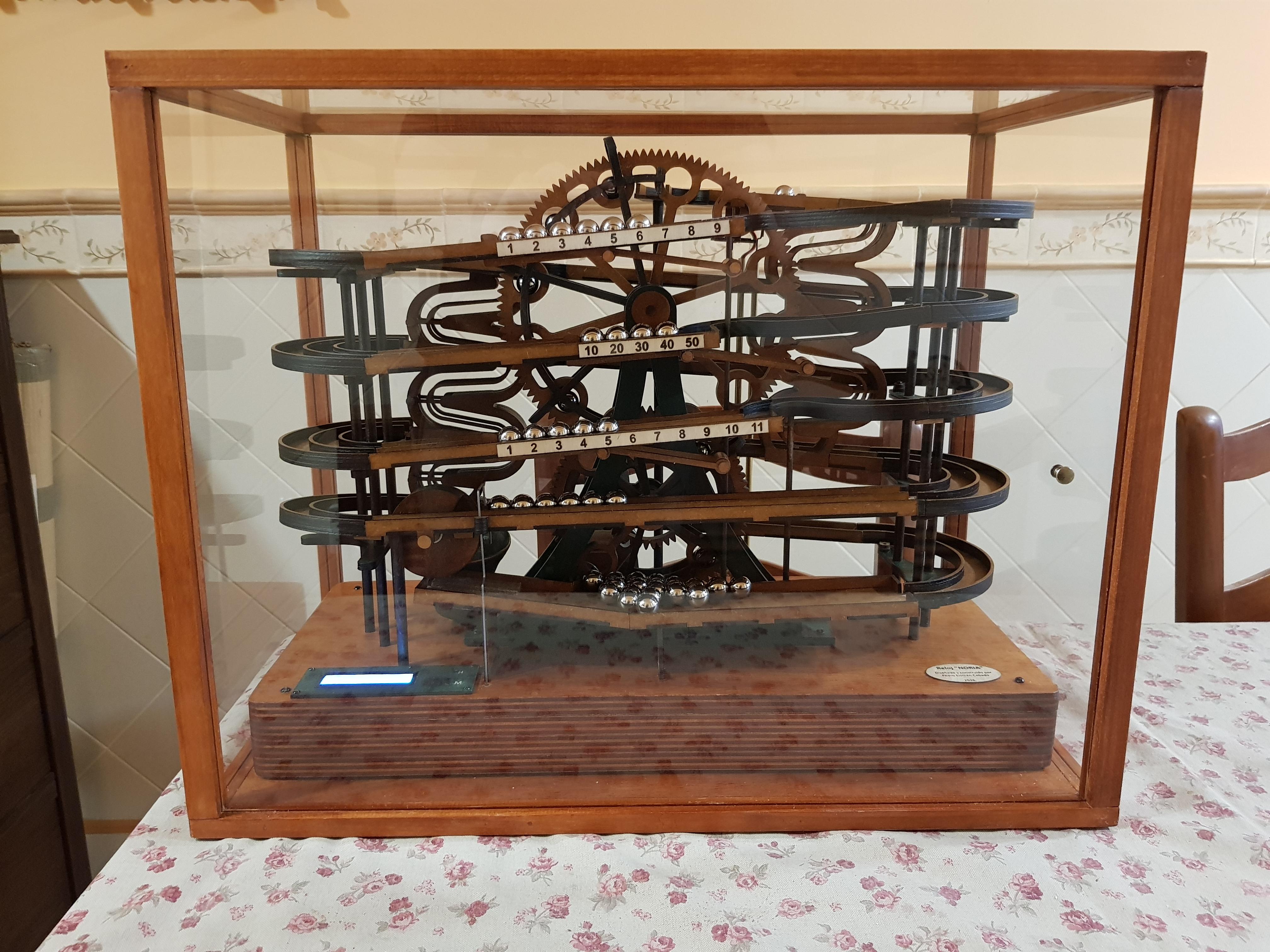
A mi me gusta ponerles una urna a mis mejores modelos para evitar que les entre el polvo. En este caso además la urna ayuda a mitigar el ruido que hacen las bolas. No doy muchos detalles de su fabricación: cuadradillo de samba de 20*20 mm y ranurado en el centro con sierra circular. Las planchas de metacrilato son de 3 mm de espesor.
Bueno, creo que no me dejo nada. Es posible que falte algun detalle en los DXF o que alguna pieza no encaje del todo bien. He hecho muchos ajustes en estos más de dos meses de diseño y construcción y es posible que haya cometido algún error al copiarlas aqui. En cualquier caso, considero que he incluido lo esencial.
Espero que sea de vuestro interés.
I like to put a display case on my best models to keep dust out. In this case, the case also helps to dampen the noise the balls make. I won't go into too much detail about its construction: 20x20mm square samba wood, grooved in the center with my circular saw. The acrylic sheets are 3mm thick.
Well, I think that's all. It's possible that some details are missing from the DXF files or that some pieces don't fit perfectly. I've made many adjustments during these two-plus months of design and building, and it's possible I've made some mistakes copying them into this site. In any case, I believe I've included all the essentials.
I hope you find it interesting.