Prove It!! Mystery "no Moving Part" Water Powered Pump, Pumped 6 Meter High. From 1350 AD to 1800 AD. Is It Possible? Pulser Pumps in Granada Spain
by gaiatechnician in Outside > Water
86 Views, 0 Favorites, 0 Comments
Prove It!! Mystery "no Moving Part" Water Powered Pump, Pumped 6 Meter High. From 1350 AD to 1800 AD. Is It Possible? Pulser Pumps in Granada Spain


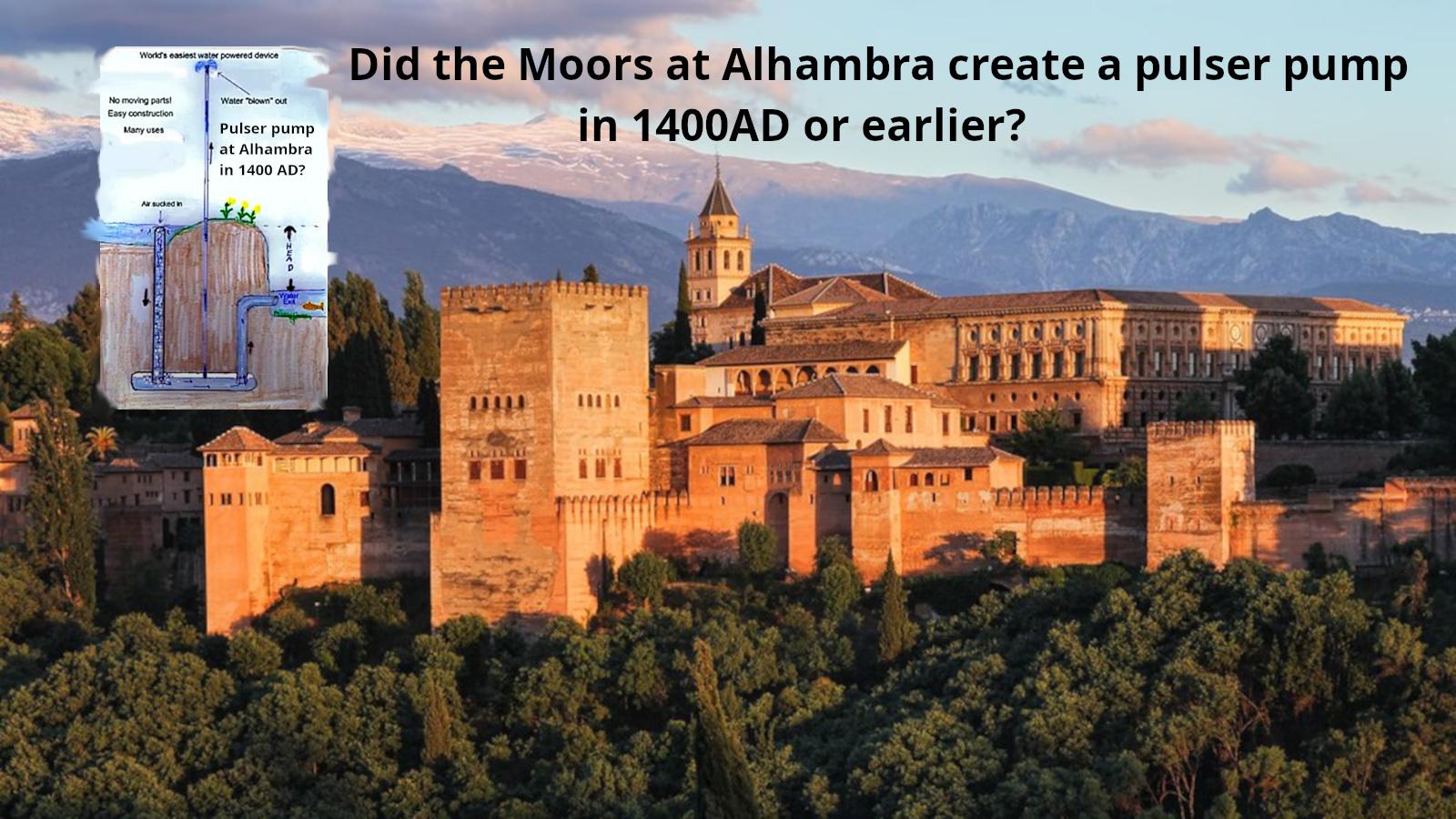
The Alhambra in Granada Spain is one of the most famous castles in the world. The ALcazaba was the Armory where the soldiers were housed. A new water supply system "replaced a unique device (WAS IT A PULSER PUMP?) that had been functioning up to the end of the eighteenth century, after the Christian conquest, being carefully kept up as it was, even though its operating principle was not understood." The mystery pump had no moving parts, and used water power to pump water 6 meters up to the soldiers quarters. for at least 300 years! Knowledge of how the pump worked was lost in 1491 when the Moorish Nazrid dynast were defeated by Christian Castille and they had to leave.
Alcazabas of Antequera and Ronda. Water Elevation without Energy Input
The description of the remains of the artefact that enables the ascent of water to the Alcazaba of the
Alhambra, along with the experiments carried out in the twentieth century, allows us to consider its
presence in other citadels of the Nasrid kingdom. Such could be the case at the Alcazaba of Antequera,
as described above in the Alhambra.
Supplies
4 inch diameter water pipes, 6 inch diameter water pipes. Pipe fittings Plastic containers . 1 inch diameter plastic pipes, preferably rigid. Water flowing at at least 250 liters per minute . The French version of Wikipedia has an excellent set of pages about the Trompe, through history. All my computer web browsers translate it to English really well! https://fr.wikipedia.org/wiki/Trompe_hydraulique It is just amazing, and it is filled with cool old pictures. You should check it out. When trompes were invented or reinvented in Italy around 1650, they were above ground devices and used to produce low pressure air to make steel. Then around 1850, people started to use high pressure trompes underground to make high pressure air to run pneumatic machines. But at none of those stages do they seem to have used medium pressure air to pump water. Almost certainly, that is what the Nasrid dynasty did. But there are gaps in science testing. Nobody has tested medium pressure trompes driving medium pressure airlift pumps. Lets change that!
Combat Misinformation by Building a Full Size Pulser Pump
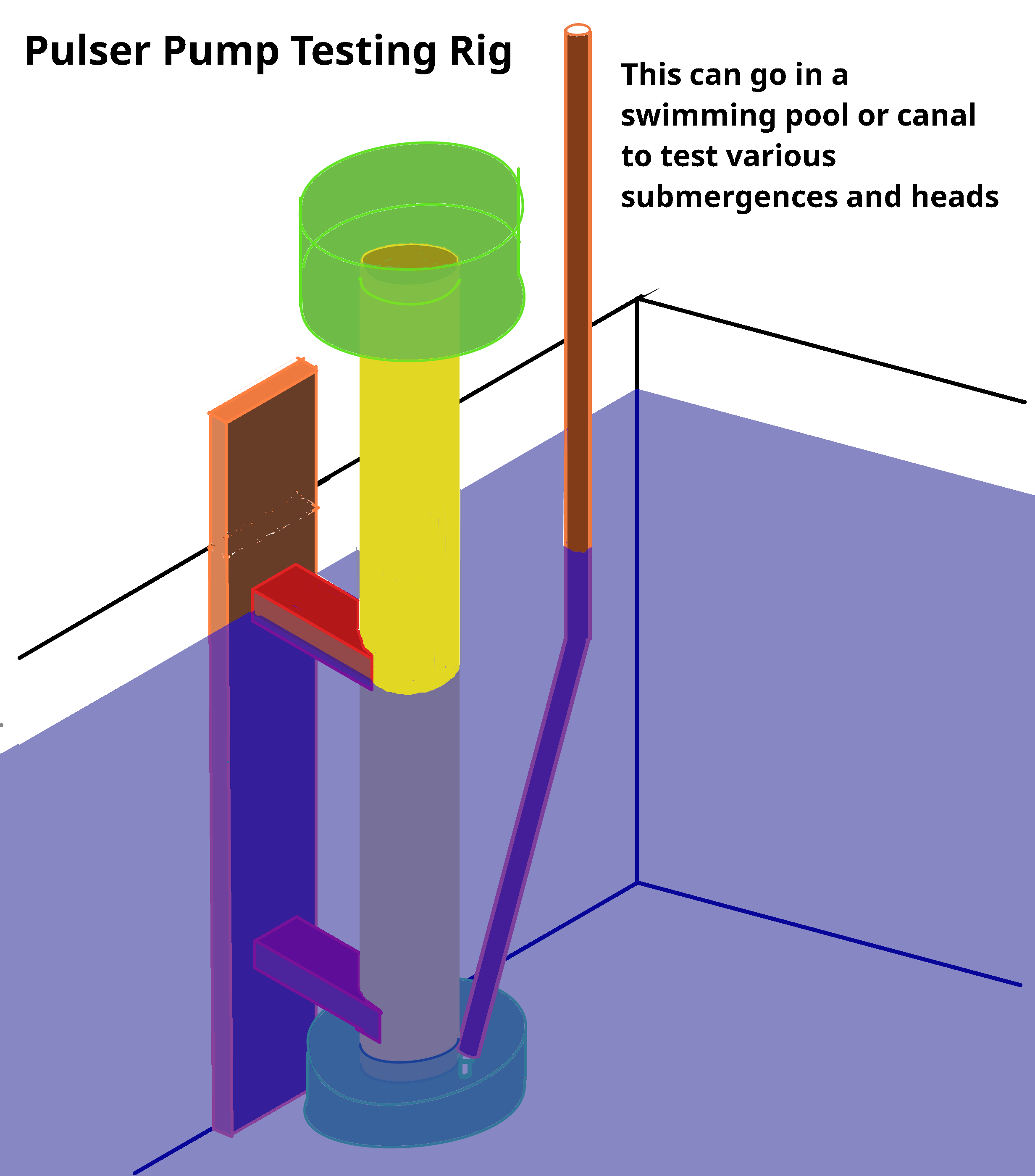
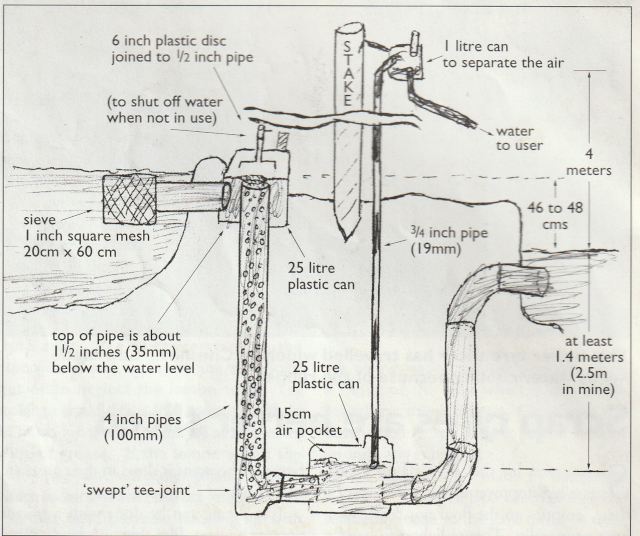
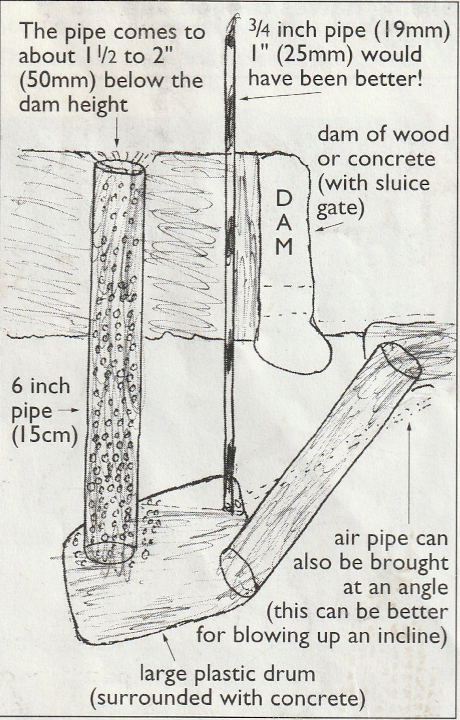

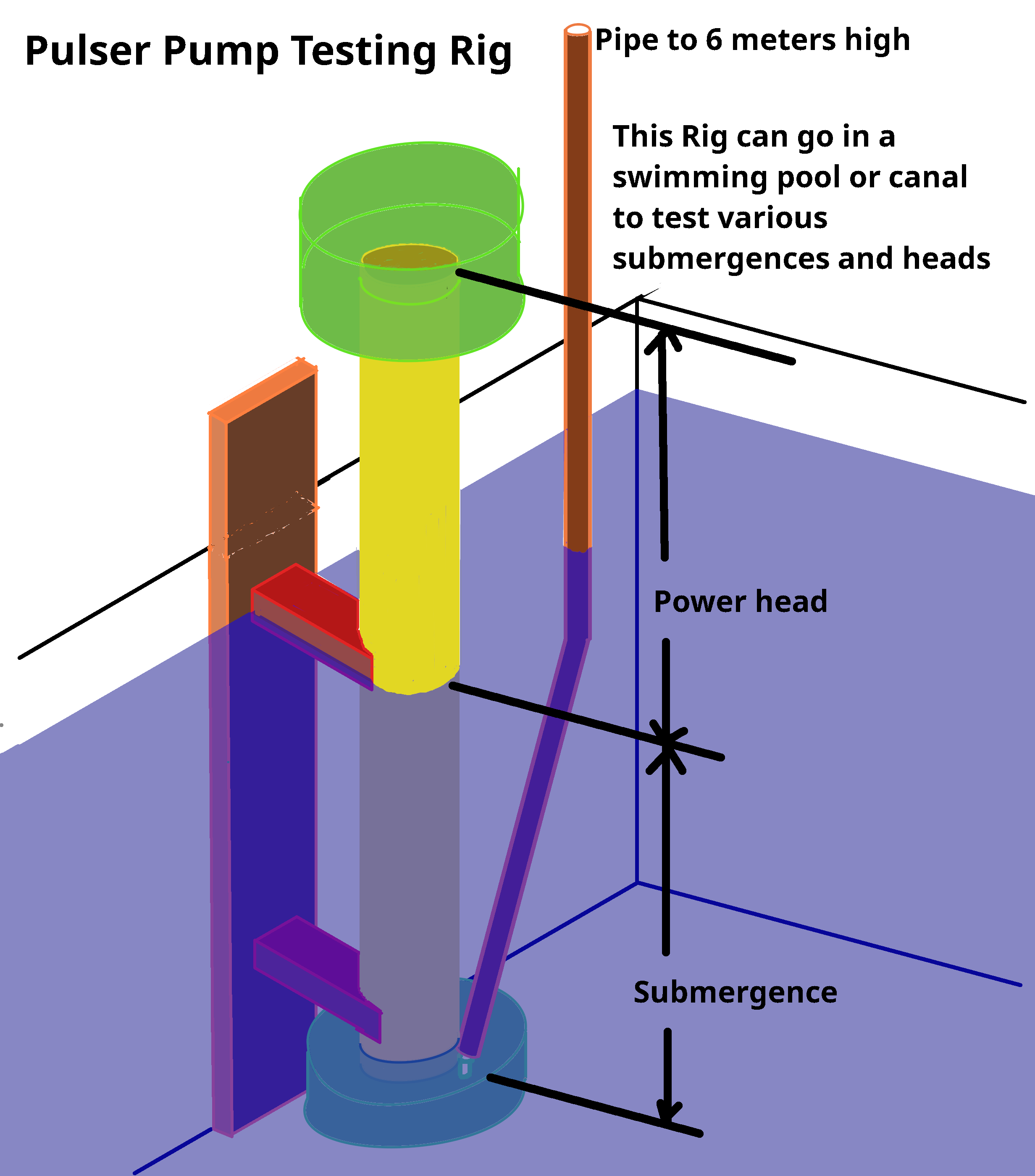
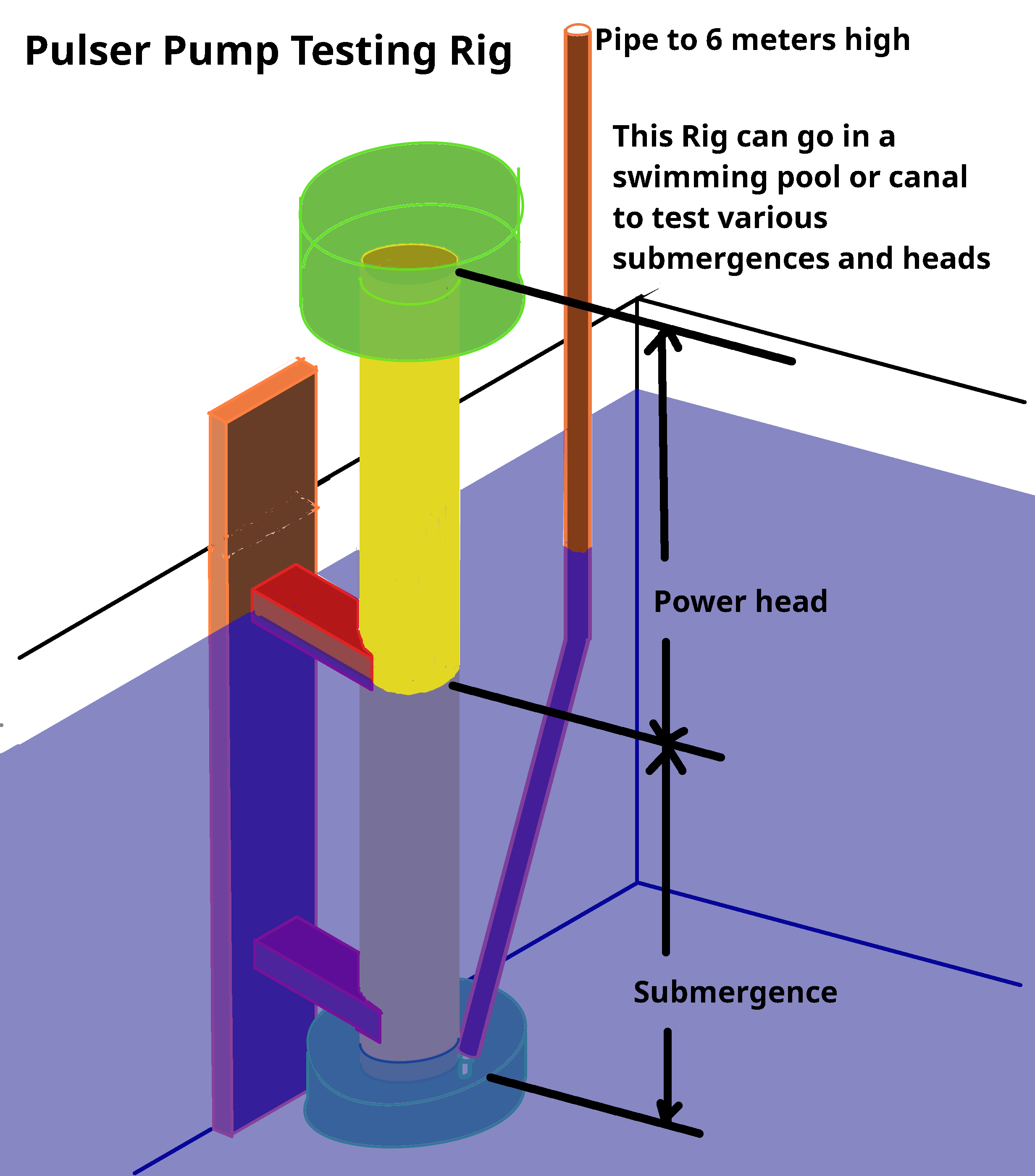
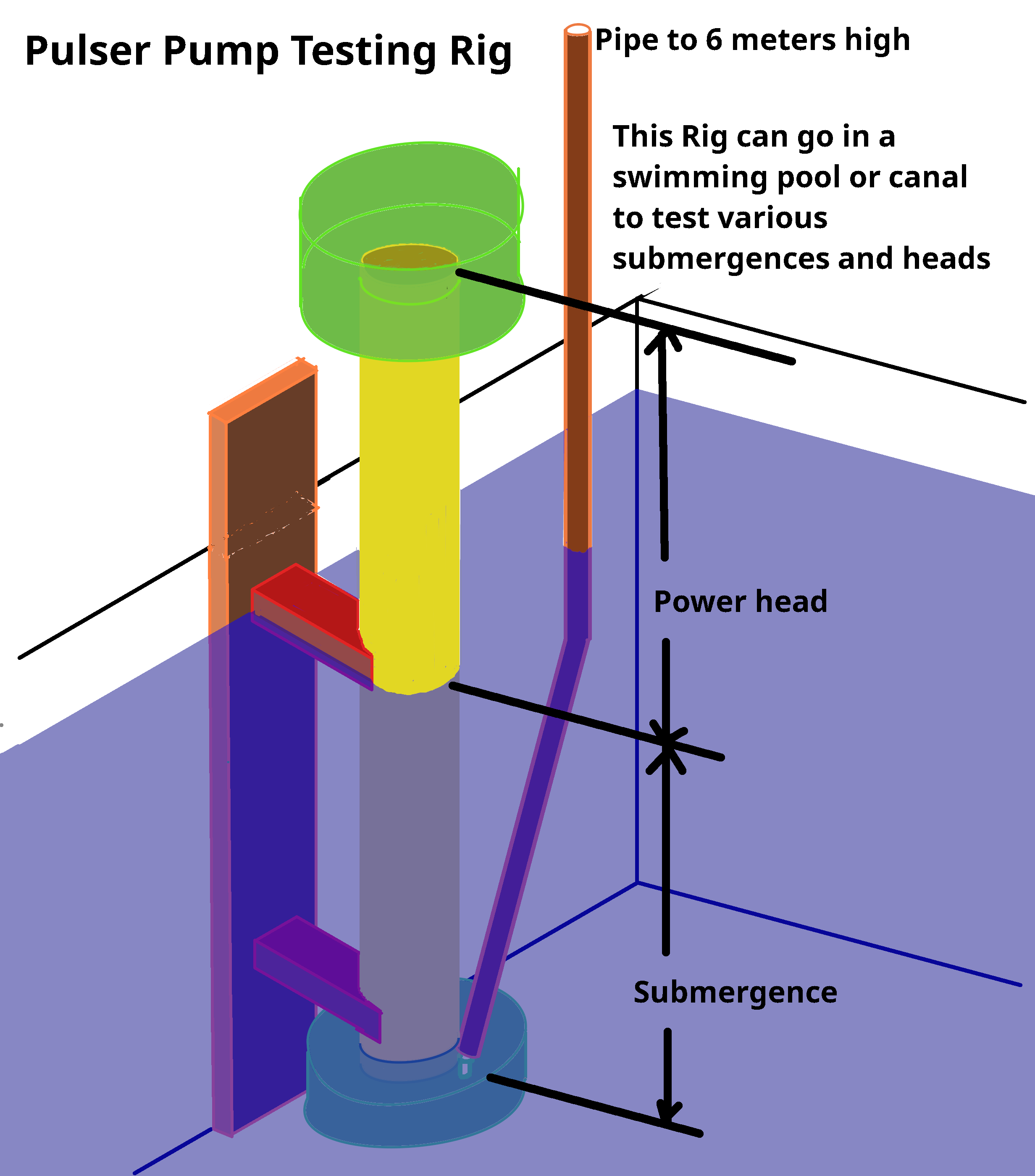
The ideal way to scientifically study the pulser pump is a testing rig similar to my diagram. You can put it in a canal, or a swimming pool or plunge pool under a waterfall and direct a flow of water into the top container. For a 4 inch diameter pipe, you can use 250 to 400 liters per minute of water. If you choose a 6 inch diameter pipe, you can go with 400 to 800 liters per minute approximately. I suggest your submergence should be at least 1.5 meters. (about 5 feet) . About a year ago, someone speculated that the mysterious Alhambra pump with no moving parts was a trompe powering an airlift pump. They got 8 million views on youtube! But they were talking about a "whirlpool" entering the pump, and there was no exit for the power water. It could never have worked in real life like they imagined! So they had animations which contained some impossible features. About a month ago, someone suggested it was a pulser pump and made a small model on youtube. After 2 weeks it had 1.5 million views. There was lots of speculation both during his video and after it in the comments about if and how it works at scale. Also his model has unneeded features and errors that will decrease the efficiency. This is a big problem. You see, when there in no real information, misinformation fills the vacuum. For whatever reason, scientists have never evaluated the pulser pump! The biggest pulser pumps that anyone has ever tested are mine! By me, and that is hardly ideal.
So here is the deal, check out my details and copy one of my designs fairly closely, and try pumping to 6 meters with it. You might end up a little bit famous, because you will have proved that the Alhambra pump was possible! My pulser deep pulser pump and my 6 inch pulser pump have both pumped to 8 meters high, so you should have no issues achieving it! I can't prove it because I am in Canada and they are in Ireland and I don't have a passport. But anyway, it is much better if someone else does the proof! That is the essence of peer review.
A guy made a nice one in England "cornish pulser pump algaeholic 16,463 views 9 Jul 2009
this is a working pulser pump (a model, really as it is such small scale). " And several others made smaller scale ones.
Brief Pulser Pump History Part 1
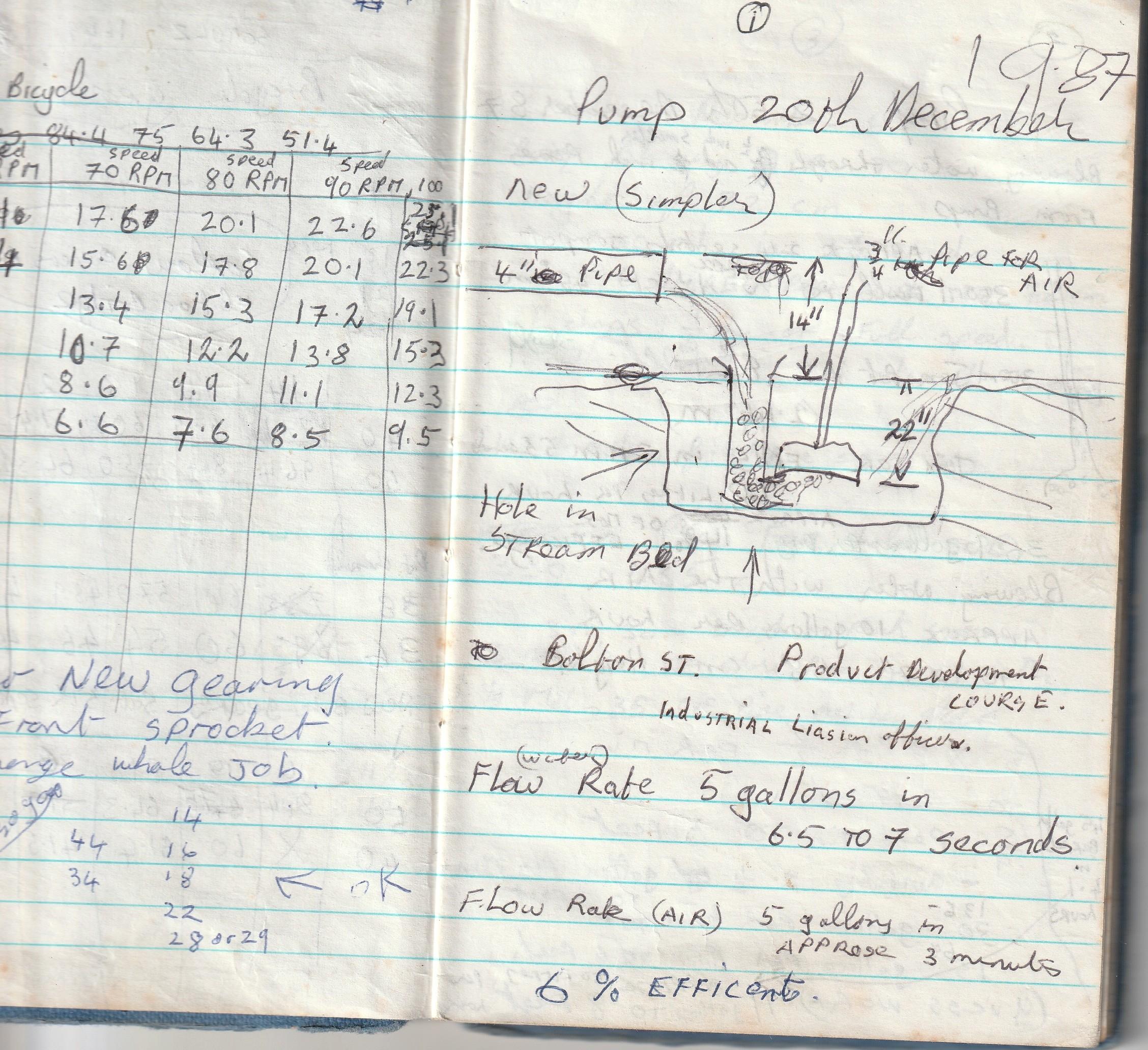
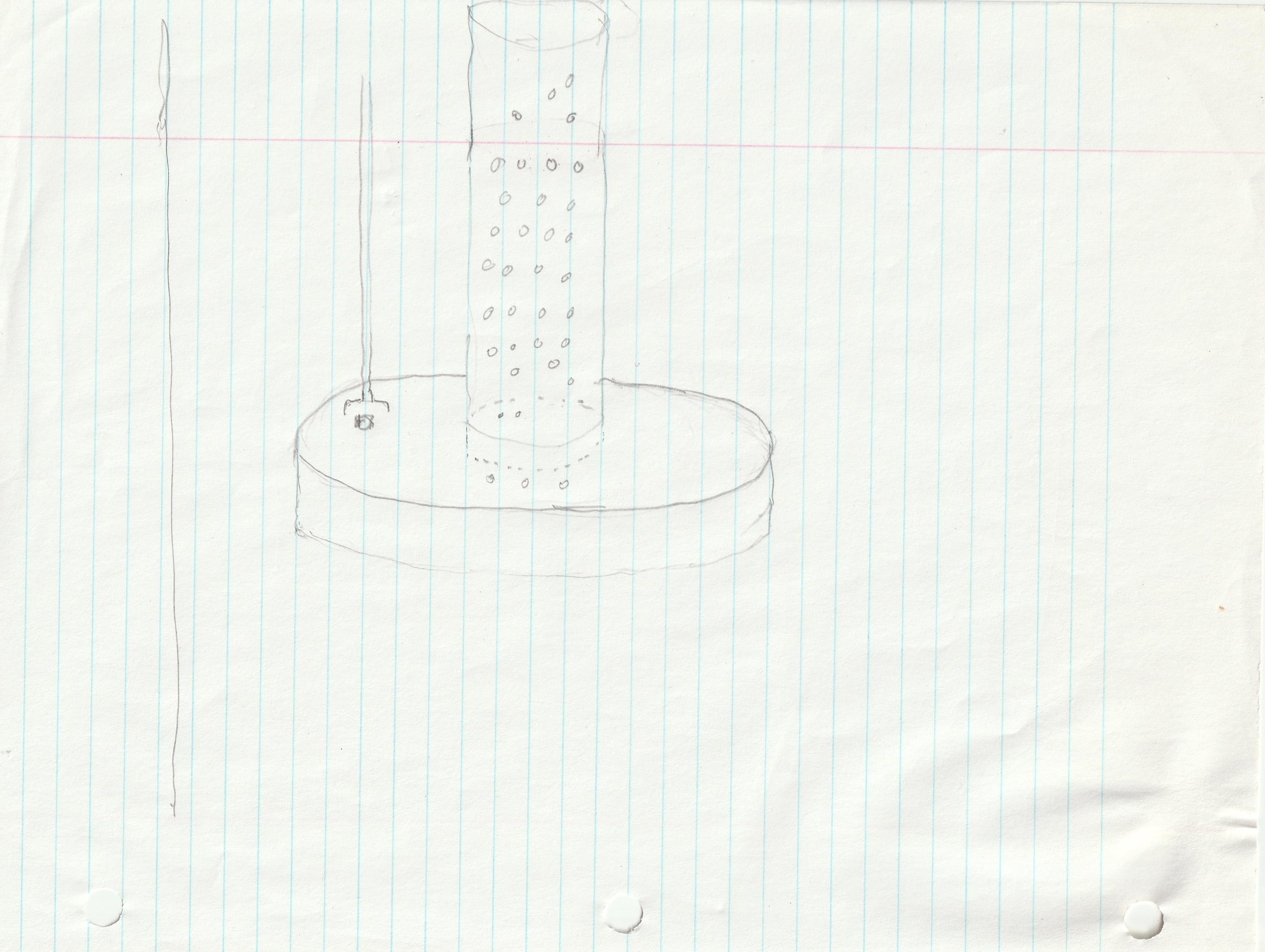
I'm lazy, I always wanted to use water power to water my garden, but the site had very low "head" and flow. I tried make a mini "ram pump" but it only worked for a few hours because we have DUCKS, and they mess up the water when they go looking for food upstream. I discovered the pulser effect by accident in December 1987 when I was trying to collect low pressure air for another experiment. Water was pumped quite quickly to about 6 ft high where I had a barrel to water my garden. This was a complete accident! I found that if your air collection chamber is deeper, the pulsing effect increases, so a few months later, I dug a hole beside the stream and put in a barrel in the hole, so it wouldn't collapse and tested various collectors and pipe sizes.
Part 2 an Underground Pump

Following testing, I built an underground version and continued with that for about another year. I was pumping water to about 15 ft high and letting the water flow down and then up a pipe to the cattle in the shed.
Lessons Learned and 2 New Pumps!
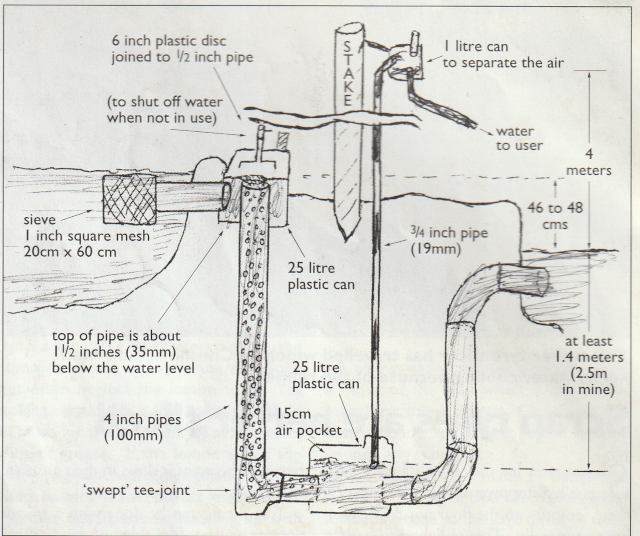
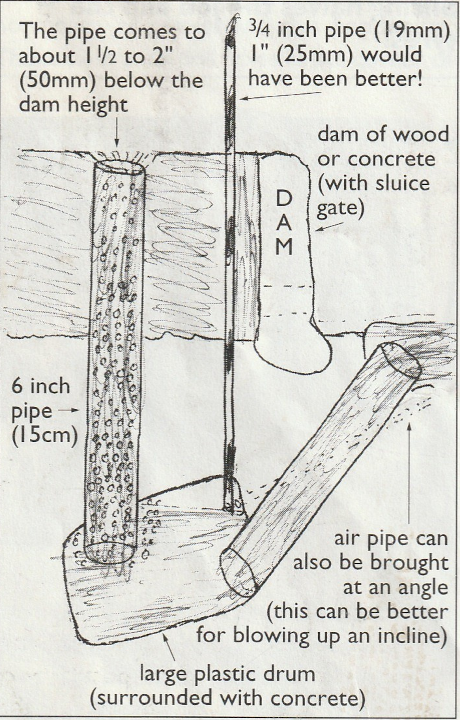
I dug up and recycled parts from the first pump and dug a really deep hole for the next version upstream. Upstream was more suitable, because I could serve animals in 2 different sheds.
Final Version. the Split Process Pulser Pump!
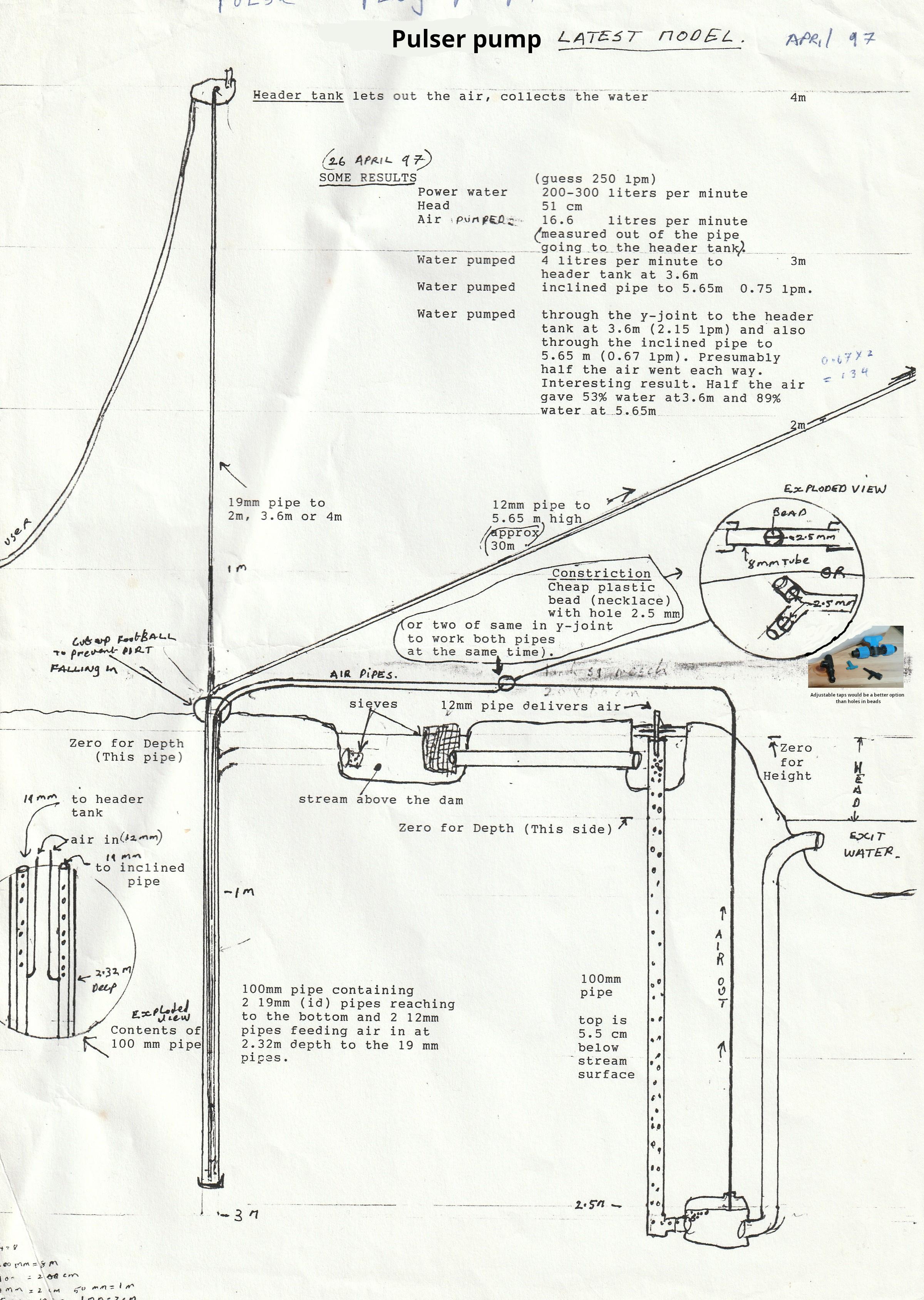
I found this to be the most efficient version. It could provide water to both sheds at the one time.
Return on Investment, Total Cost of Ownership, Efficiency
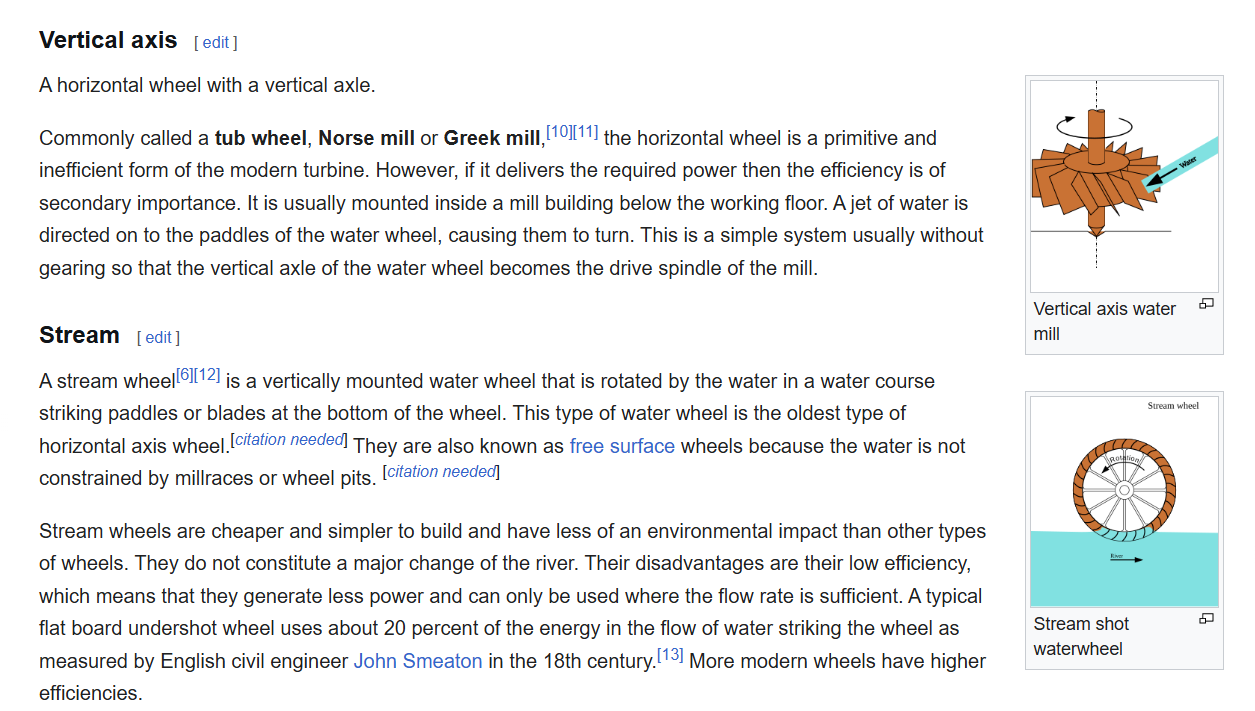
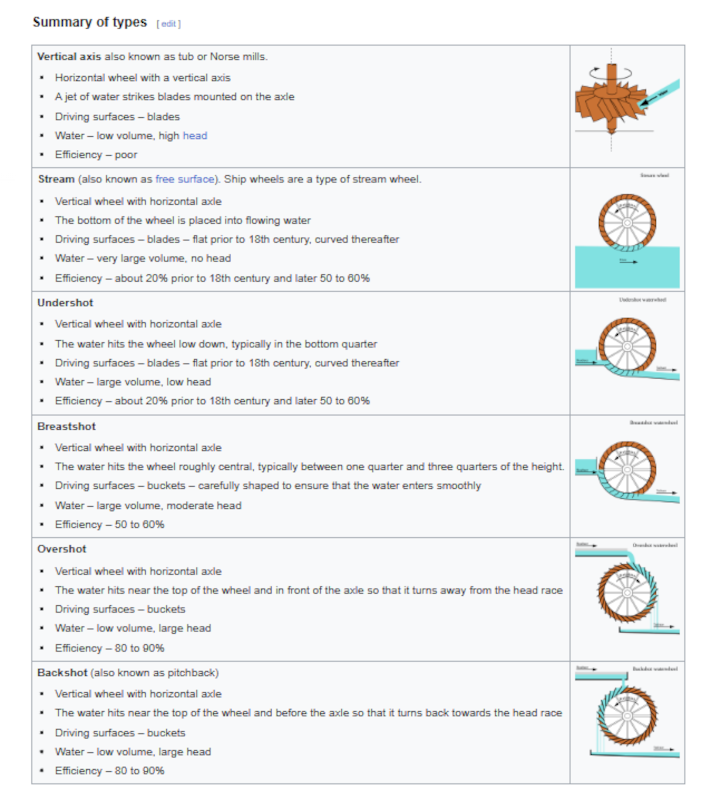
I carefully measured the efficiency of my 2.5 meter deep pulser pump because for a little while I worked as a lab technician in a college and Lecturer Dr. Norman McMillian said it was very important in the interim to get data, even though my site was tiny. They were hopeful that they could test it (as a side project, with funding) when making a new low head mini hydro-electric plant on the Barrow river in Carlow, Ireland. But the plant never happened. 250 to 350 liters per minute falling about half a meter is in hydropower terms, a nothing site. Nobody would ever use it. It was 12.3 percent efficient pumping water to 3.2 meters high, and 6.9% efficient pumping water to 5.3 meters high. (march 1992) And it was about 27.6% efficient producing lightly compressed air. (when I included the volume of air AND the compression it goes up to 34.3% efficient!) These numbers have been used for a bit more than 1/4 of a century by people to make excuses to sit on their hands and NOT investigate pulser pumps. Because even modern vertical waterwheels are 65% to 85% efficient. But here is the thing. You don't see a lot of them about, do you? And here is the other thing, inefficient designs ran for 2000 years at about 20% efficiency! That's right, for 2000 years, waterwheels at 20% were "good enough"! Check the attached screenshots from Wikipedia! Waterwheels were used to power bellows for making steel What might the final efficiency have been there? You can multiply the efficiency of the waterwheel by that of the bellows. I will guess 80% efficient. 0.2 multiplied by 0.8 and you get 16% process efficiency. But my tiny old pulser pump was at over 30%! Indeed, trompes were invented in Italy sometime around 1600 AD, and quickly spread to Spain where they became the Catalan trompe and then they spread to Spanish America. Why? because they were simpler and better than waterwheel bellows for blowing air into the bloomery vessels for making steel! Thought experiment. You have a small river and you want to pump water a few meters high, and you don't wan to spend a lot of money doing it, so it has to be DIY. What do you do? If you put a waterwheel in, it's lots of carpentry. You want to do a turbine, but you are not an electrician. How much do they cost per hour? Meanwhile, putting in a pulser pump means buying some pipes and pipe fittings and digging a pretty deep hole beside the river. After that, you just keep the intake clean and it stays working. After all the guys in the Alhambra just kept their pump working for about 200 years without knowing how it worked! So yeah, before all that can happen, someone needs to make a test rig and produce figures to show what bigger flow rates and bigger heads can do with pulser pumps and trompes. Thanks Brian.
Technology Development, You and Shiny Bright Things!
So, I always thought that it was the job of academia and industry to develop things like the pulser pump. But they and the funding committees are attracted to shiny bright things. They cannot see a commercial angle. But if nobody makes and tests things like the pulser pump, nobody will find better ways to design them or to use them. And rivers oxygen levels will go ever lower and they will fill with toxic blooms every summer. I also did an instructable about vortex power plants, about 12 or 13 years ago, this is a brand new hydropower technology that started around 2006 in Austria. They weren't super efficient but the advantage is they can be made so that fish can travel up and downstream THROUGH the turbine housing, they are simple and they can take a big volume of water! These plants are low head hydro that actually do use a whirlpool to produce power. In that case the turbine blades destroy the whirlpool and this is what transmits the power to the generator. Nobody got inspired by that instructable. Now the efficiency of gravitational vortex plants is on the rise and there are about 4 companies worldwide that have cornered the gravitational vortex market! How did they do it? They improved the design of the turbine blades. And that is exactly what I suggested we do as amateurs more than a decade ago!
Testing Rig Is Better Than Theorizing!
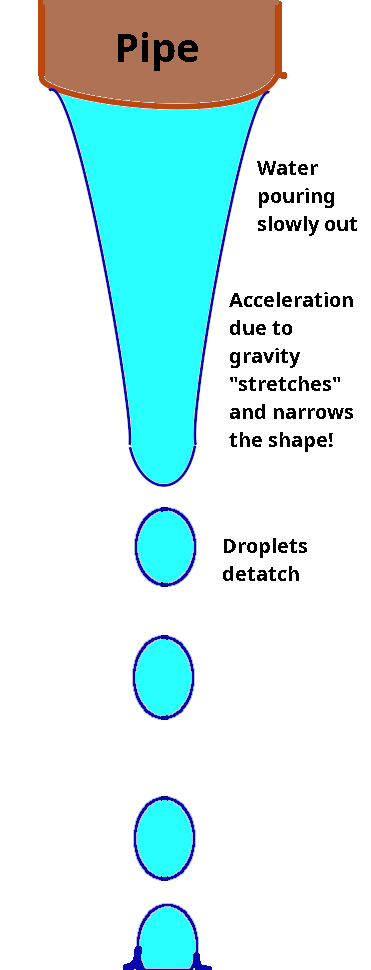
If you look at water coming slowly straight down from a tap in your kitchen, or a hose in the garden the profile has a shape a bit like in the diagram. The water elongates before breaking into droplets. This elongation is because of acceleration due to gravity. The lower part is going faster than the top part so it has to narrow! In a trompe pipe, it cannot narrow, but it must still accelerate, so it draws in air to take up the empty space. So now you got water traveling down and air bubbles in the water. This is very hard to model. For instance
it takes water 0.319 seconds to fall half a meter, and it reaches a speed of 3.1 meters per second
it takes it 0.45 seconds to fall one meter and it reaches a speed of 4,41 meters per second
it takes water 0.55 seconds to fall 1.5 meters and it reaches a speed of 5.39 meters per second
It takes water 0.64 seconds to fall 2 meters and it reaches a speed of 6.2 meters per second.
Notice that the times and the speeds are not progressing linearly! And the velocity after falling 2 meters is just twice that of when it falls half a meter, even though that water contains 4 times the kinetic energy!
What happens when water going twice as fast is going down a pipe with air bubbles mixed in? Do the bubbles get smaller? is more energy lost in turbulence? and what happens at the bottom when the bubbly mixture reaches the separation chamber? Will the air easily separate out or will the fast water bring the air out past the separation chamber? Again, only a test rig can answer questions like this.
Equations of Motion and Energy and Power
Potential energy formula is m g h m is Mass in kg, g acceleration due to gravity 9.8 ms^-2 and h distance that it falls in meters m. This gives the energy in joules. If you want watts, you need to find out how much is falling pre second. So divide the joules answer by seconds taken.
Equations of motion .
The three equations of motion for objects experiencing constant acceleration are
: v=u+at
s=ut+ 1/2at^2
and
v^2=u^2+2as
Where s is displacement or distance travelled,
u is initial velocity,
v is final velocity,
t is time,
and a is acceleration
Distance travelled s is measured in meters
Time t is measured in seconds
u velocity is measured in meters per second ms^-1
a acceleration is measured in meters per second squared ms^-2
^ means “to the power of”
There are nicer ways of writing these formulae as fractions, but it isn’t so easy to write these in text format.