How to Build a Dim Bulb Tester
by ojmerc08 in Circuits > Electronics
16 Views, 0 Favorites, 0 Comments
How to Build a Dim Bulb Tester
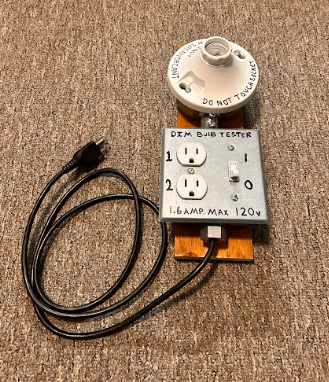
A dim bulb tester is a simple device used to test for shorts, typically when powering older equipment with hard to find parts that cannot risk being damaged. A dim bulb tester can also help protect the equipment from damage due to a short. Building a dim bulb tester is a good beginner electronics project that most people with a basic understanding of electricity can build. In today's blog, I am going to show you step by step how to construct your own.
In its simplest form, a dim bulb tester is an incandescent lightbulb connected in series with the equipment you are testing. When connected to mains voltage, the current load of the equipment passes through the filament of the bulb, causing it to glow dimly. If a short is present in the equipment circuitry, the resistance will drop, causing the bulb to become brighter. This does two things: one, the bright glow indicates that there is a short present and two, the bulb will act as a resistor, which can help protect the equipment from damage. Since the load is drawn through the filament of the bulb, a fairly high wattage bulb is usually required. I built my tester with the intent of using a 200 Watt bulb. It is also important to note that the bulb must be of the incandescent type, or the tester will not function.
Supplies
This project involves mains voltage which can easily harm or kill you if you do not handle it correctly. Please take the proper precautions and be careful. I do not take any responsibility for your actions. Most of the components for the tester can be bought at almost any hardware store. A list of the parts to build my exact tester is provided below.
- 3 conductor cord with plug (mine is 18awg)
- 2 gang metal box
- Cable strain relief connector
- 15 amp duplex (or single-plex) receptacle
- 15 amp single pole light switch
- Duplex and switch metal cover
- Metal octagon box
- A-15 screw in socket base
- Incandescent light bulb (wattage explained later)
- 1x4 pine board (mine is like 12”)
- Various connectors, hardware, screws etc.
.jpg)
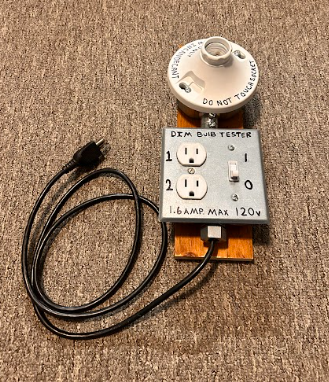
First, I like to put the connectors on my boxes and get them mounted to the board. I put my strain relief connector on the 2 gang metal box and then connected the 2 gang box to the octagon box using two conduit connectors and a short length of EMT. I recommend just getting a short rigid conduit nipple to connect the boxes, but I did not have one on hand. Next, I put my mains cord into the strain relief connector. My mains cable is an IEC cable for a computer power supply that I cut the end off. You should use a cord that is of a much higher current rating than what you plan to run through the tester. I used an 18 Awg cord which can typically handle 10 amps, but I am only planning to run 1.6 amps max through this tester. It is important to bond the ground wire of the cord to the box, as well as the receptacle and switch. After putting the mains cord into the strain relief, the tester should be wired according to the circuit diagram below.
As for choosing the wattage rating of your bulb, it should be rated for slightly higher wattage than the draw of the equipment being tested. For instance, if you are testing a piece of equipment that draws 1 amp at 120 volts, you will need a bulb rated for more than 120 watts (1 times 120 is 120.) I was able to pick up a 200 watt bulb from my local dollar store. If we divide 200 watts by 120 volts, we find that this bulb can handle a maximum load of 1.6 amps.
This concludes my blog on how to build a dim bulb tester. I attached some images of my tester that I built below. I hope that this helps someone or at least gives them a good read. I plan to create more blog articles soon, so please check those out when they are posted. Thank you and have a good week. ~