2025 Aluminum Alloy Design Competition - Nightmare on Alloy Street
by Nightmare on Alloy Street in Workshop > Metalworking
94 Views, 0 Favorites, 0 Comments
2025 Aluminum Alloy Design Competition - Nightmare on Alloy Street
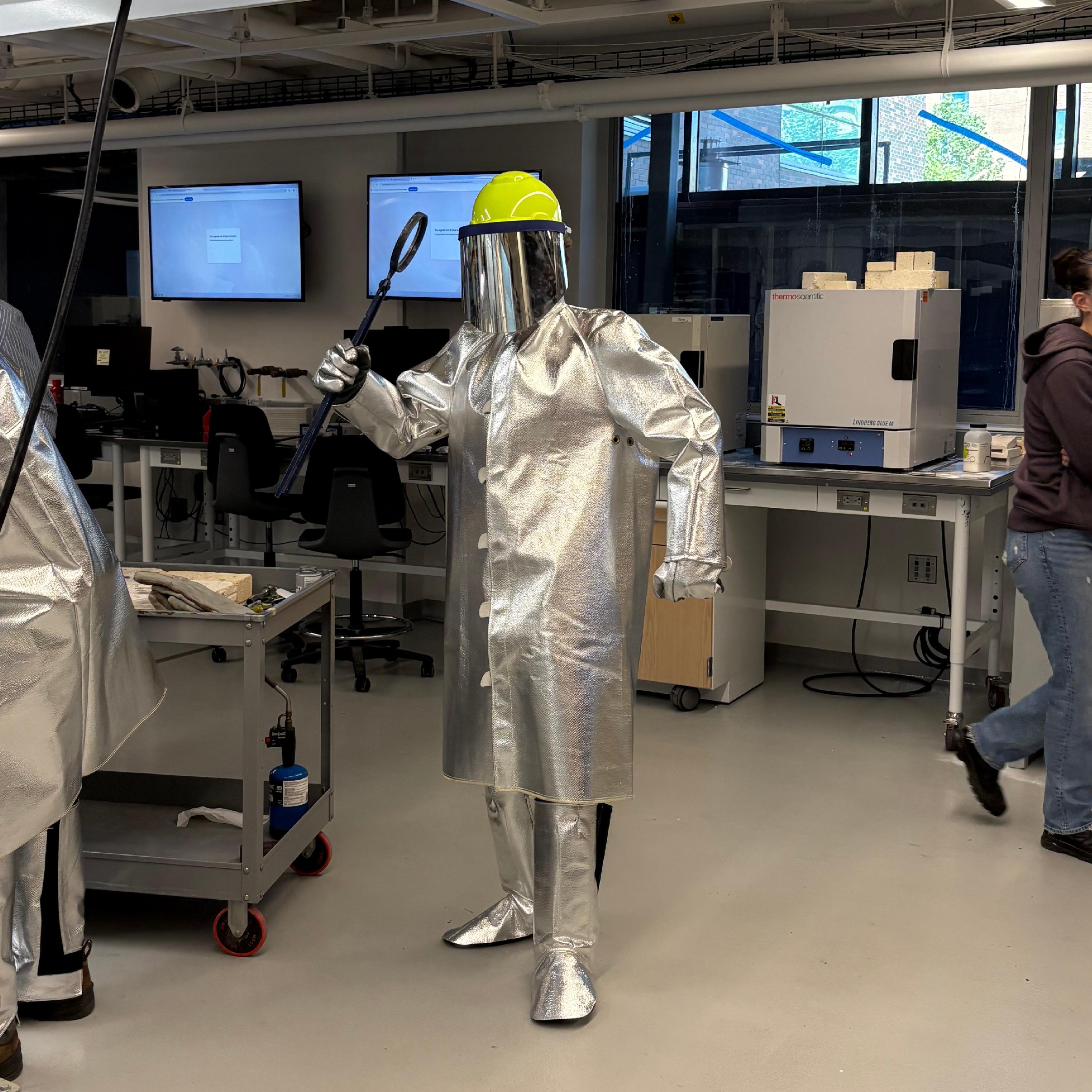
The Aluminum Alloy Design Competition challenged 9 teams to design an alloy with the best possible combination of yield strength, ductility, and electroconductivity while following specific requirements and time constraints. Each team was tasked with developing a unique composition and thermomechanical processing route for their individual alloy, controlling all variables within reasonable limits.
The competition was held on October 31st, 2025. Scoring was based on the product of the three normalized values to encourage decent performance across all categories. A bonus competition evaluates our alloy's corrosion resistance by measuring weight loss after two weeks of exposure to saltwater.
Below are the steps that Team 8 took to achieve our desired alloy. Our final product was a 7475 Aluminum alloy with a T65 treatment that received a total score of 381,455 and finished 2nd in the main competition.
Supplies
Alloying Materials:
Teams were provided with master-alloy forms of each permitted element:
- Aluminum: Commercially Pure pieces and shot
- Copper: 99.9% Cu shot
- Zinc: 99.9% Zn shot
- Silicon: 50% Al - 50% Si master alloy
- Magnesium: 50% Mg - 50% Al master alloy
- Iron: 10% Fe in aluminum
- Titanium: 6% Ti in aluminum
- Nickel: 20% Ni in aluminum
- Chromium: 20% Cr in aluminum
- Manganese: 60% Mn - 40% Al master alloy
Equipment:
- Casting: Mettler Toledo scale, Heat resistant PPE, RDO induction furnace, book billet mold
- Thermomechanical Processing (homogenization, solution heat treating, artificial aging): IRM 2-high rolling mill, IRM push through preheating furnace, Thermoscientific Lindberg Blue M furnace
- Metallography: Buehler SimpliMet 4000 mounting system, bakelite, Buehler EcoMet 30 polishing station, sandpaper, 6 µm diamond paste with diamond extender on a Pan-W cloth, 3 µm diamond paste with diamond extender on a Pan-W cloth, 0.05 µm colloidal silica and water on an imperial cloth
- Optical Microscopy: Olympus GX53 brightfield optical microscope, PAXcam microscope camera and imaging software
- Corrosion: VWR Symphony Ultrasonic cleaner
- Testing:
- Hardness: Rockwell 574 hardness tester
- Tensile: MTS Criterion Model 43 tensile testing machine
- Electrical Conductivity: ZETEC DC-2 electrical conductivity meter
Standards:
- Thermomechanical Processing (homogenization, solution heat treating, artificial aging): ASTM B918-17A
- Metallography: ASTM E3-11 (2017)
- Optical Microscopy: ASTM E883-17
- Etching: ASTM E407-07, Papageorge 2-step etching procedure
- Testing:
- Hardness: ASTM E18-22
- Tensile: ASTM B557-15, ASTM B918-17, ASTM E8-16
Materials Selection and Processing Online Resources:
- CES Selector / ANSYS Granta
- ASM Handbook Online
- Heat Treater's Guide: Practices and Procedures for Nonferrous Alloys
- Primer on Flat Rolling (2nd Edition)
- Various academic articles and technical reports used when researching Team 8's chosen alloy
Technical Staff & Support:
Teams had access to professional instructors for equipment operation and supervision:
- Elvin Beach - Course instructor
- Pete Fallon - Foundry operations, rolling, heat treating, and mechanical testing
- Wayne Papageorge - Metallography, optical microscopy, hardness testing, and electrical conductivity
- Graduate TAs: Nicole Hudak, Liz Kuebel, and Ziyao Su
Material Selection and Proposal


Material requirements:
- Final alloy composition must contain at least 90% Aluminum
- Must only use the materials listed
- Must be rolled to 2-3 mm for Metallography/Optical Microscopy
- Attempt to maximize 0.2% offset yield strength, total elongation, and electrical conductivity
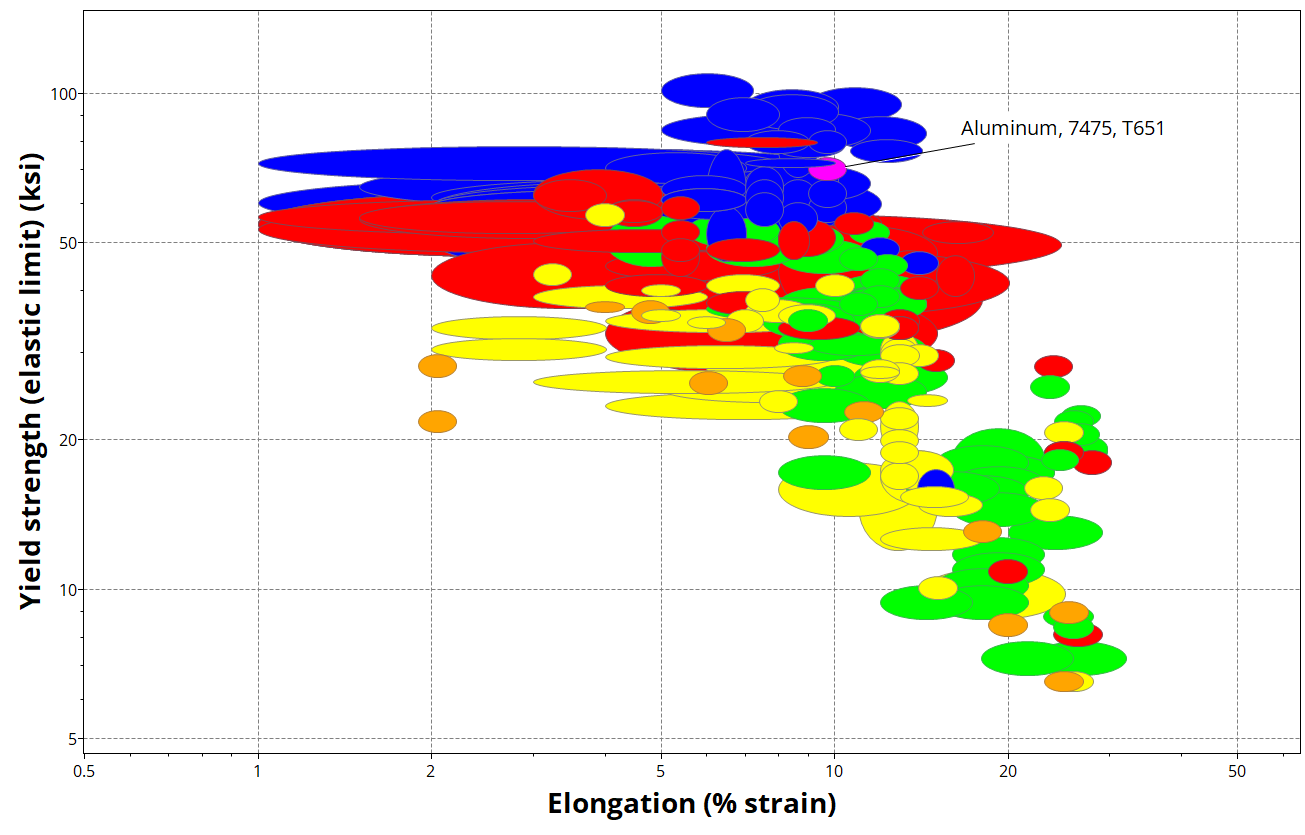
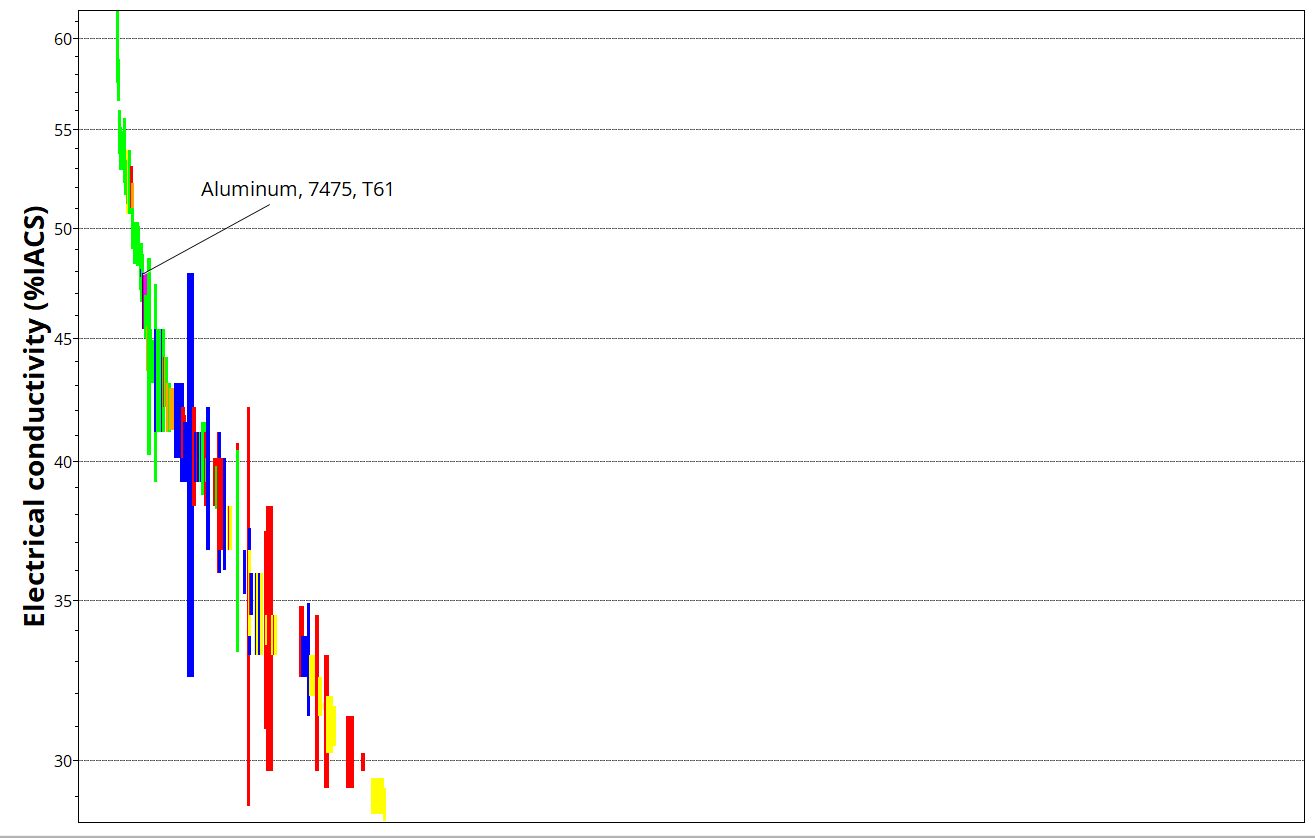
SELECTION: 7475 aluminum, T651 temper
This alloy is part of the Al-Zn-Mg 7xxx series, known for high strength and decent fracture toughness. Compared to similar alloys, ours offers a balance of strength, toughness, and fatigue resistance.
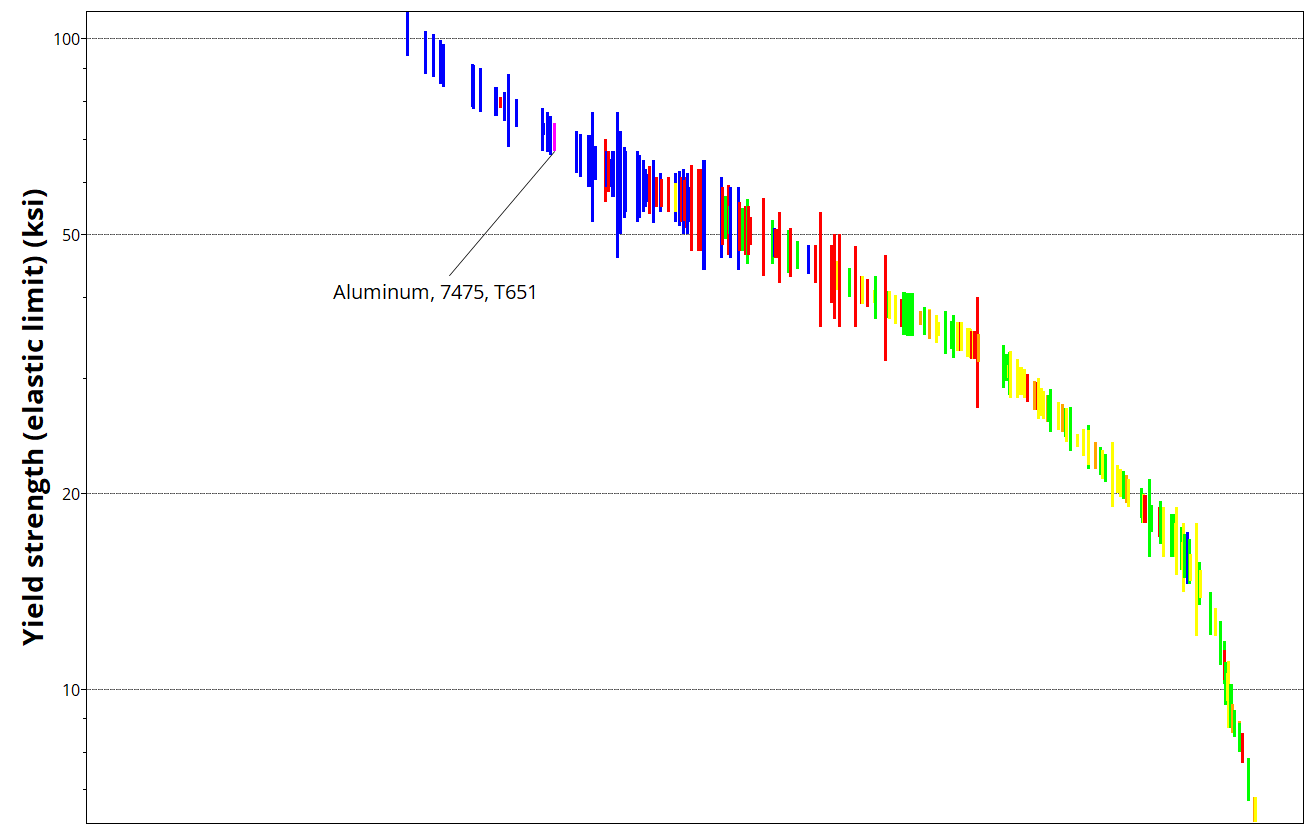
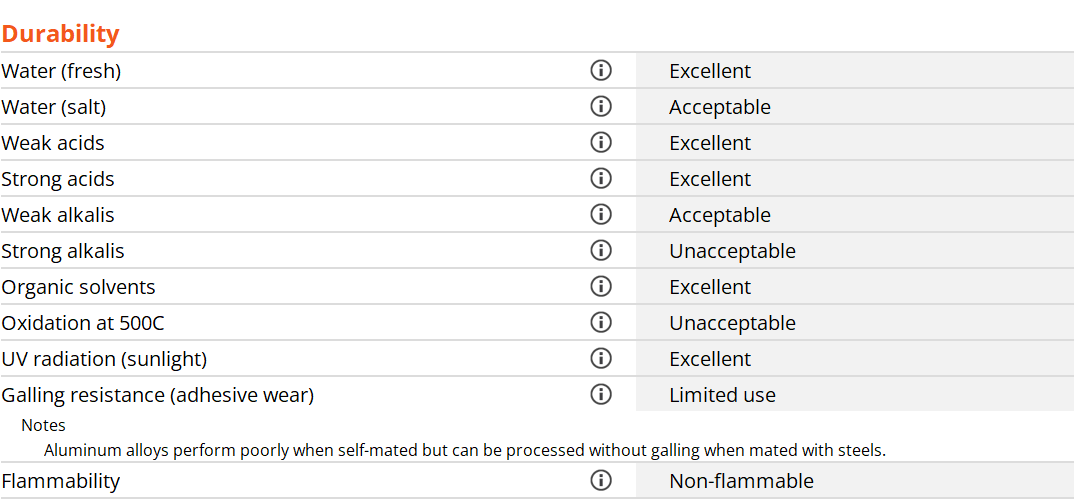
To make this decision we used the Granta software to compare mechanical and physical properties between 5xxx, 6xxx, and 7xxx series alloys. From here we narrowed our selection to a few 7xxx and 6xxx and carefully determined that 7475-T651 provided strong performance in all three categories without sacrificing one for another.
7475-T651 showed high yield strength (67-74 ksi), moderate ductility (9-10.5% elongation), and above average electrical conductivity (45-48% IACS) which placed it among the most balanced of the alloys considered. It also allowed for compositional tuning within the standard limits.
With the aid of research on similar alloy construction, our thermomechanical processing plan began as follows with important changes made and discussed in the following sections:
- Initial casting
- Cold rolling to thickness of 2-3mm
- Solution heat treatment: 460-499°C, holding for 40 minutes, quenching within 15 seconds of retrieving from furnace
- Cold rolled to relieve internal stress using a non-zero pass
- Artificial aging: 110-127°C, 22 hours
Our proposed composition:
- Al (aluminum): 90wt%
- Cr (chromium): 0.2wt%
- to improve stress-corrosion resistance
- Cu (copper): 1.9wt%
- maximize strength
- Mg (magnesium): 2.2wt%
- to strengthen through precipitation
- Zn (zinc): 5.7wt%
- to strengthen through precipitation and aid quench sensitivity
Casting

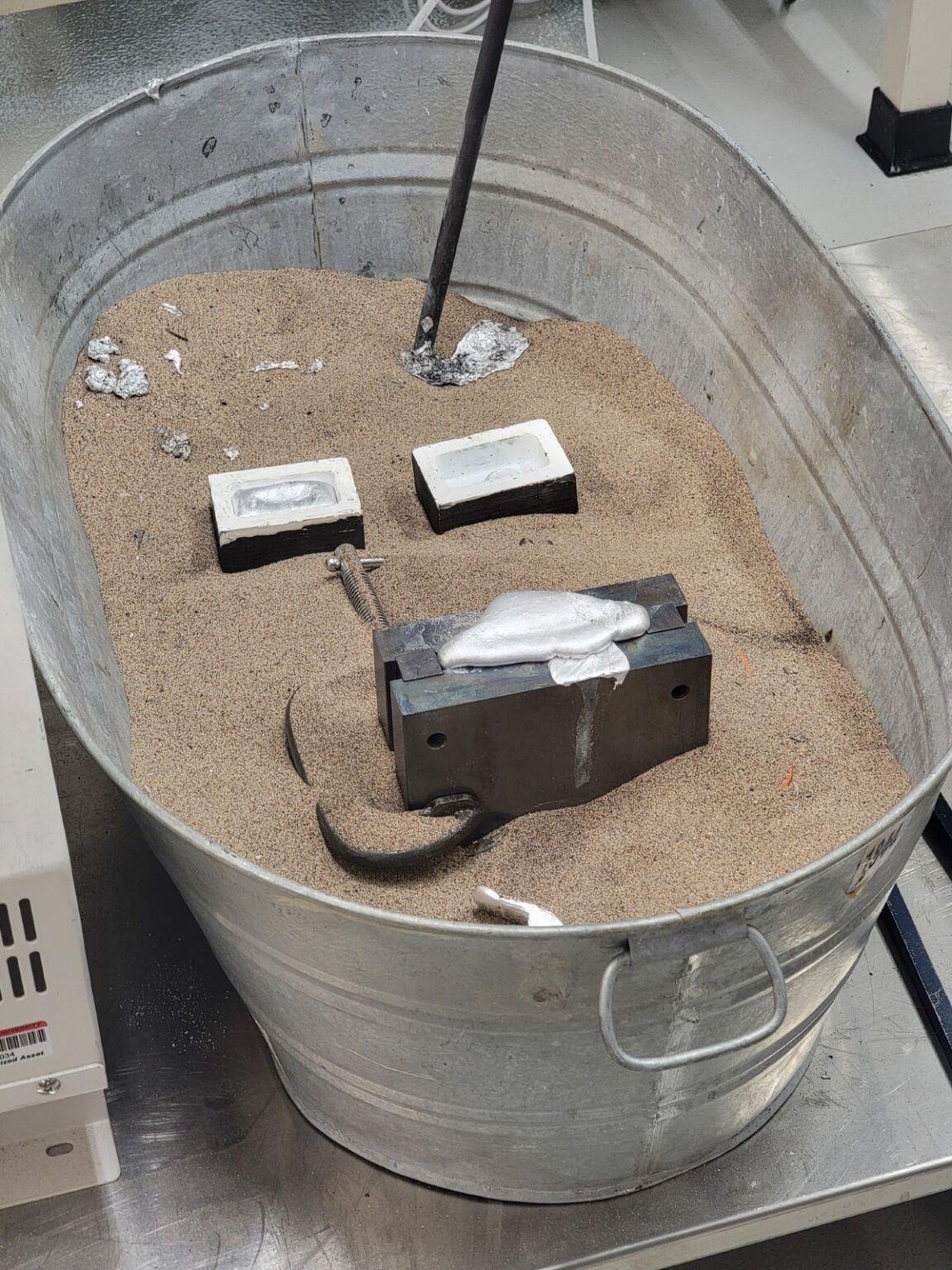
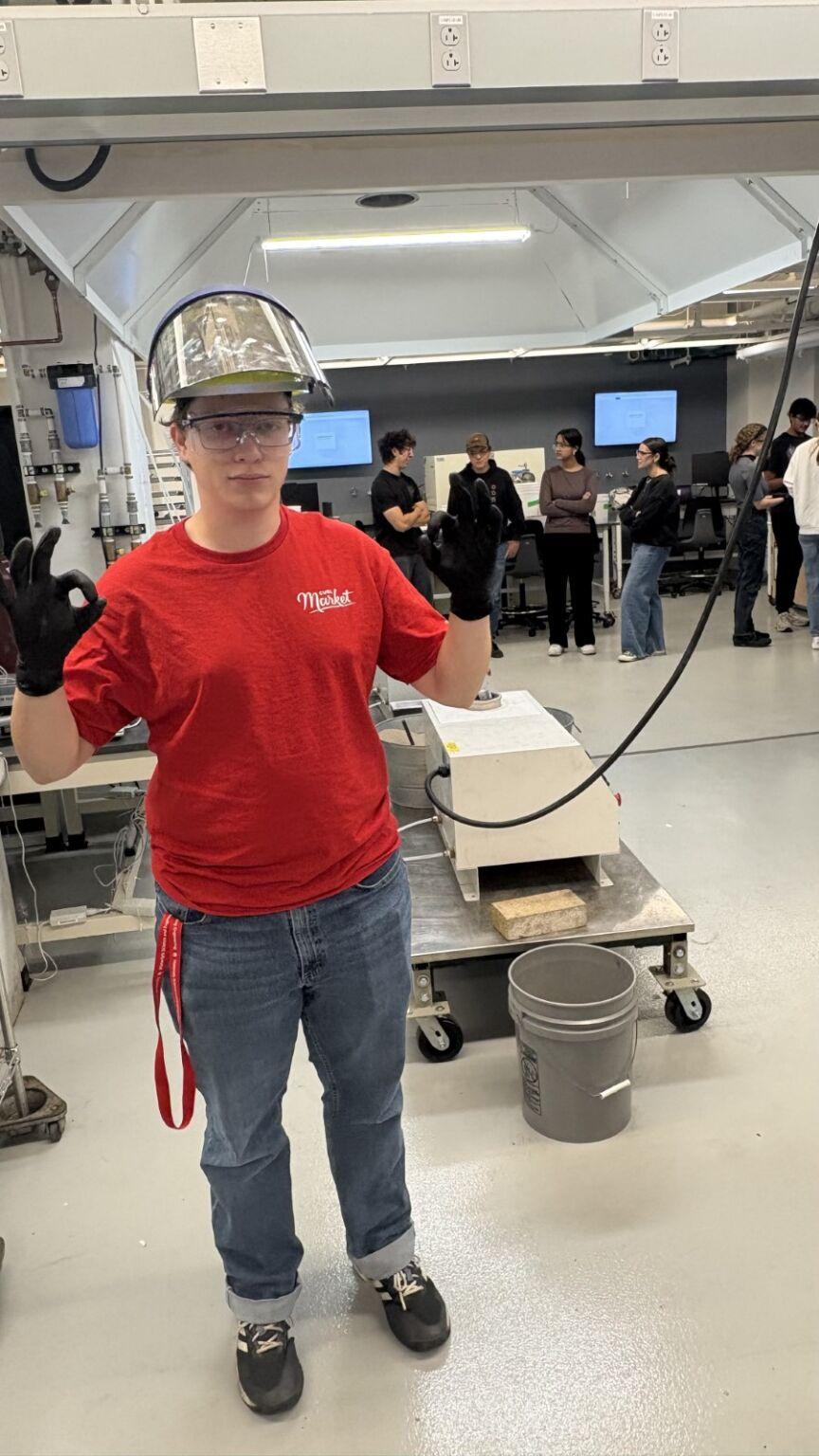
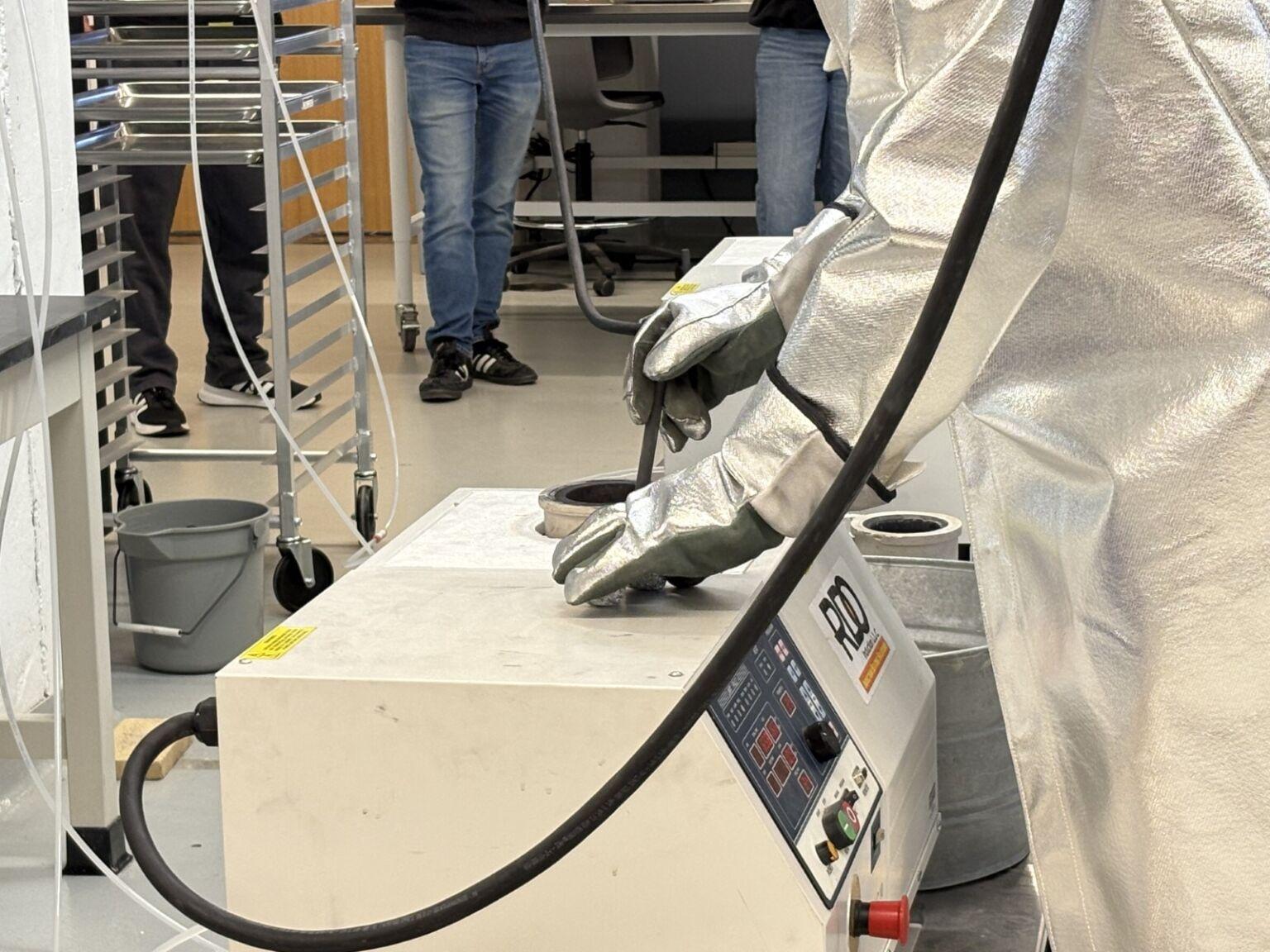

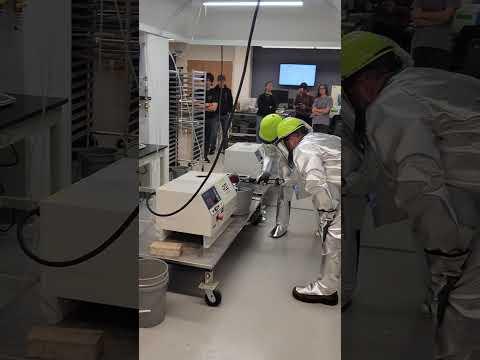
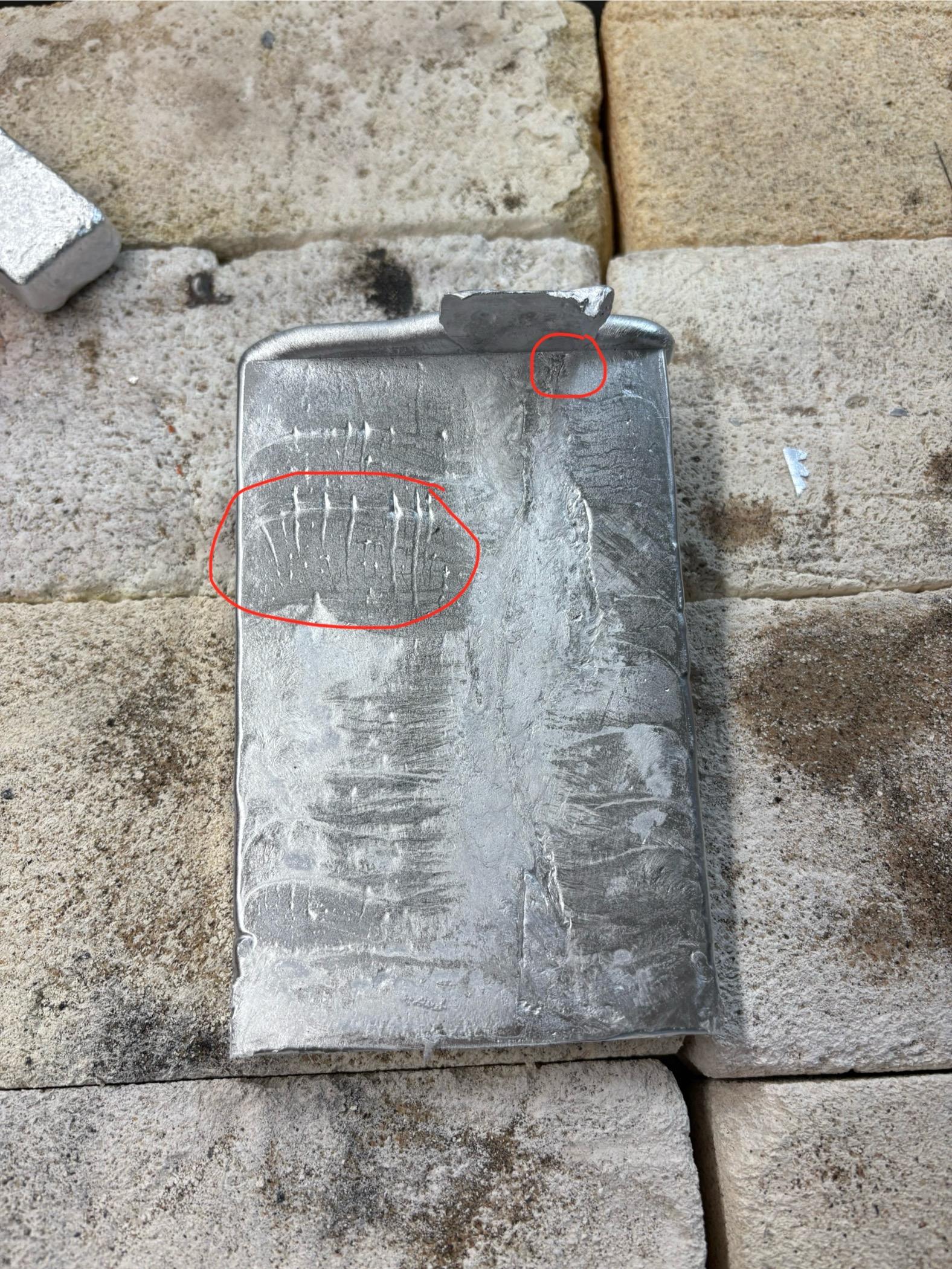
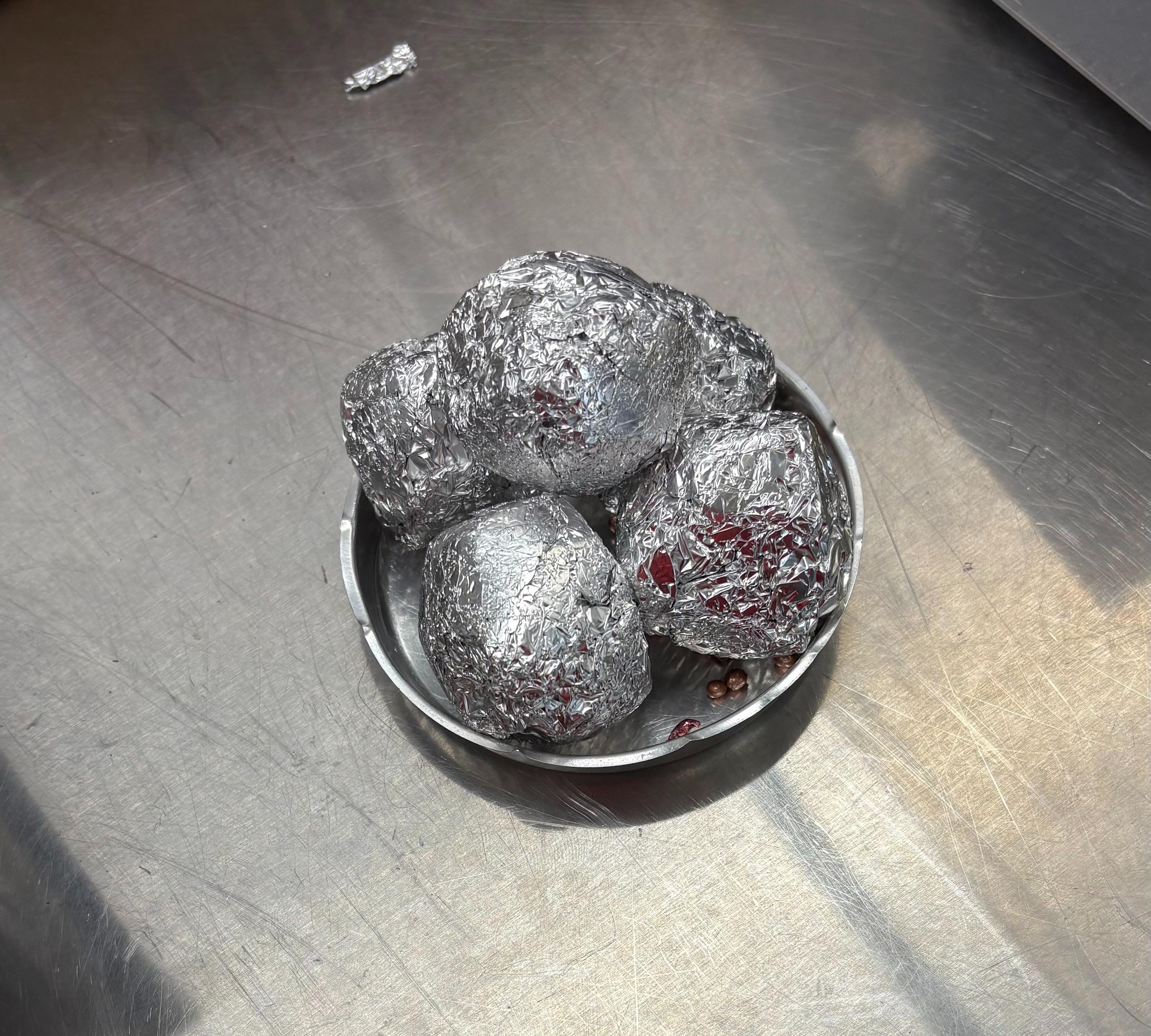
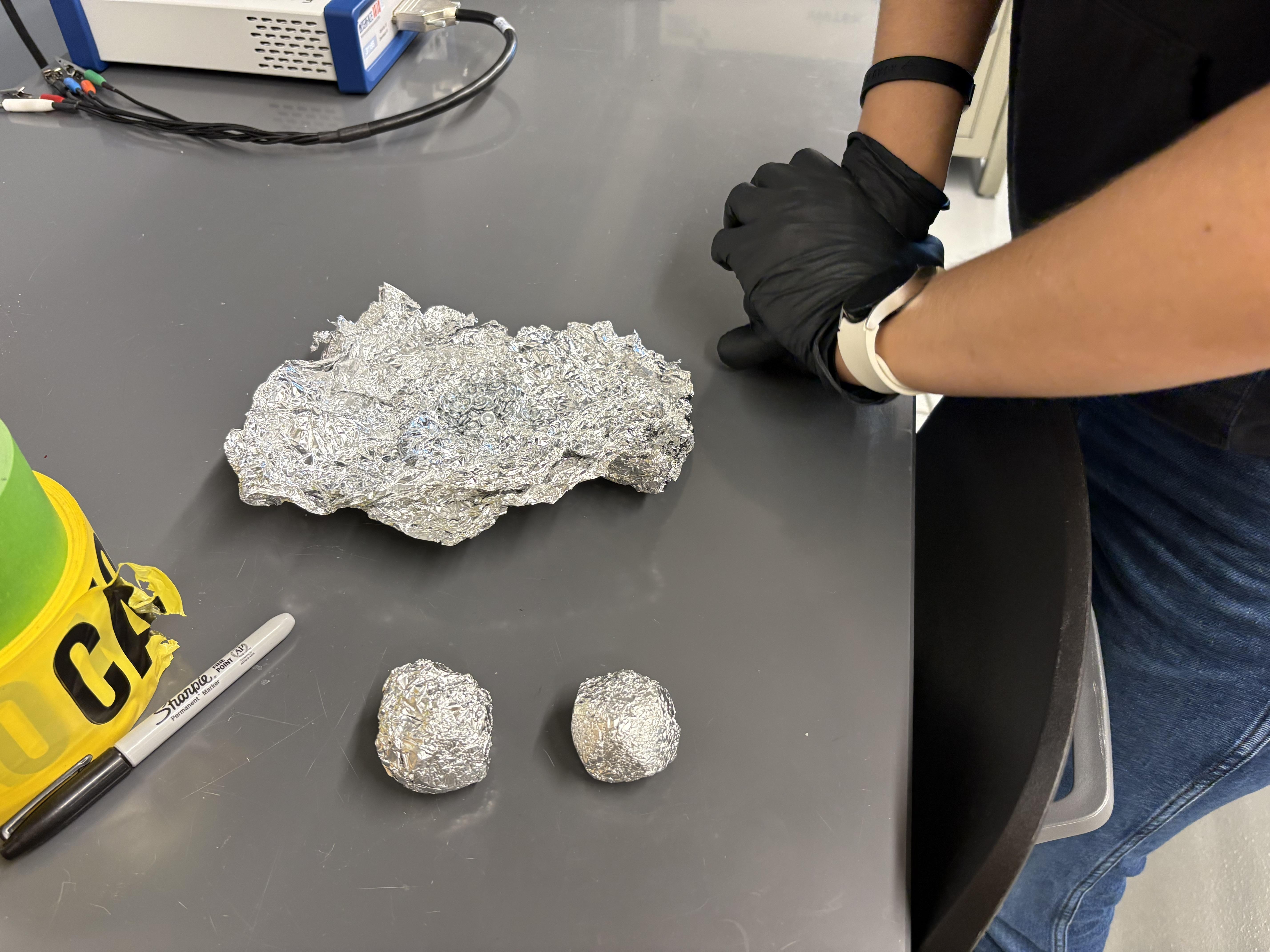
As the alloying components used for the cast were not in pure form (in an aluminum master alloy), calculations were done using a provided Excel spreadsheet to determine the mass of each element to use. Zinc and magnesium were required to be wrapped in aluminum foil to prevent loss as they react strongly with oxygen; thus, the mass of the aluminum foil had to be accounted for.
Mass of alloying elements added:
- Aluminum (Al): 600.5 g
- Copper (Cu):
- Calculated: 14.25 g
- Actual: 14.21 g
- Zinc (Zn):
- Calculated: 42.75 g
- Actual: 42.70 g
- Chromium (Cr):
- Calculated: 7.50 g
- Actual: 7.55 g
- Magnesium (Mg):
- Calculated: 33.00 g
- Actual: 32.99 g
- Al foil for Zn shot: 24.64 g
- Al foil for Mg alloy: 33.35 g
- Total amount of Al with master alloys: 675.0 g
Once the alloying elements and pure aluminum chunks were weighed out to the best of our abilities, we waited approximately 30 minutes for the crucible to heat in the induction furnace, simultaneously preheating the book mold in a separate furnace. After the 30 minute timer, the solid aluminum chunks were added and allowed to melt before adding in the Al-wrapped Zn and Mg "meatballs". The remaining Cr and Cu were added last.
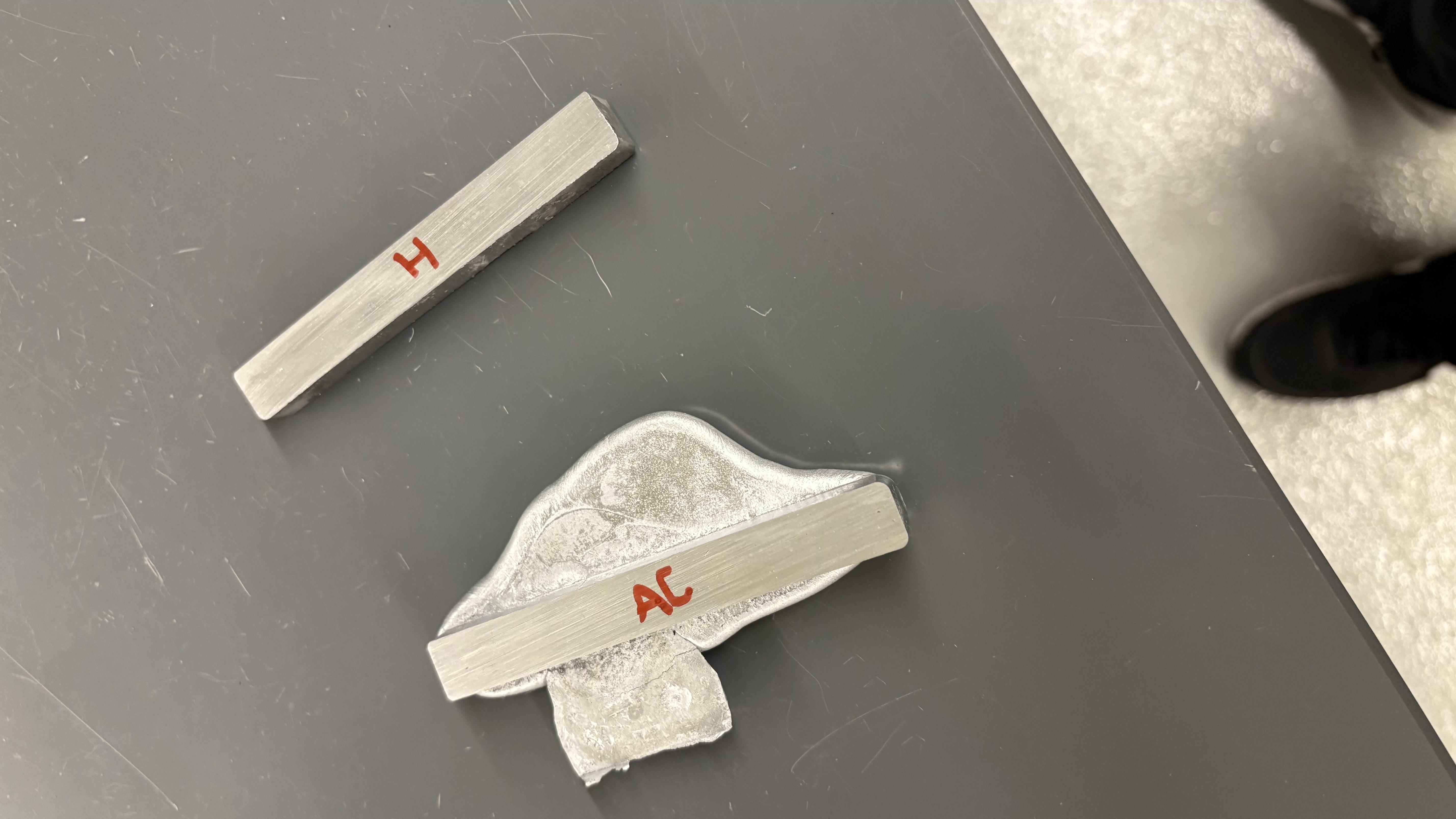
The alloy was cast using a book mold, resulting in a 4x6" block of aluminum alloy. An as-cast sample was retrieved for metallography and optical microscopy from the overflow, and the remaining material was prepared for subsequent processing.
Testing a piece of the as-cast alloy yielded the following results:
- Hardness (HRH): 97.6, 96.8, 98.1, 100.6, 101.
- Average Hardness (HRH): 98.8
- Electrical Conductivity (% IACS): 30.07, 30.30, 29.63, 29.56, 30.22, 29.70, 29.91, 29.69, 29.78, 29.96, 30.04, 29.95, 29.89, 29.92, 30.18
- Average Conductivity (% IACS): 29.920
Analyzing the Micrographs
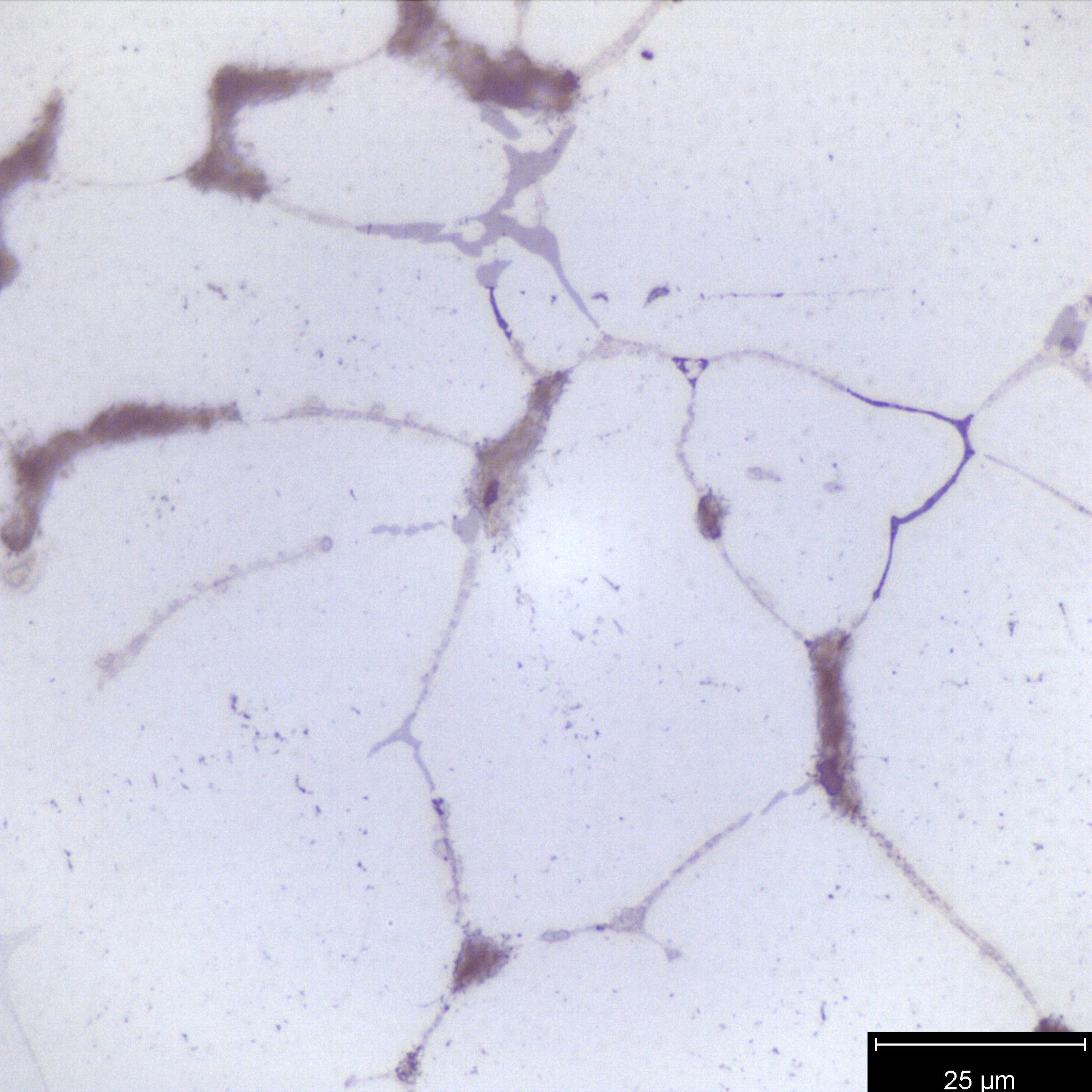
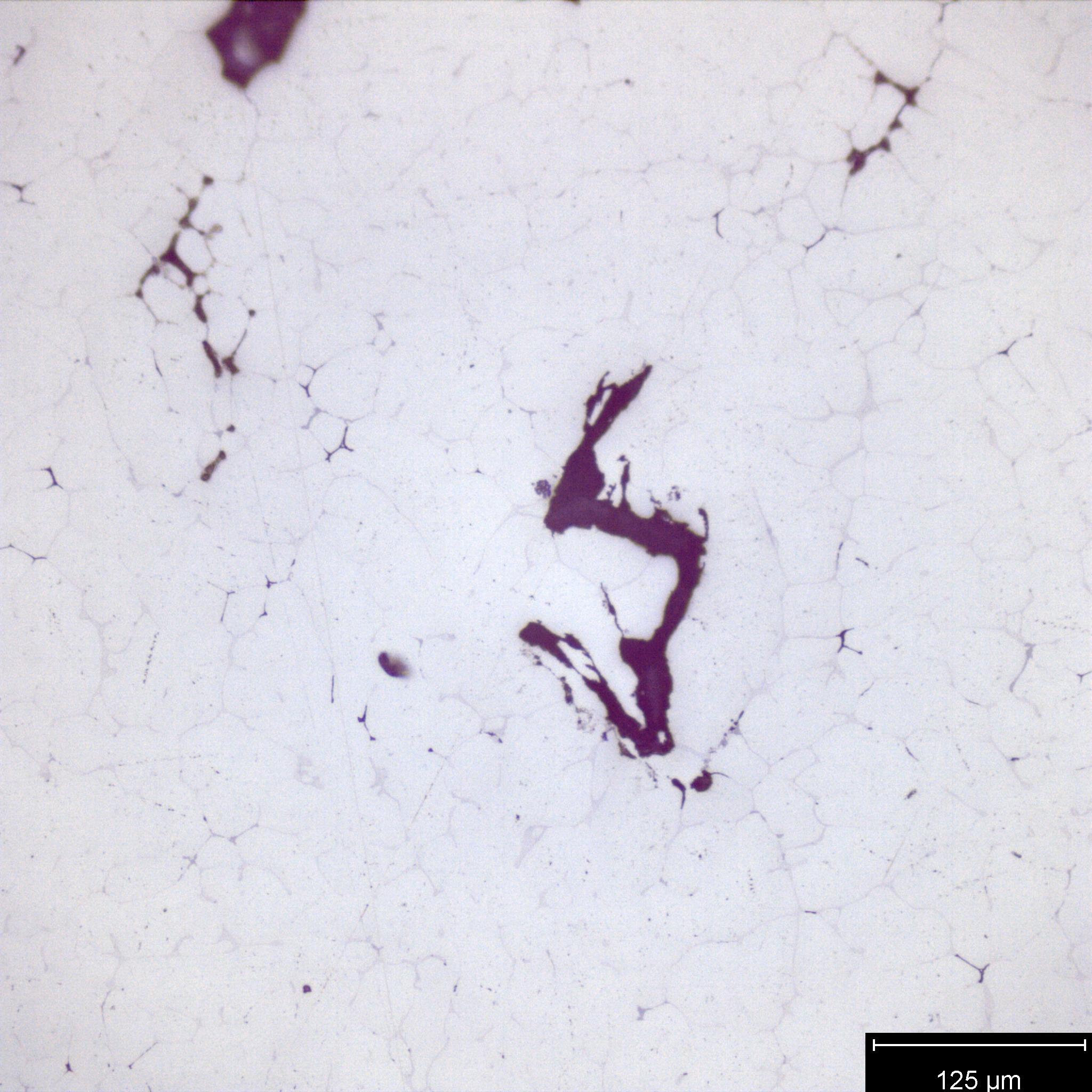
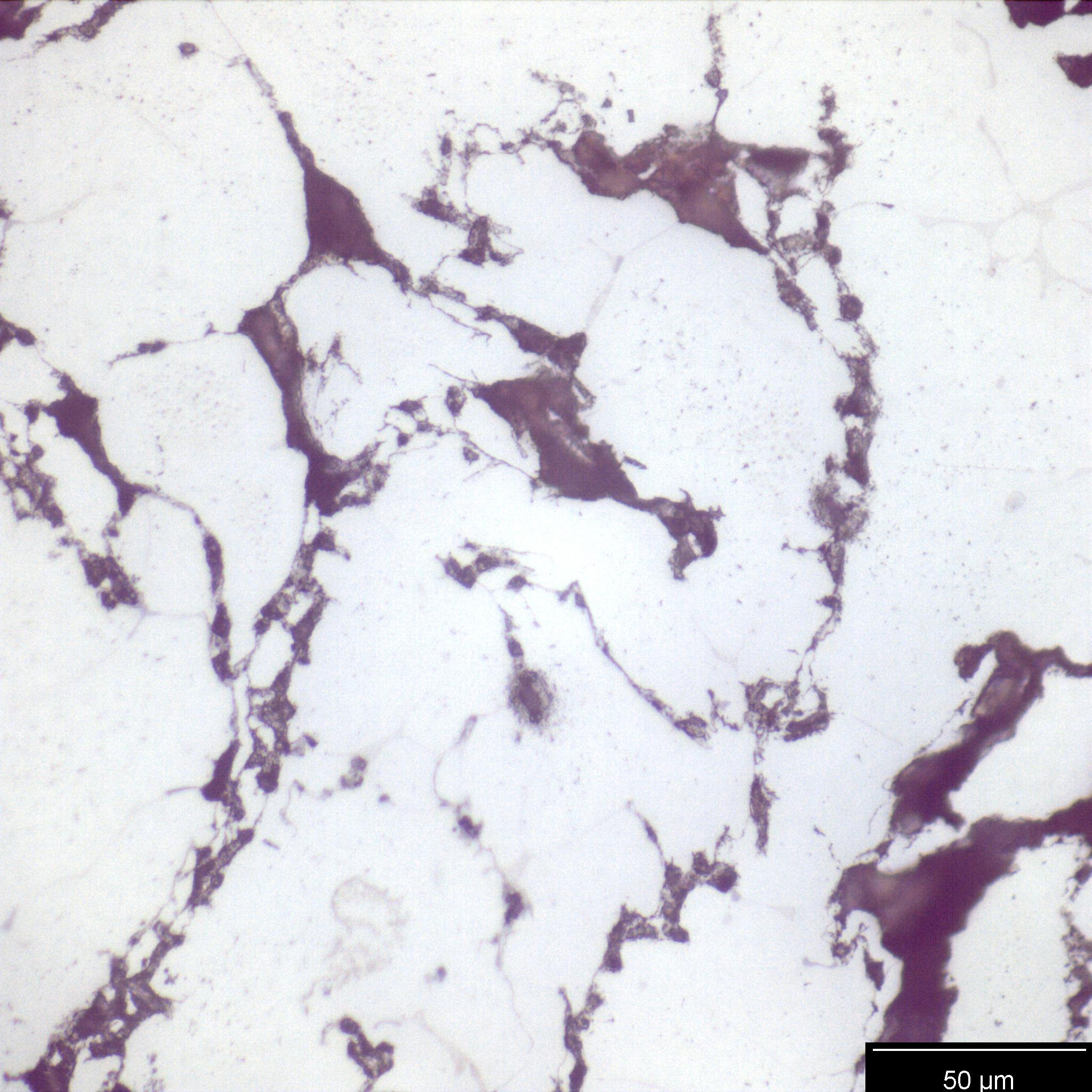
The micrographs above show how the as-cast has many impurities that coalesce at the grain boundaries, resulting in a large concentration difference between the bulk and the grain boundaries.
Homogenization
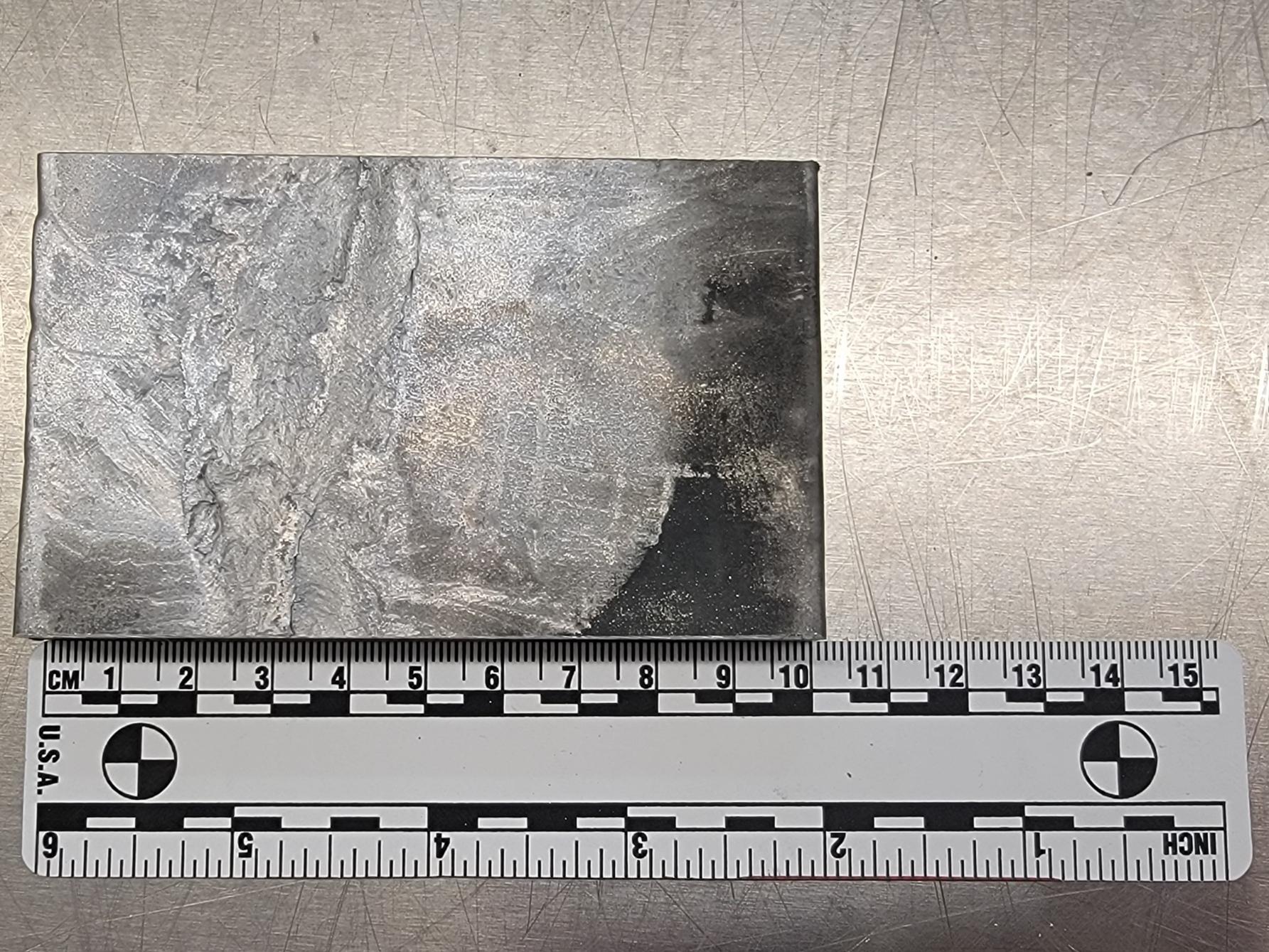
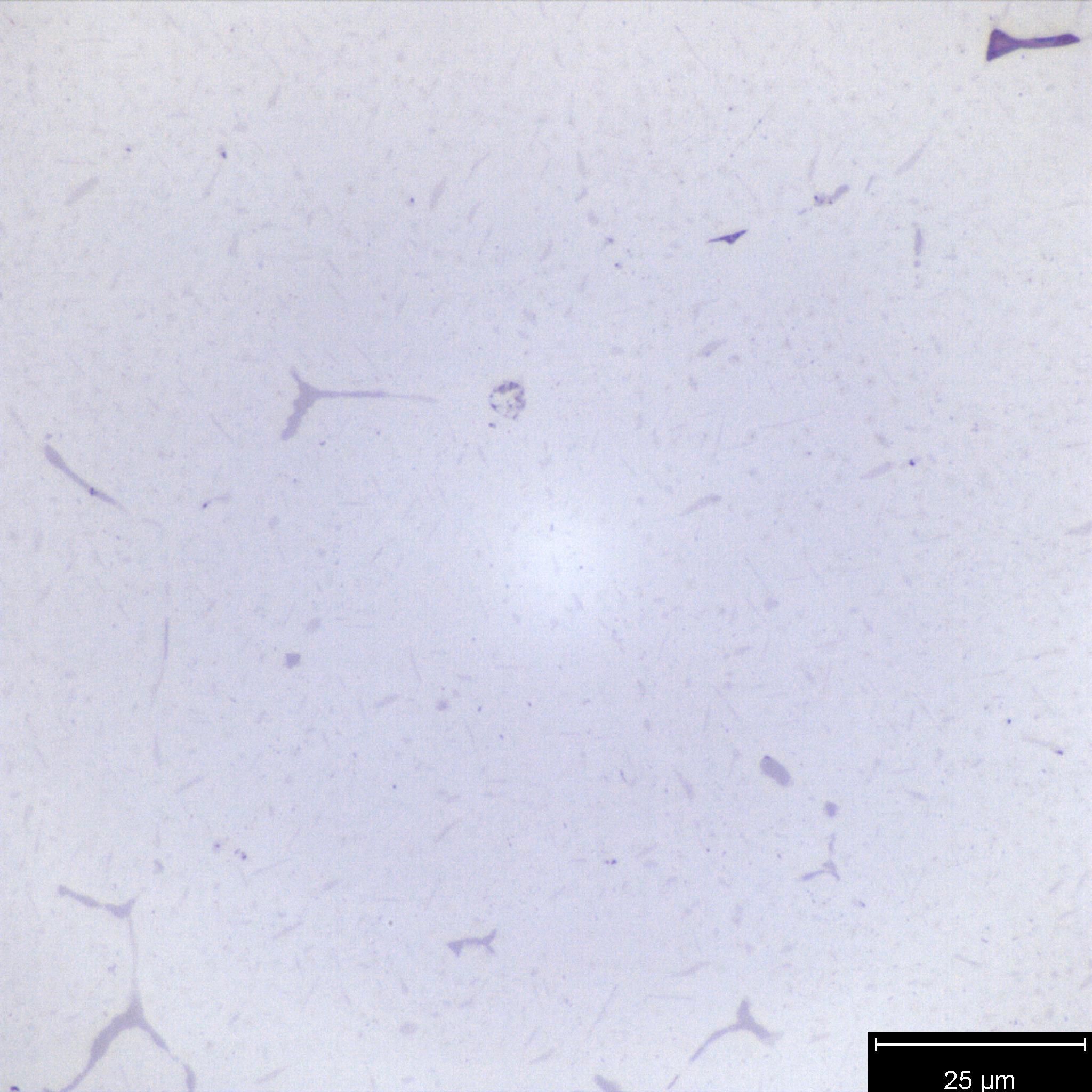
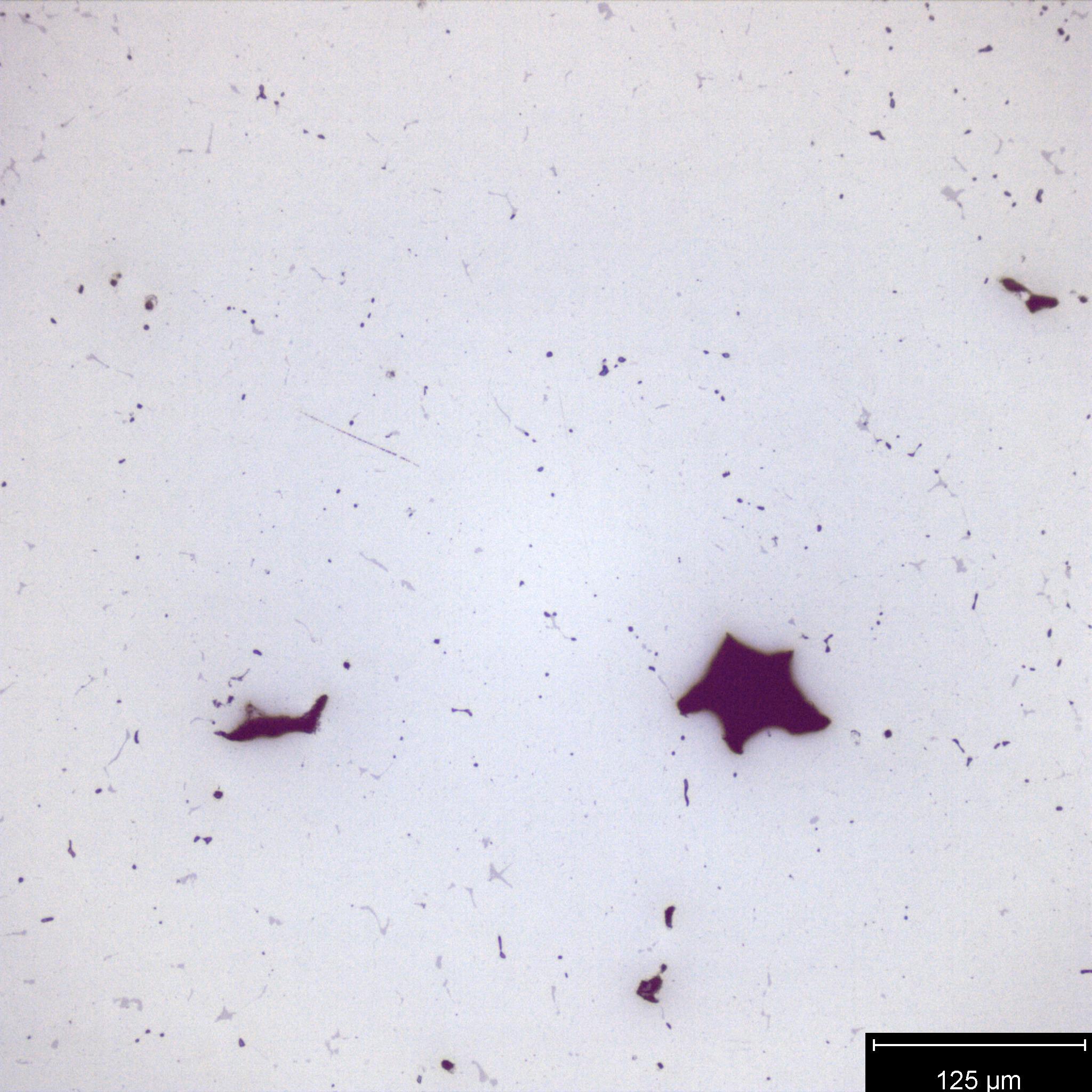
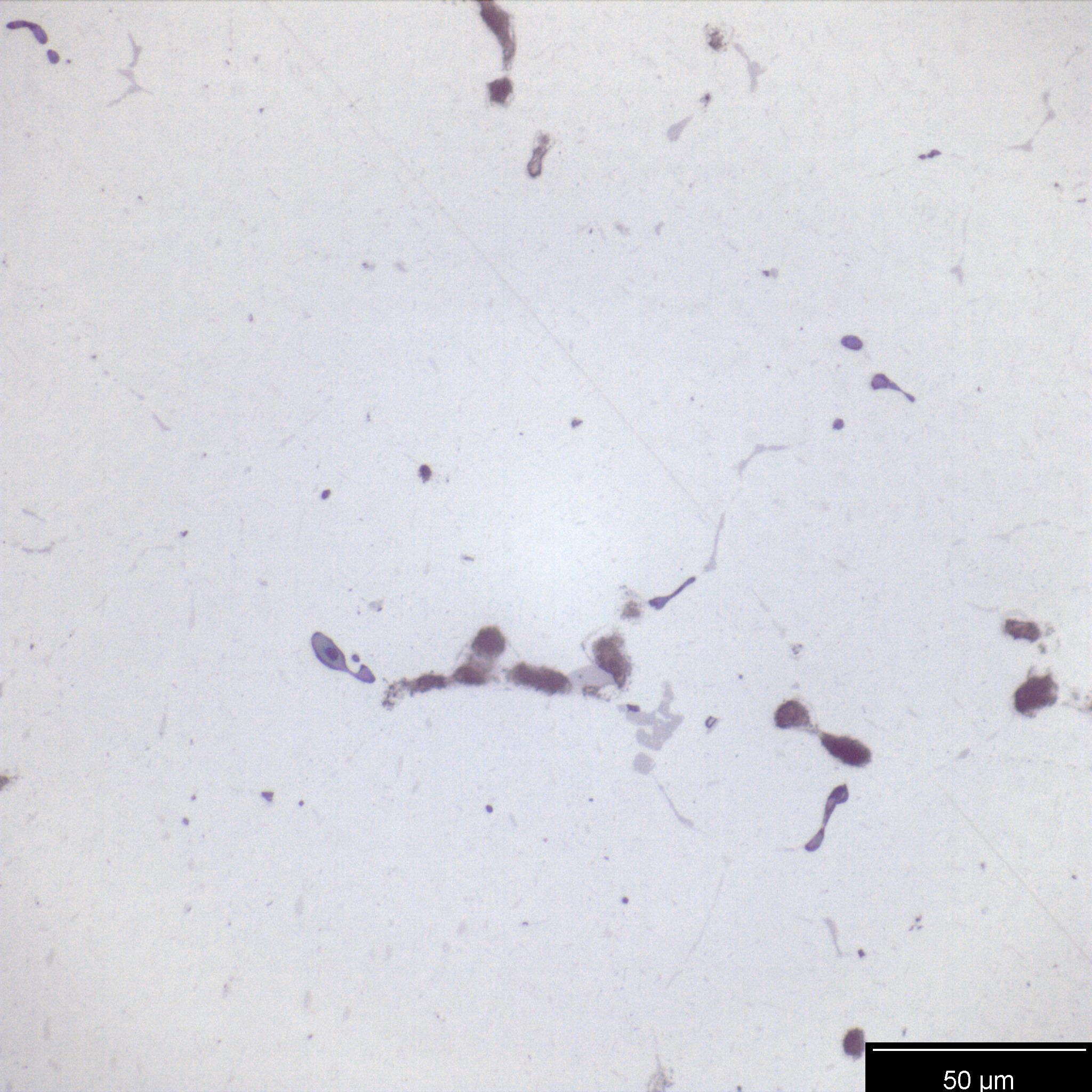
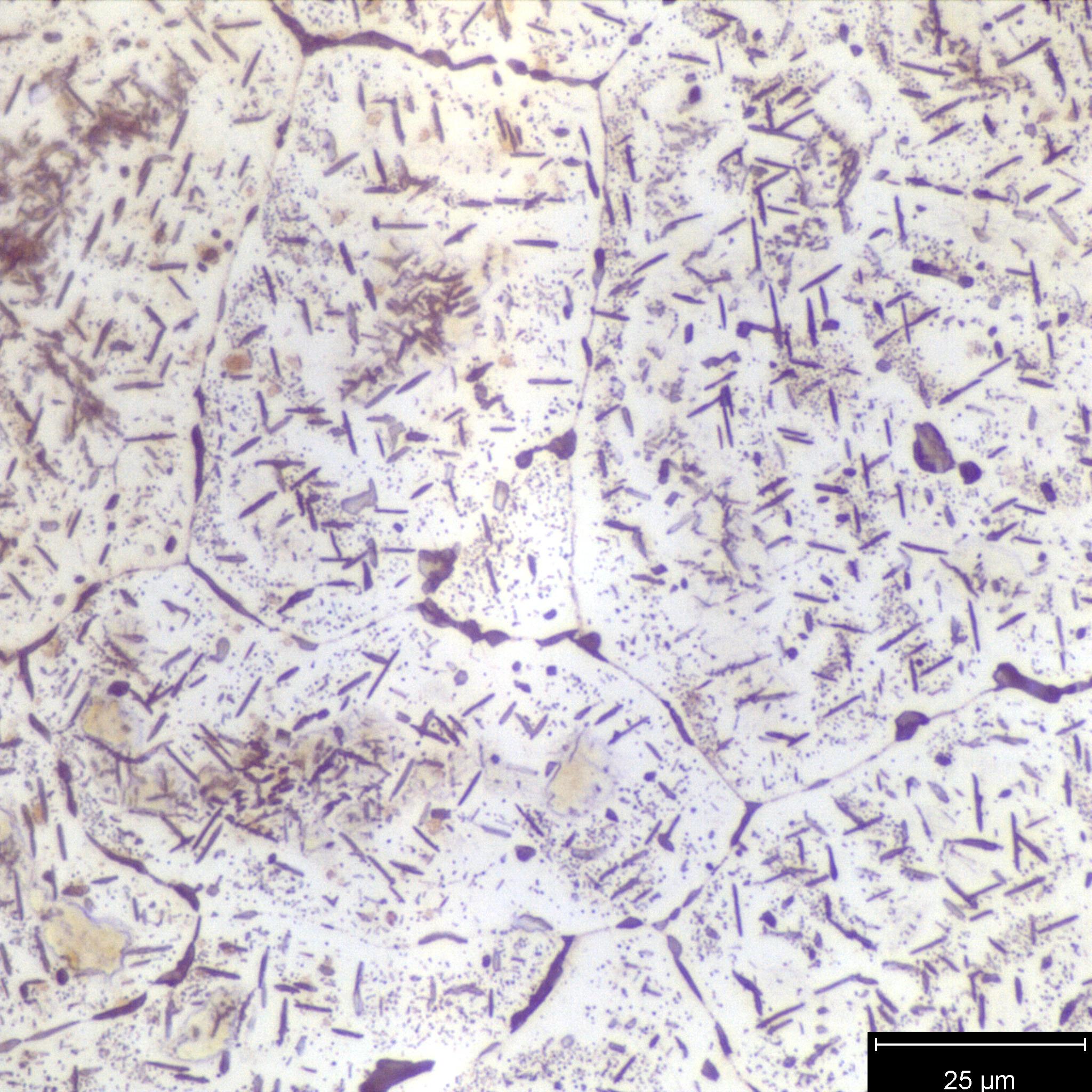
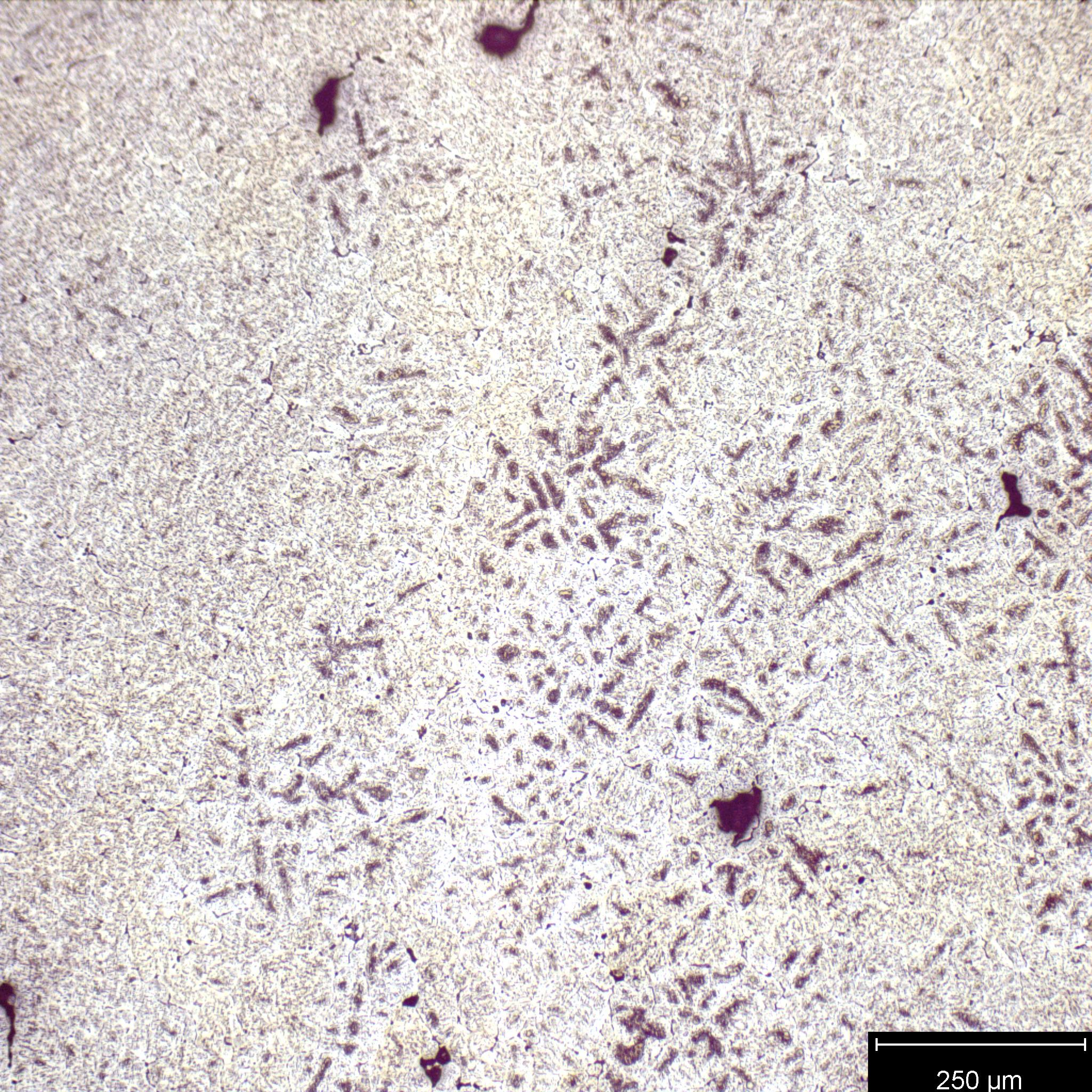
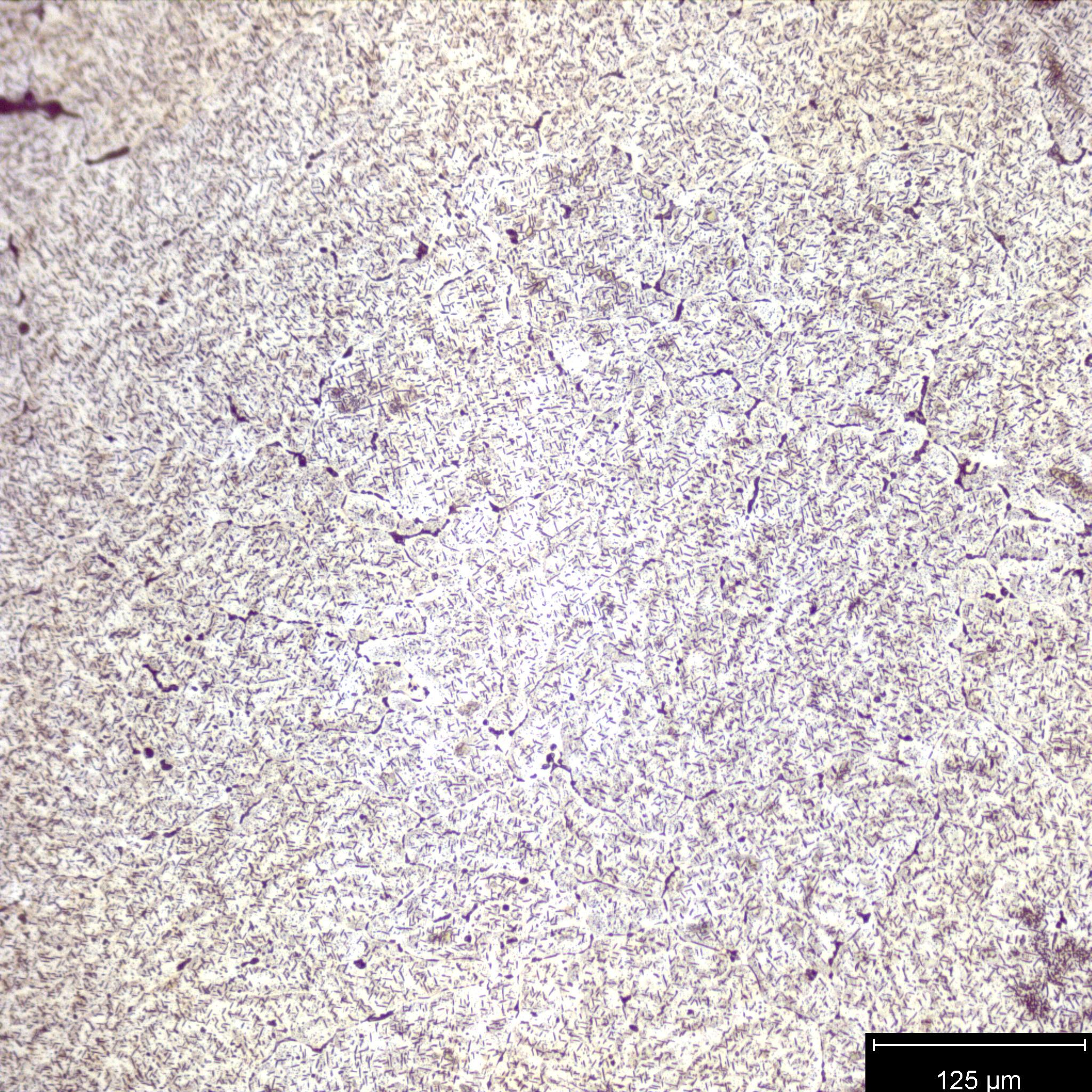
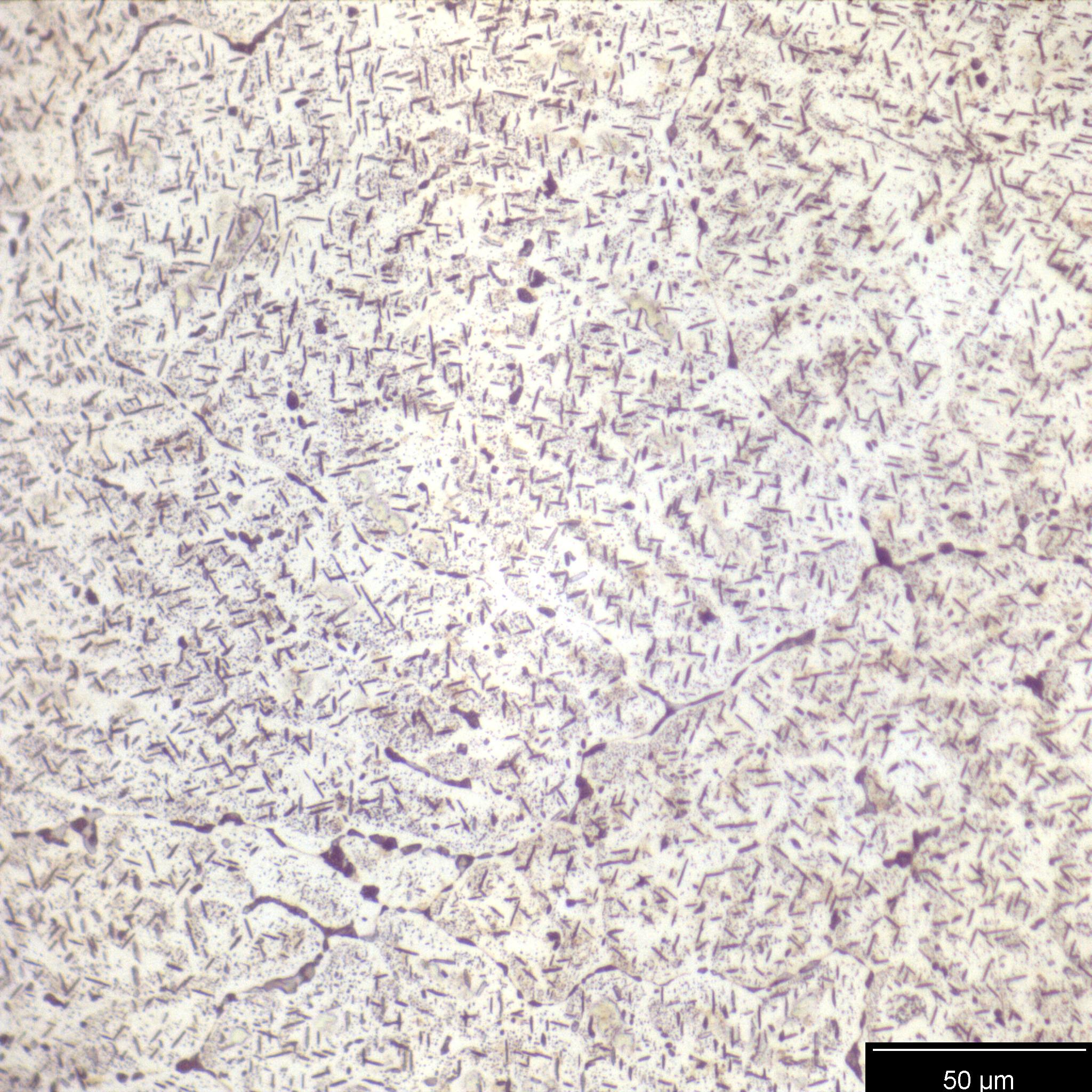
The cast piece was homogenized at 470°C for 12 hours to promote a uniform solute distribution. This prepared the alloy for workability during mechanical processing by allowing diffusion to even out the concentration gradients of the added elements. Our original processing procedure did not include a homogenization step; however, further research and recommendation from lab instructors encouraged us to include this important step. If homogenization is skipped, the segregation of the solute metals from casting remains and causes inconsistent mechanical properties. This can lead to defects in future processing steps. We overlooked homogenization at first due to the lack of discussion in the literature and government documents we researched pertaining to the homogenization process of 7475 aluminum alloy.
Testing a piece of the homogenized alloy yielded the following results:
- Hardness (HRH): 91.5, 91.8, 92.5, 92.1, 91.0
- Average Hardness (HRH): 91.78
- Electrical Conductivity (% IACS): 35.81, 36.09, 36.14, 35.80, 36.44, 37.55, 36.50, 36.42, 35.01, 36.14, 37.28, 37.85, 37.41, 37.19, 37.81
- Average Conductivity (% IACS): 36.63
Analyzing the Micrographs
The micrographs above show the impurities (darker color) as increasingly scattered throughout the sample, unlike the as-cast sample, which had impurities more concentrated around the grain boundaries. This distribution can most easily be seen in the etched micrographs, where the dark phase appears in small clusters throughout the picture.
Mechanical Processing - Hot Rolling

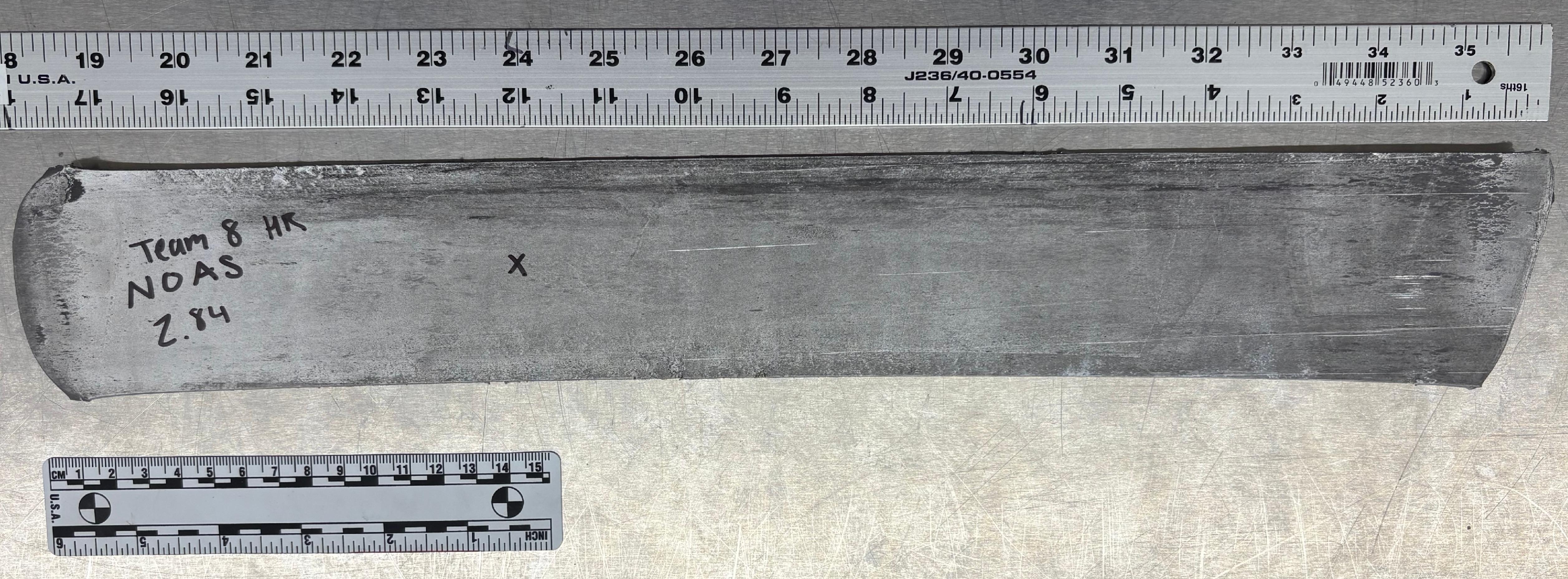
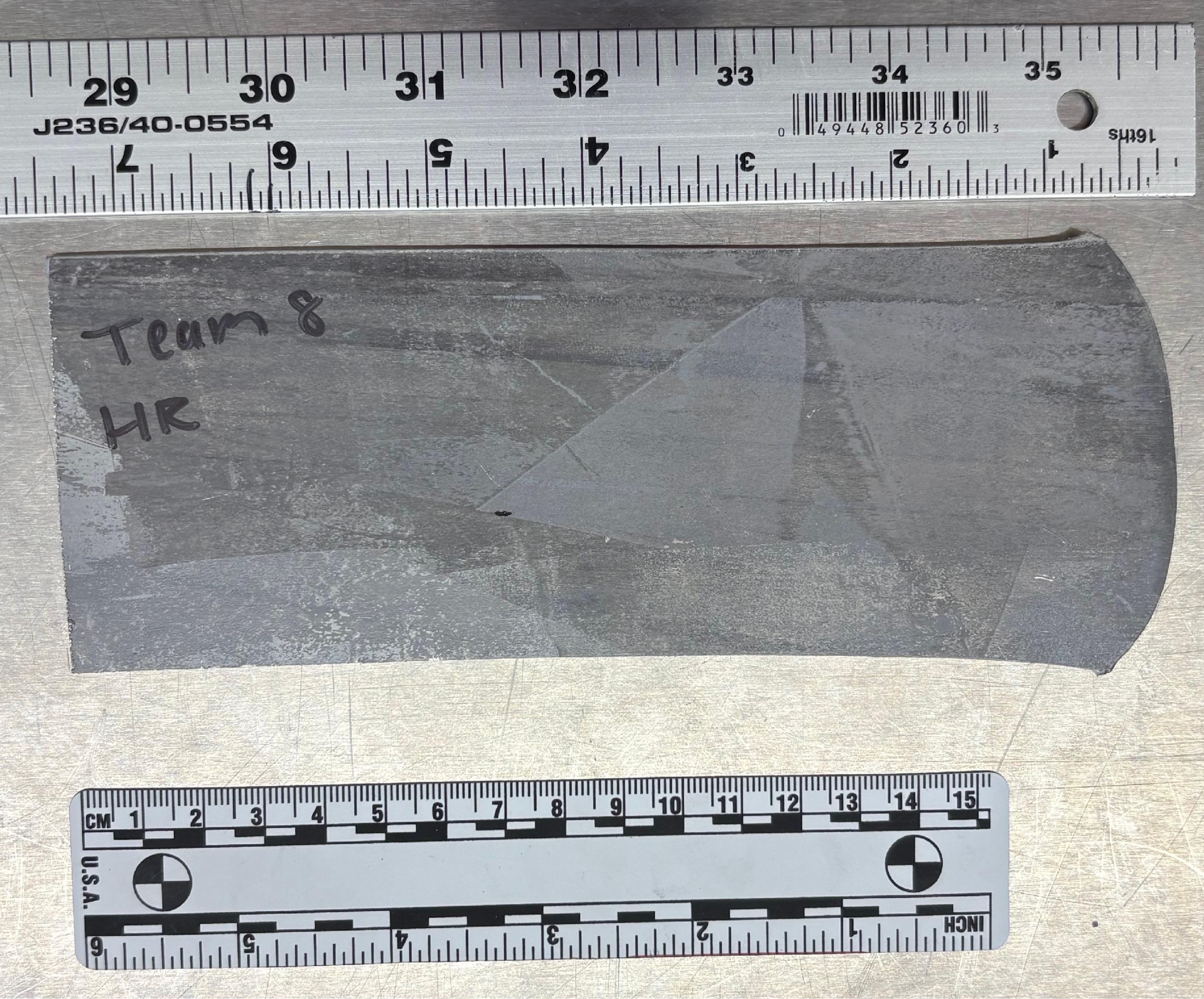
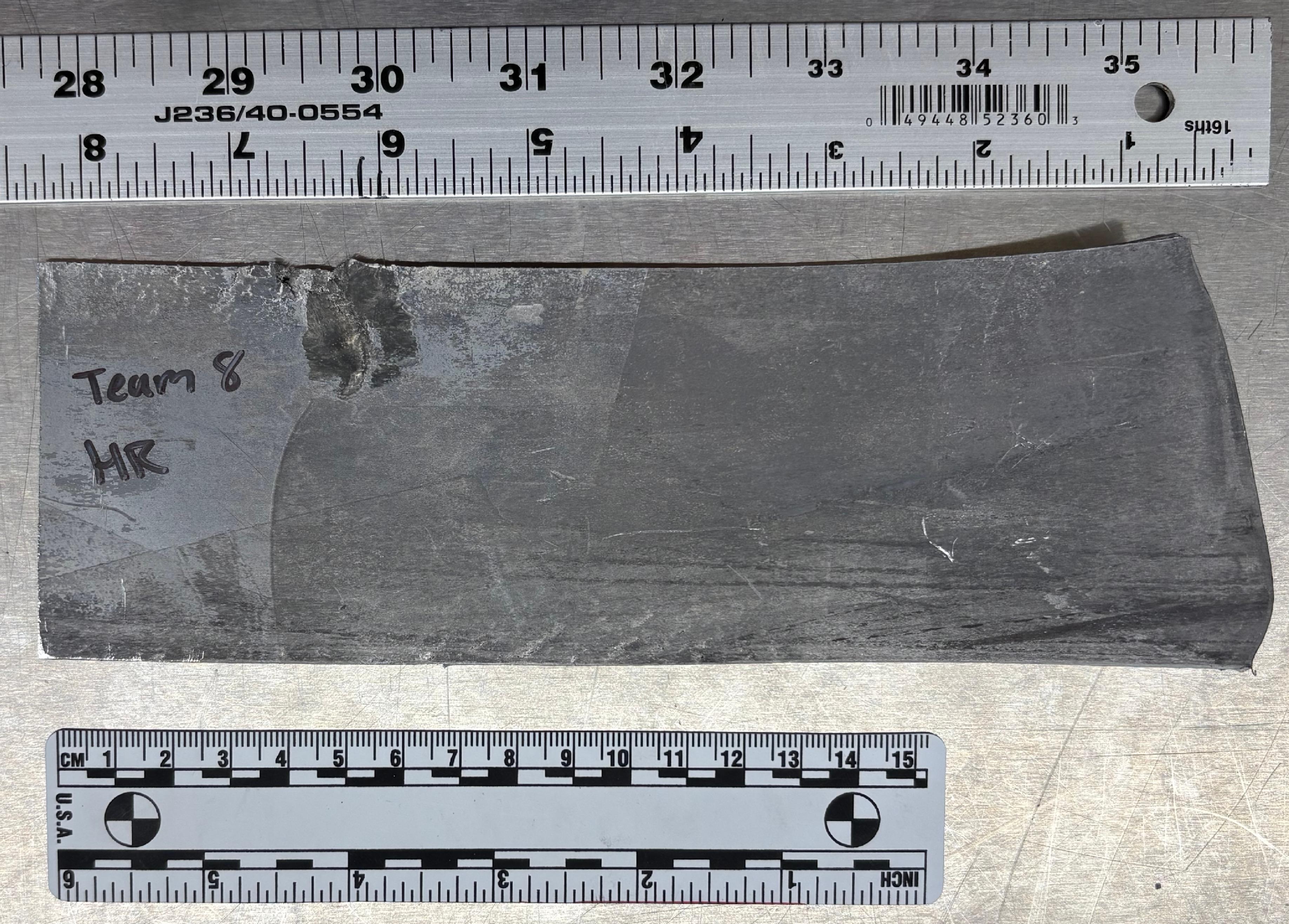
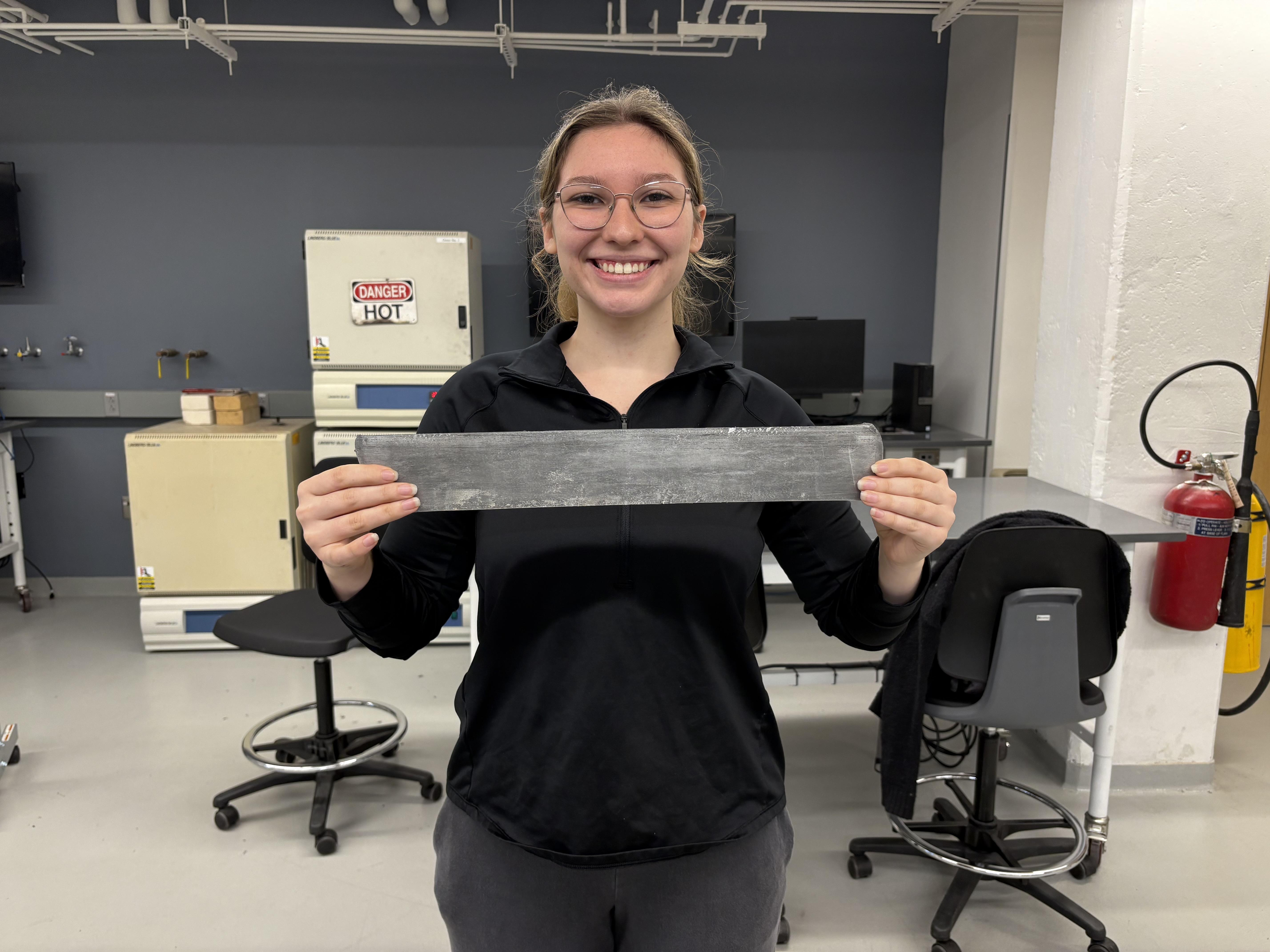
The now-homogenized block of aluminum alloy was cut into 4x3" portions for rolling, making sure to file down the sharp edges after cutting. The goal was to reduce the initial thickness of this piece down to 2-3mm. Initial and final dimensions of both halves are listed further down in this section.
Our original procedure called for cold rolling; however, it was recommended that we switch to hot rolling to reduce the amount of passes the workpiece required through the roller. With this in mind, and with the fact that we were working with a 7xxx series alloy, we set the temperature for the heating element in the roller to 515°C. The rollers themselves were 180°C.
The workpiece sat under the heating element for 15 minutes prior to its first pass through the roller at 0.5 mm for the micrometer setting. After the first pass, the workpiece only had to sit for 3 minutes before being passed through at 1 mm. While hot rolling, it was important to monitor the peak load and not let it exceed 20,000 lbf.
After successfully hot rolling our first half, we decided to proceed with hot rolling the second half. This step improved refined the microstructure through deformation and recrystallization.
1st Piece Dimensions
- Initial thickness: 12.79 mm
- Final thickness: 2.8-2.9 mm
- No. of passes: 11
2nd Piece Dimensions
- Initial thickness: 12.79 mm
- Final thickness: 2.9 mm
- No. of passes: 11
Testing a section of the hot-rolled alloy yielded the following results:
- Hardness (HRH): 106.0, 107.4, 106.7, 105.1, 107.2
- Average Hardness (HRH): 106.48
- Electrical Conductivity (% IACS): 37.28, 37.65, 37.22, 36.85, 37.74, 37.55, 36.80, 37.32, 37.65, 37.43, 37.33, 37.00, 37.91, 37.70, 37.45
- Average Conductivity (% IACS): 37.39
Solution Heat Treatment and Quench
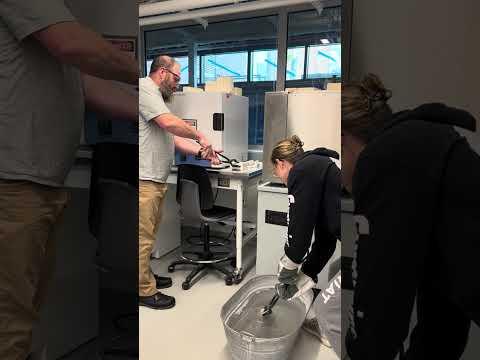
The rolled material was solution heat treated at 480°C for 40 minutes to dissolve the materials precipitates without approaching the melting point. This process is meant to create a more uniform and refined grain structure and a significant increase in material strength. Then, the bar was quenched immediately after being pulled out of the furnace. We did this by dropping the rolled material into a bucket of room temperature water within 15 seconds after the heat treatment. Rapid quenching is essential to prevent undesirable precipitation that would reduce strength.
Testing the solution heat treated and quenched alloy yielded the following results:
- Hardness (HRH): 99.1, 100.4, 100.8, 100.6, 100.1
- Average Hardness: 100.2
- Electrical Conductivity (% IACS): 29.32, 29.65, 28.45, 29.32, 29.07, 27.02, 29.10, 25.82, 30.3, 30.2, 30.25, 29.94, 30.27, 30.21, 30.34
- Average Conductivity: 29.28
Artificial Aging
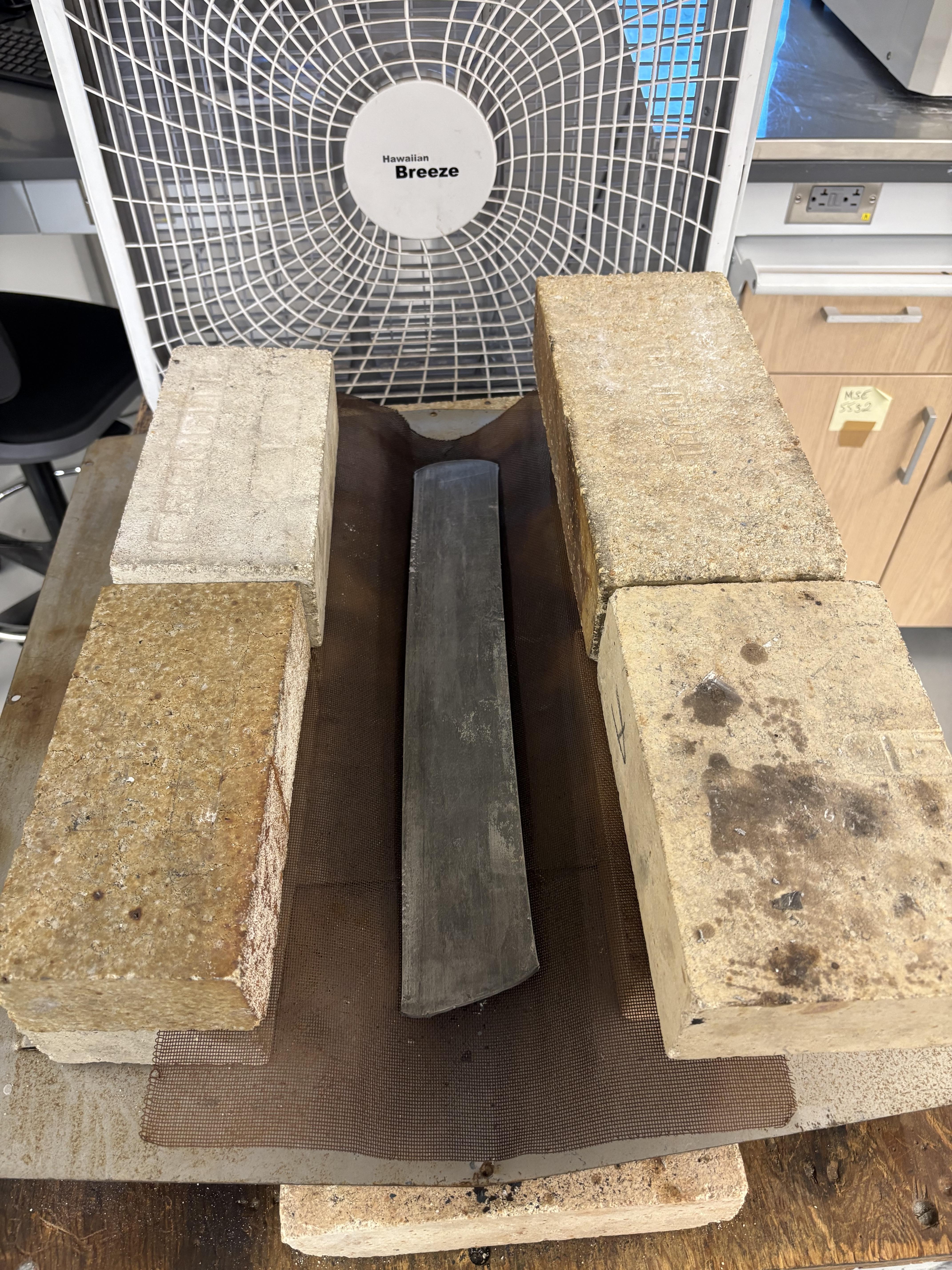
Shortly after quenching, the material was artificially aged at 120°C for 22 hours to promote controlled precipitation and achieve the T6 temper. We originally planned for a T651 temper very similar to the T6, but with a mechanical stress relieving step that we were advised may be unnecessary for the small scale of this competition. This step optimized strength and hardness while maintaining ductility. Without it, the alloy would not reach peak performance, and its properties would vary as it naturally aged.
Artificial aging was the final heat treatment that led us to a fully developed microstructure and strength. This ensured our testing would reflect the alloy's final stable condition with a balance of the desired properties. Step 7 outlines our final testing stages with our now completed alloy.
Metallography and Microscopy
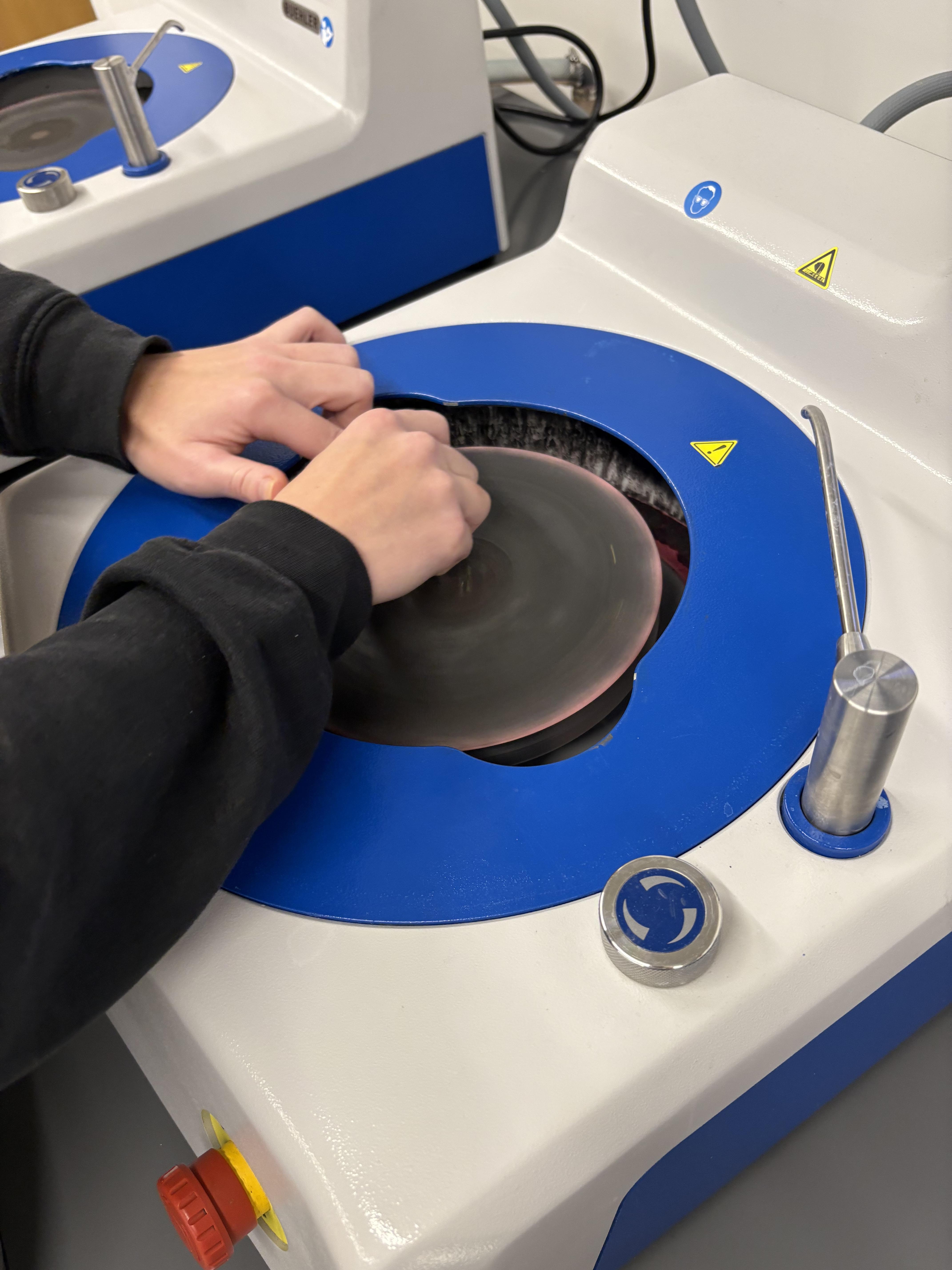
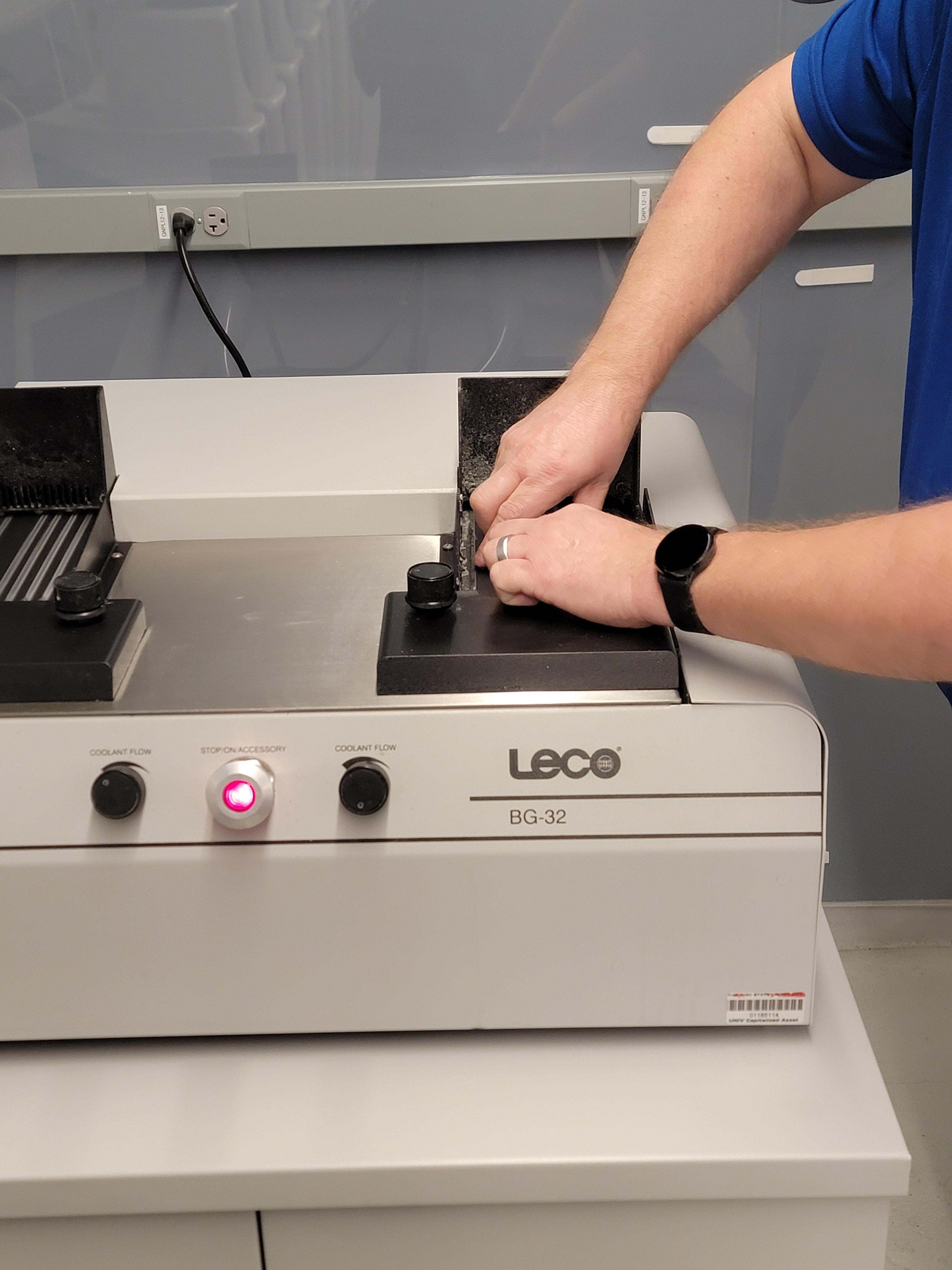
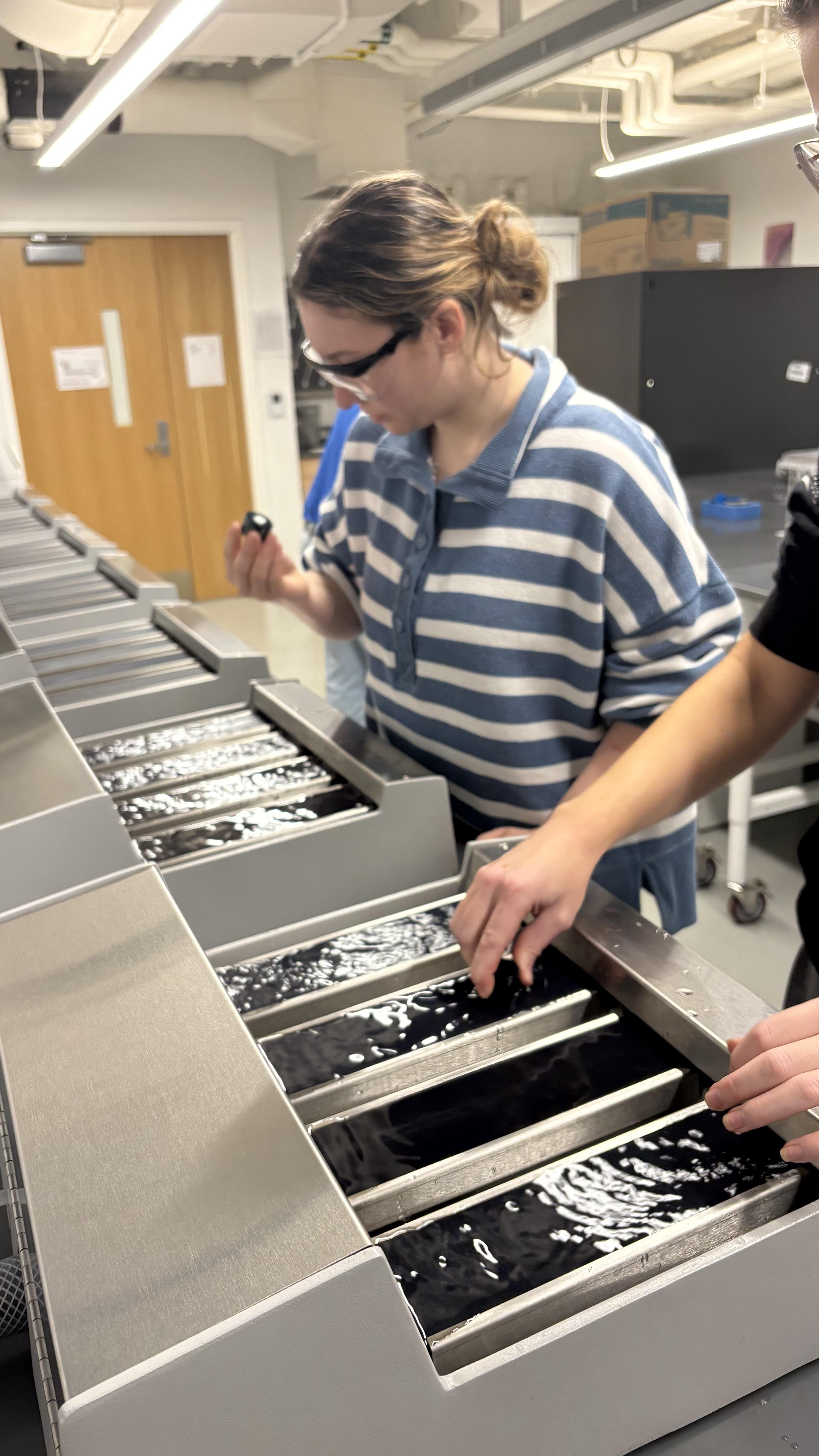
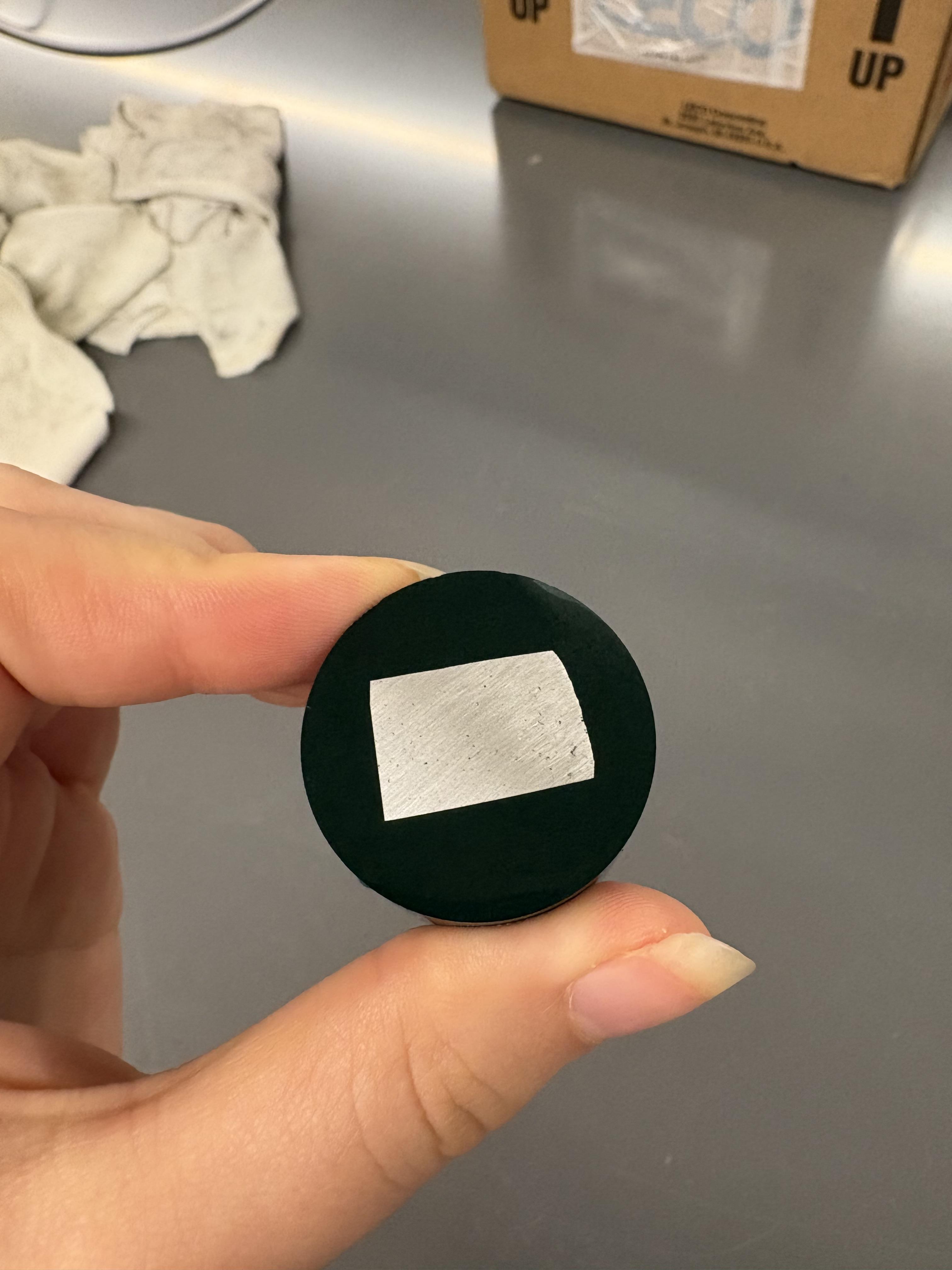
Throughout this competition we collected various samples of our alloy at each step to be evaluated with optical microscopy. The unique micrographs for each step are included in their specific section. However, the same procedure was consistently used for every step.
Metallography Procedure:
- Mounting Sample
- Retract
- Place sample and tap in bakelike powder
- Pour rest of powder
- Seal and start
- When finished, extend till top opens then extend to retrieve sample
- Grinding
- Grind mounted sample on belt sander for flat starting surface, rinse
- Start with 240 grit, turn 90 degrees from first sanding
- Grind 240 to 320 to 400 to 600 grit rinsing the sample in between and turning 90 degrees
- Polishing
- Start with 6 um diamond paste with diamond extender then a 3 um diamond paste with diamond extender
- Heavy pressure, slow rotations
- Turn 90 degrees every 30 seconds for 2.5 minutes
- Rinse, use cotton ball, spray with alcohol, dry with hand drier
- 0.05 um colloidal silica
- Fast rotation, light pressure
- Etching
- Use 2 step etching procedure created by Wayne Papageorge, 6-8 seconds for each step
- rinse sample to stop reaction and assess quality with microscope
Optical Microscopy:
- Brightfield optical microscope used to examine the surface
- For each sample we collected at least 2 images at 200x, 500x, and 1000x with
Final Microscopy and Testing
.jpg)
 Stress-Strain Curve.png)
 Stress-Strain Curve.png)
 Stress-Strain Curve.png)
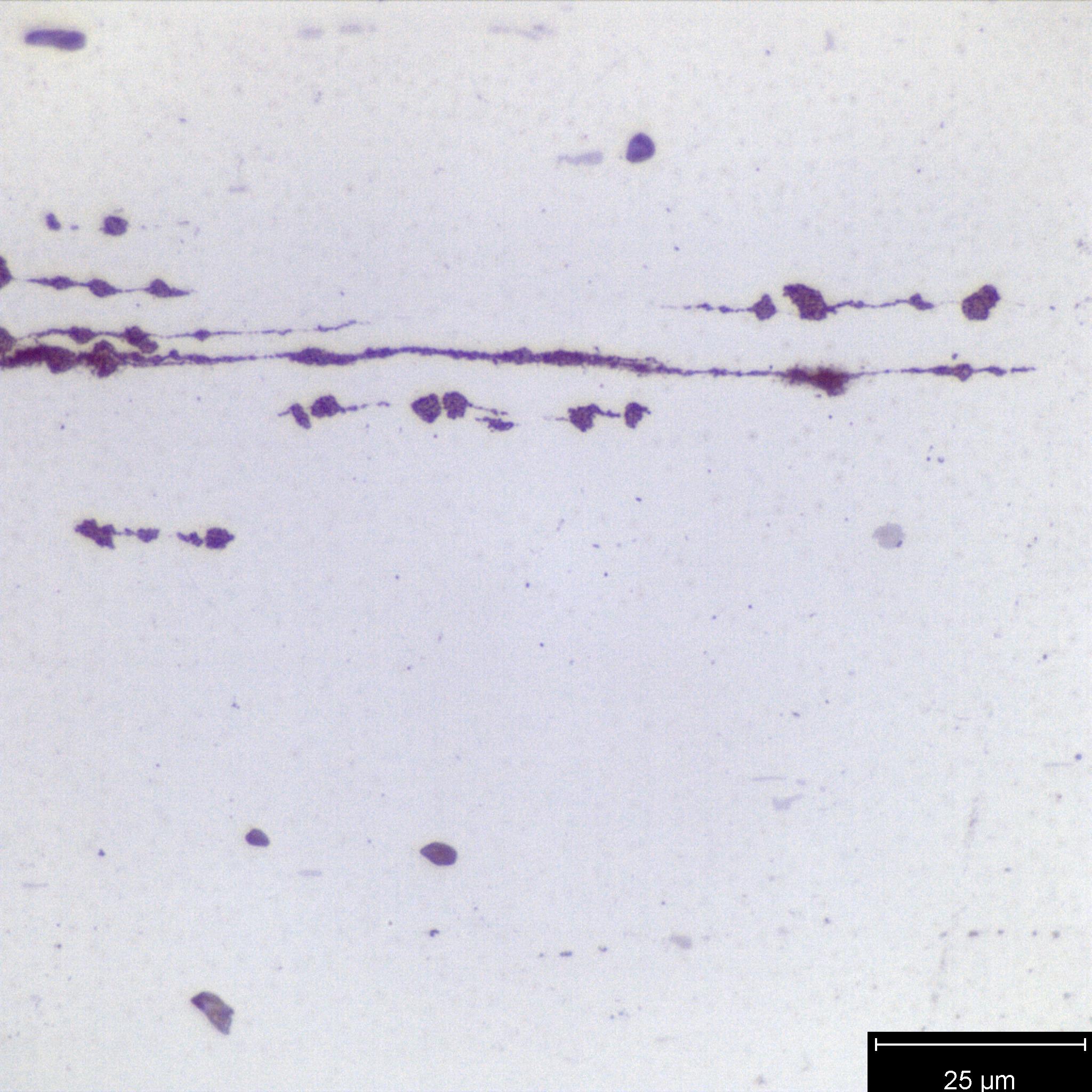
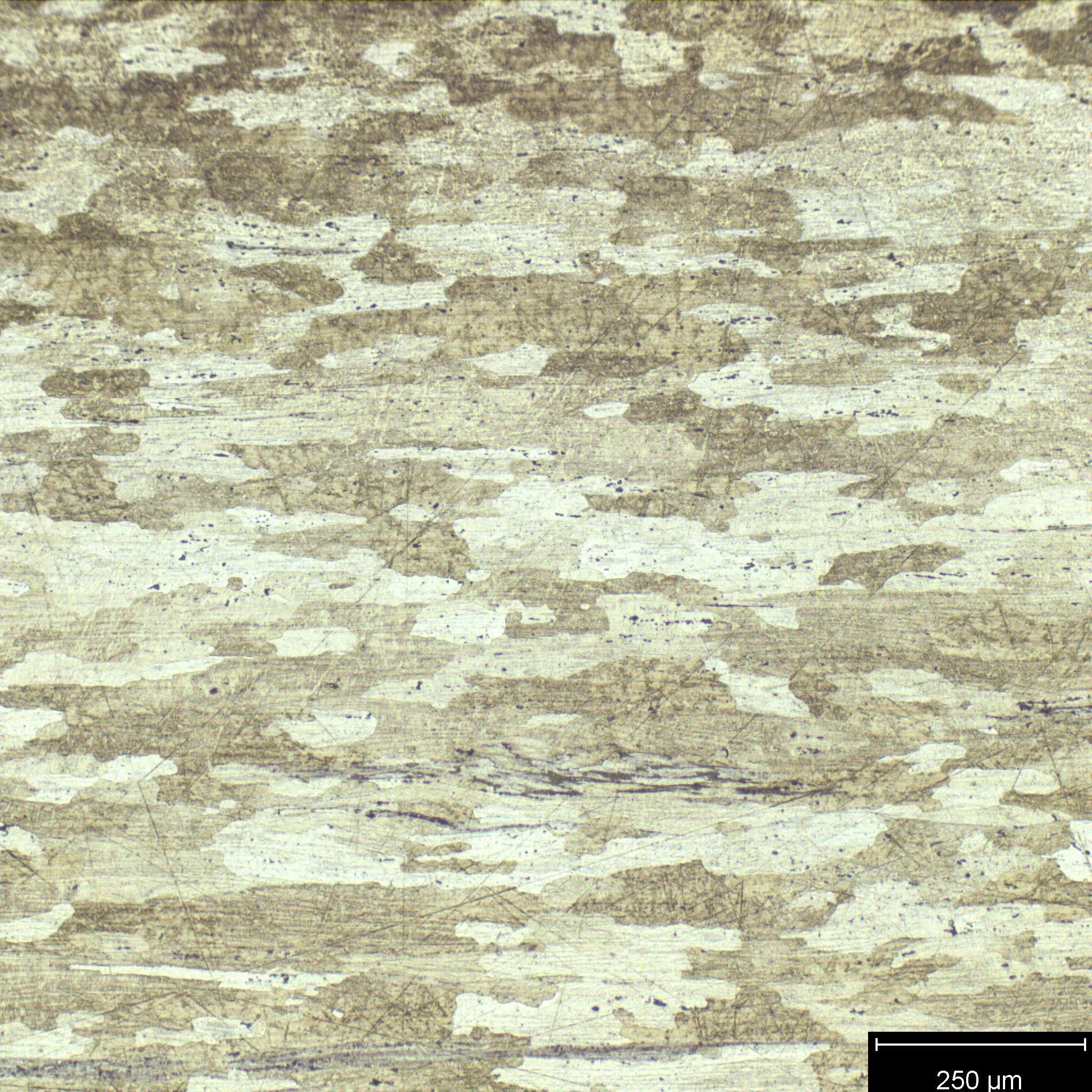
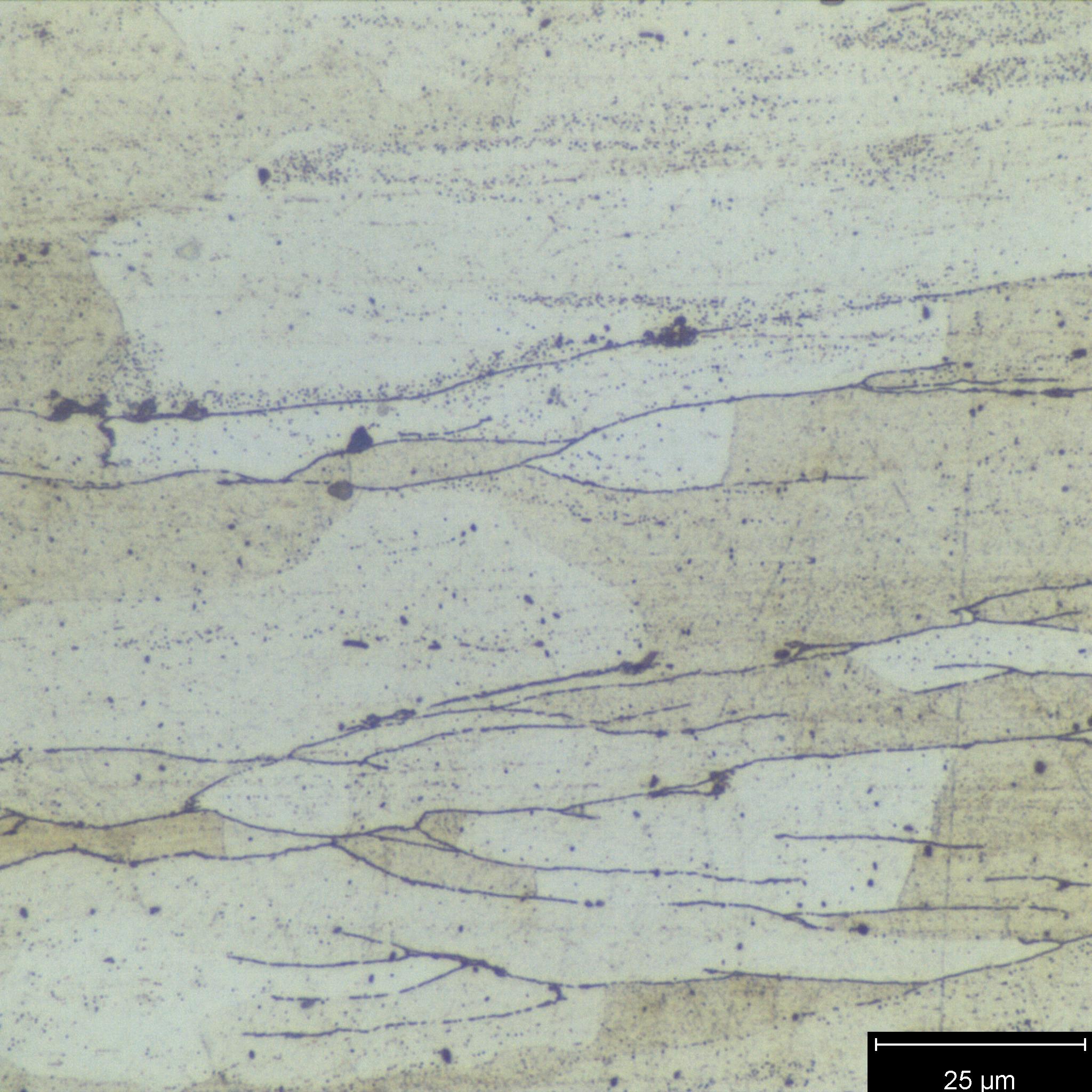
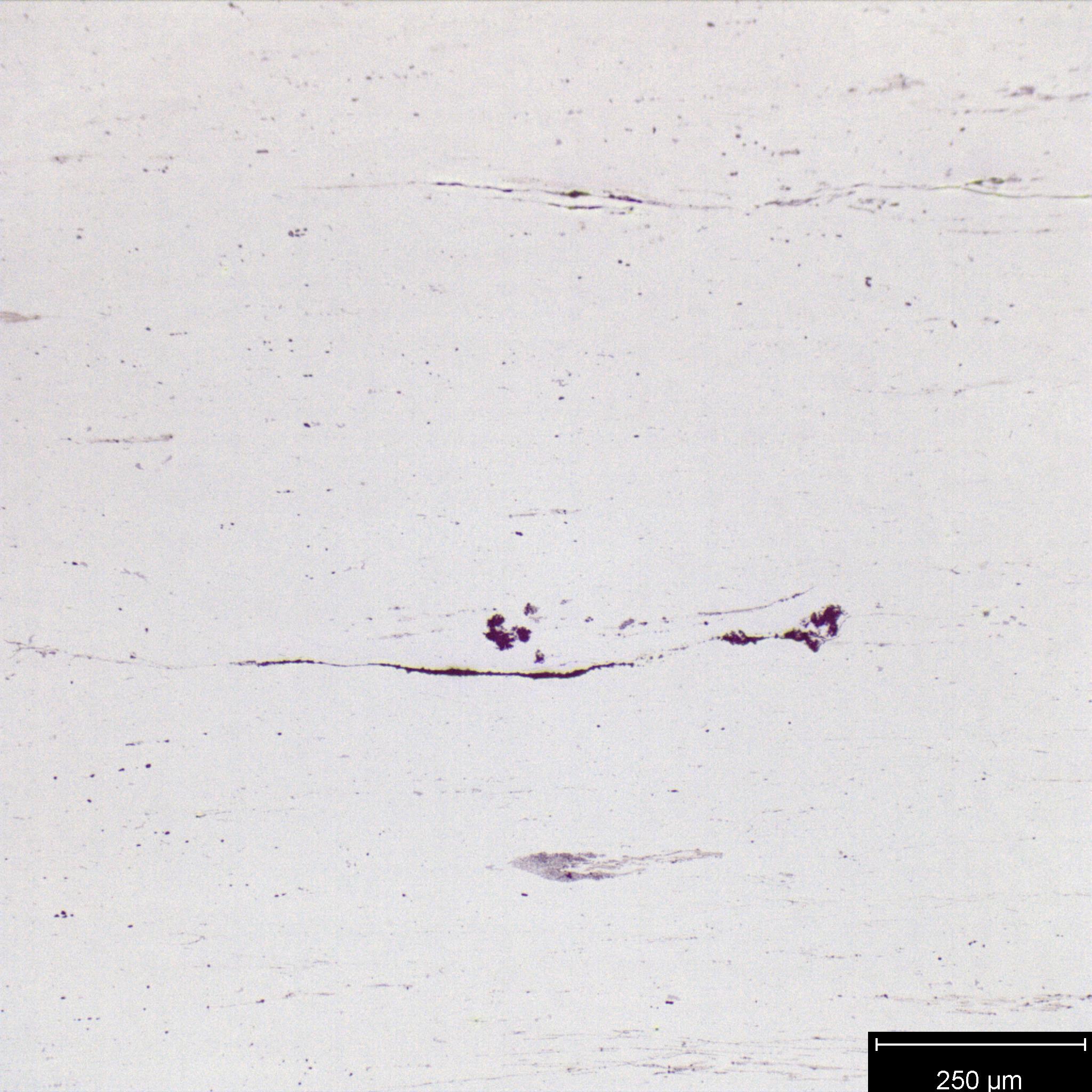
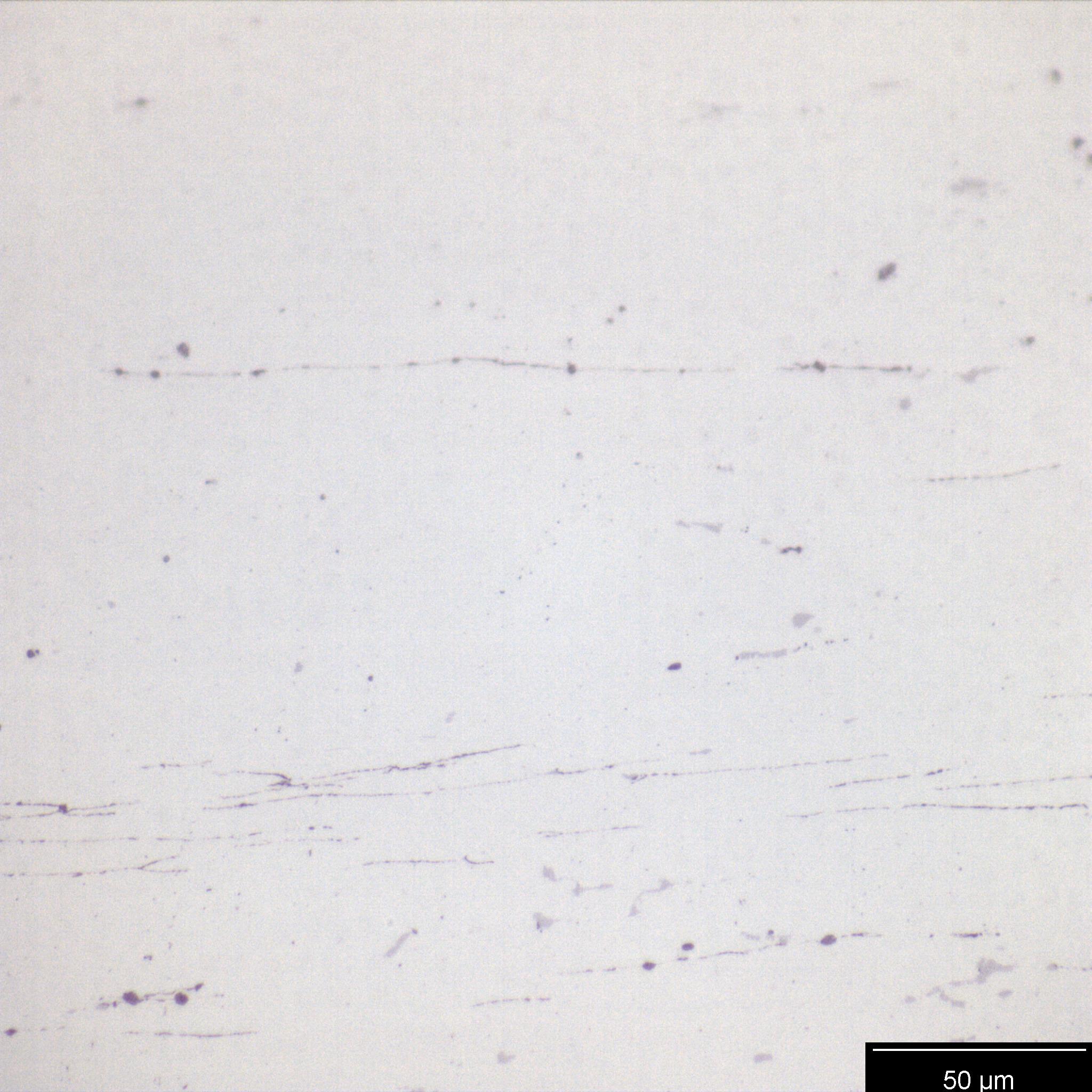
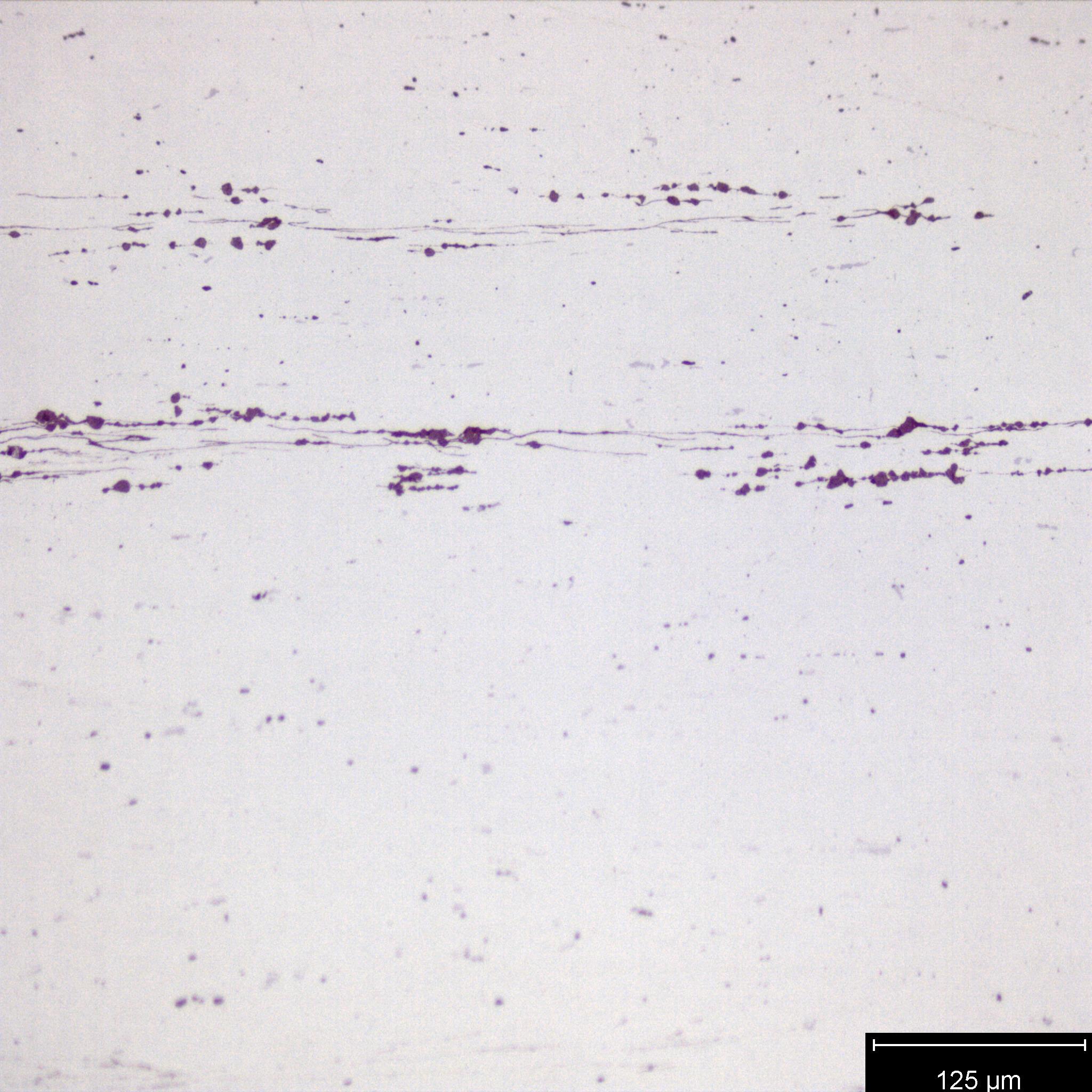
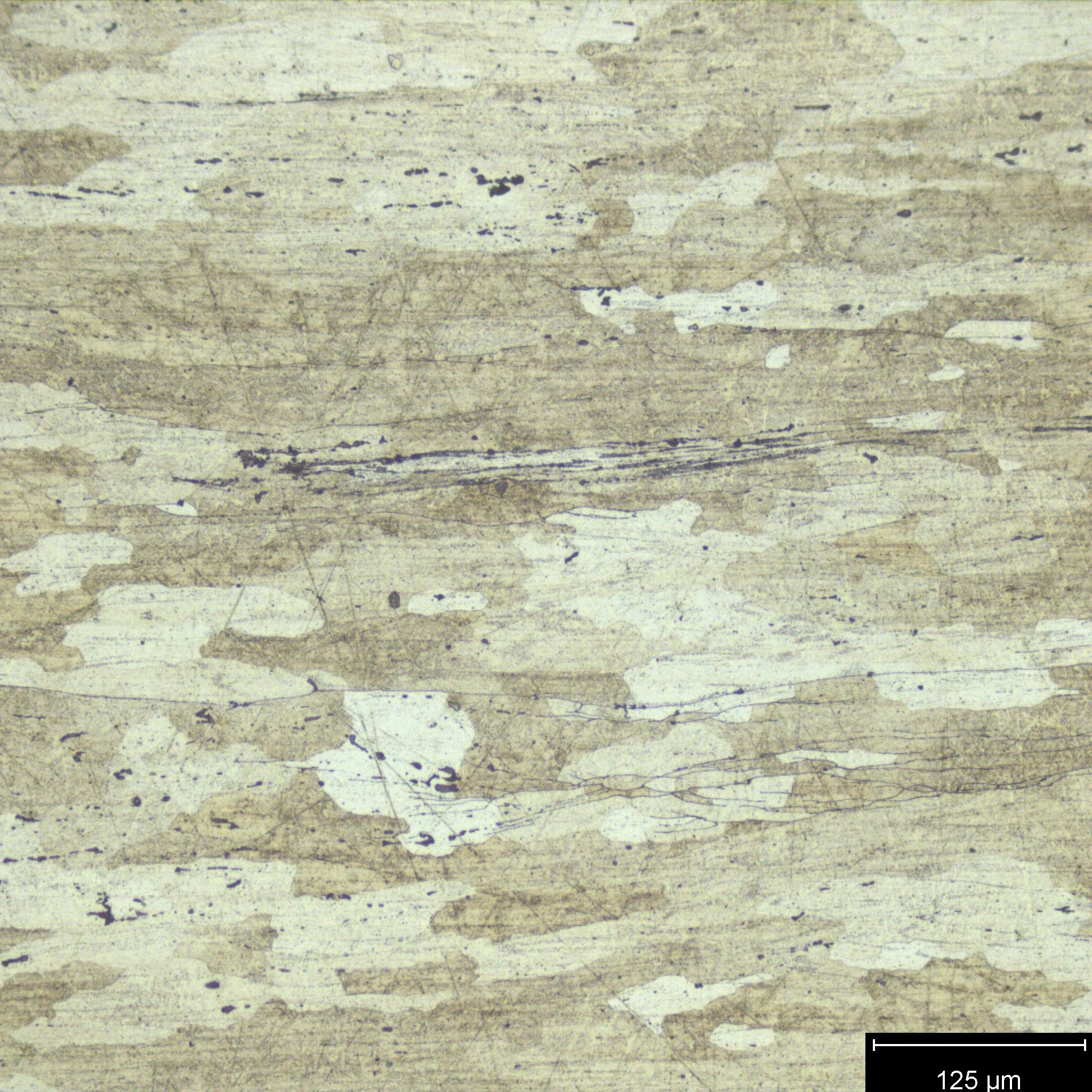
Our final material was examined using brightfield optical microscopy to evaluate the grain structure and precipitates.
Testing of the finalized alloy yielded the following results:
- Hardness (HRB): 87.5, 87.8, 88.4, 88.8, 86.7
- Average Hardness (HRB): 87.8
- Conductivity (% IACS): 30.74, 30.86, 31.00, 30.82, 30.65, 30.51, 30.28, 30.14, 30.17, 30.97, 30.65, 30.11, 31.01, 30.15, 30.91
- Average Conductivity: 30.60% IACS
- Strength (MPa):
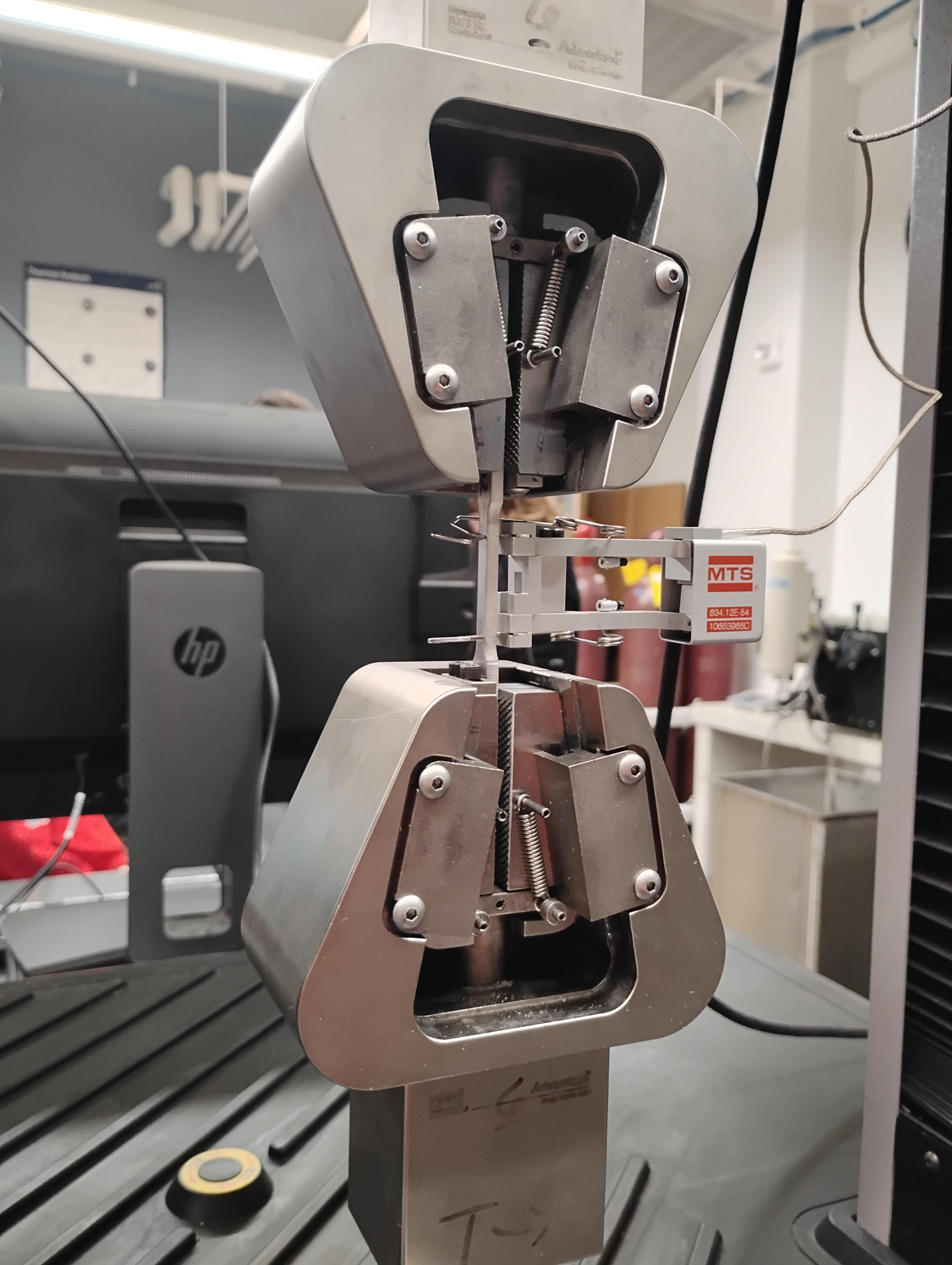
- Three tensile tests evaluating the 0.2% offset yield strength were conducted, each sample being given a name to easily remember: 400.6 (Kyle), 386.9 (Craig), and 481.1 (Tylor).
- Average Yield Strength (0.2% offset): 422.9 MPa
- Elongation at break (mm/mm):
- Kyle: 0.108
- Craig: 0.067
- Tylor: 0.090
It is important to note that upon inspecting the fracture along the gauge section of the tensile bars, Kyle and Tylor had a noticeable defect—a small, dark collection of precipitate. Craig had no noticeable defects, but performed significantly worse than Kyle and Tylor. This can be attributed to the difference in brittle and ductile fracture. Brittle fracture occurs starting on the outside of the material and works its way in (Craig), while ductile fracture occurs in the center of the material and works its way outward (Kyle and Tylor). This is even more noticeable with the amount of necking that occurred for each sample. Craig had virtually no necking, while Kyle and Tylor had a more significant amount of necking.
In selecting the final tensile bar to test for the competition, we made sure to pick a tensile bar cut from the center of the material and not the outside.
Competition Results
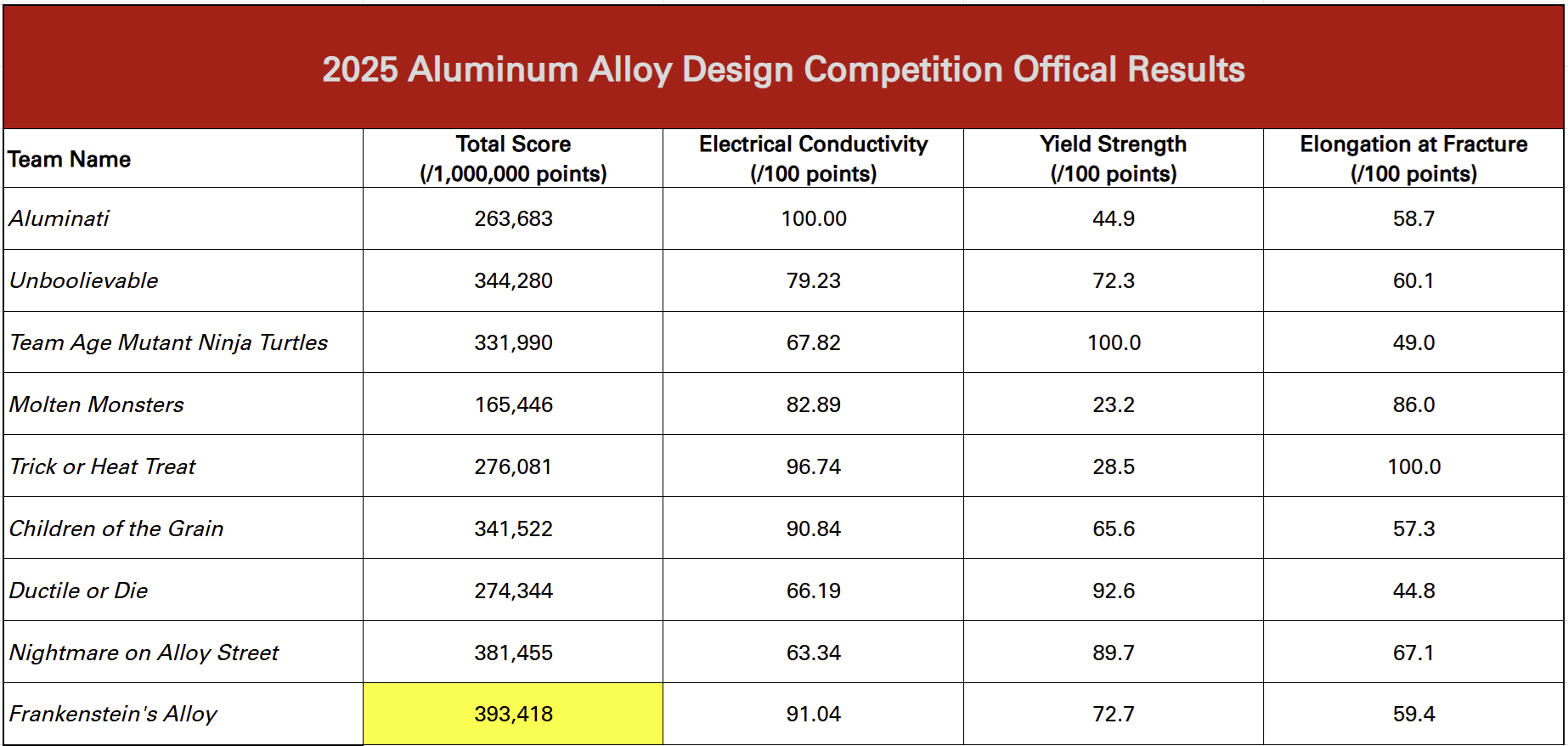
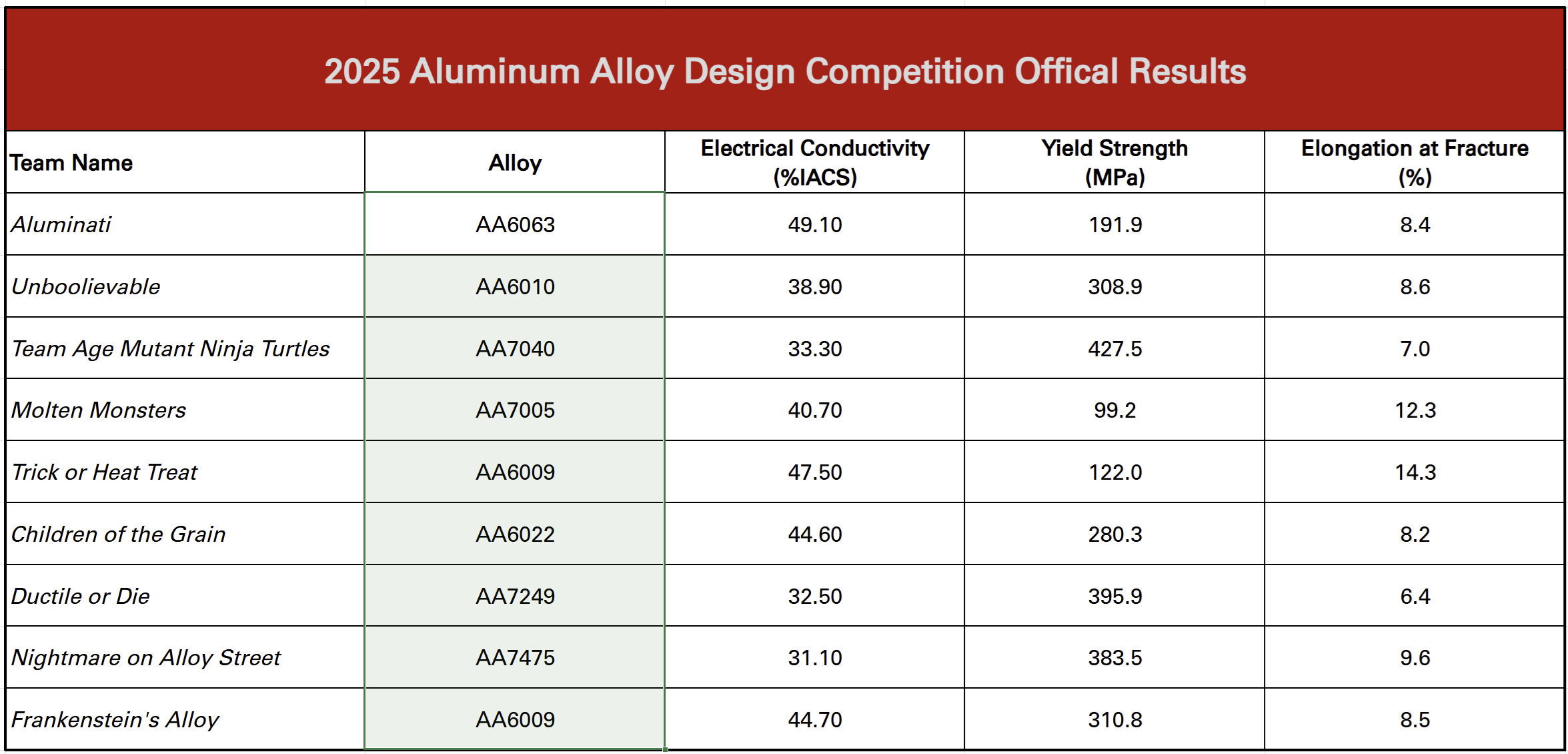
After tallying up the results of all teams, our team got a close 2nd place!
The calculations to determine the final score was based on the highest score achieved in all three categories, with the highest score being equivalent to 100, and the scores below being the percentage of the highest score that your team achieved.
In the categories of elongation and yield strength, our team got 3rd place, but in conductivity we had the worst score. The high scores of elongation and yield strength gave us a high score, but we lost to the team with a significantly higher conductivity score.
First Place: 393,418
Second Place: 381,455
Third Place: 344,280
Corrosion
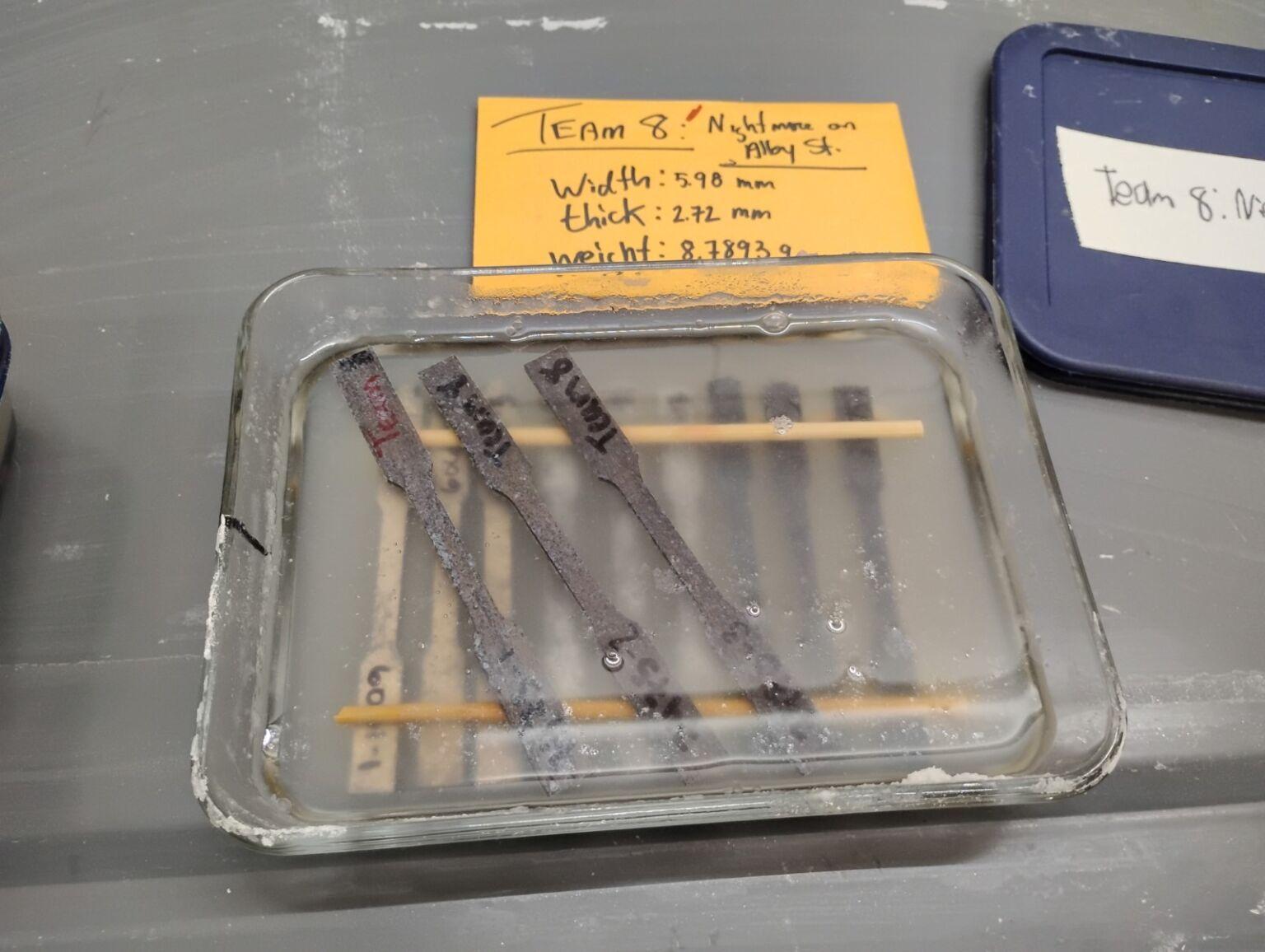
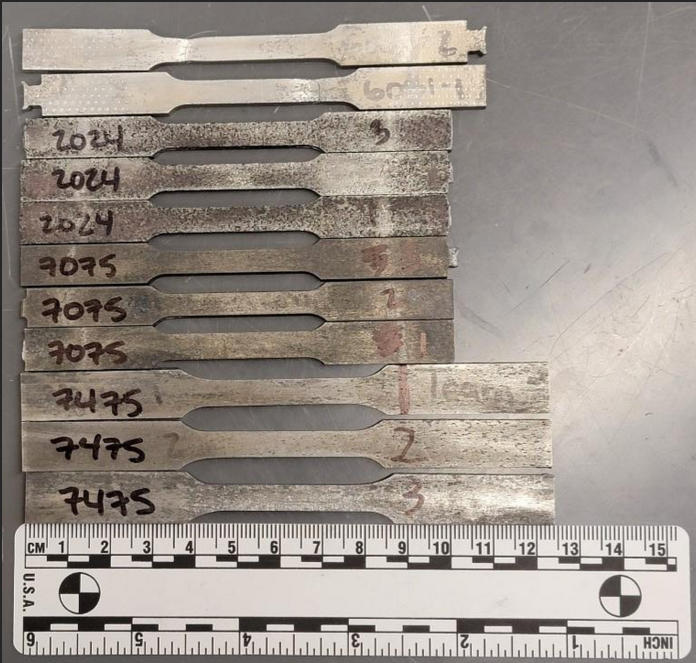
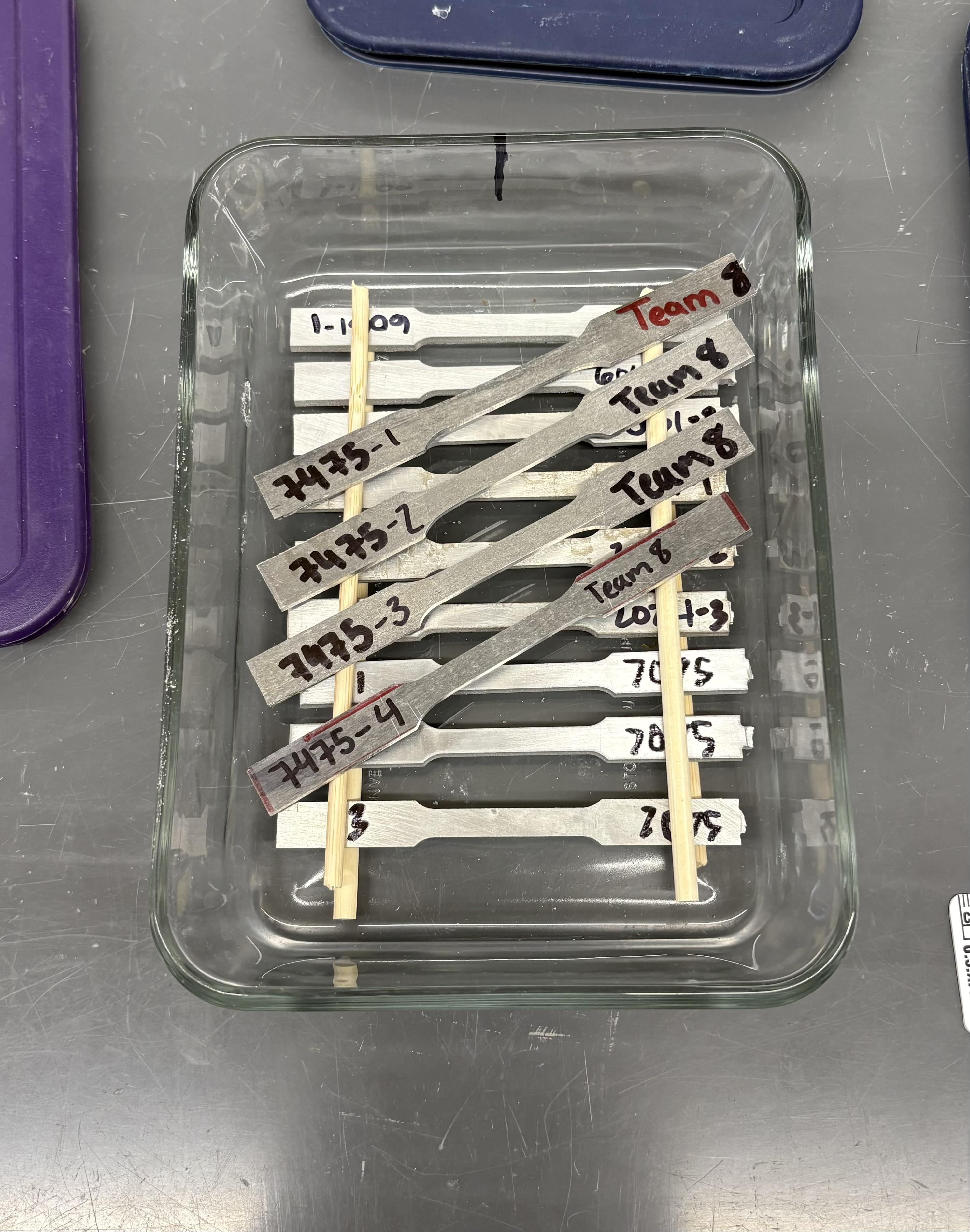
Corrosion behavior was examined by placing three of our tensile bar samples into a 0.7M saltwater bath with 25mL of 30% hydrogen peroxide added for 2 weeks.
After two weeks, the samples were removed, scrubbed, and cleaned in an ultrasonic bath. The samples had extreme pitting, and when viewed under a microscope, had intragranular corrosion.
In lab we conducted testing with galvanic couples, tensile testing, and corrosion potential measurements. Overall, the results in each experiment were lower than pre-corrosion, as expected. The competition, however, relied solely on the measurement of amount of mass lost during the corrosion process.
Testing of the finalized alloy after corrosion had the following results:
Average mass loss between samples (g): 0.09
Elongation Values (mm/mm): 0.061, 0.073, 0.068
Average Elongation (mm/mm): 0.067
Tensile Strength (MPa): 471.5, 489.2, 488.9
Average Tensile Strength (MPa): 483.2
0.2% Offset Yield Strength (MPa): 396.5, 412.2, 412.8
Average 0.2% Offset Yield Strenghth (MPa): 407.2
Modules of Elasticity (GPa): 66.1, 69.9, 78.5
Average Modules of Elasticity (GPa): 71.5
Summary and Recommendations
Overall, our team is proud of achieving second place among so many strong competitors! The process of completing this process helped us all better understand how composition, microstructure, and thermomechanical processing interact to control material properties.
If we were to repeat this experiment, we would improve our initial plan by conducting deeper research to reduce the number of adjustments throughout. We might also split up our samples to test different times/temperatures in the heat treatment steps. Based on our results, we would most likely continue to work within the 7xxxs series due to its strong performance and our newfound understanding of the processing steps.